题目内容

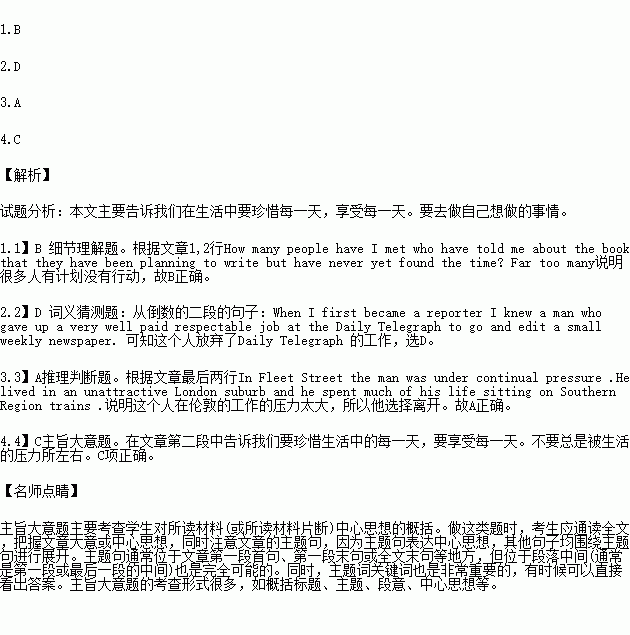
How many people have I met who have told me about the book they have been planning to write but have never yet found the time? Far too many.

This is Life, all right, but we do treat it like a rehearsal(排演)and, unhappily, we do miss so many of its best moments.

We take jobs to stay alive and provide homes for our families, always making ourselves believe that this style of life is only a temporary(暂时的)state of affairs along the road to what we really want to do. Then, at 60 or 65, we are suddenly given a clock and several grandchildren and we look back and realize that all those years waiting for Real Life to come along were in fact real life.

In America they have a saying much laughedat by the English: “Have a nice day.” They speak slowly and seriously in their shops, hotels and sandwich bars. I think it is a wonderful phrase, making us remember, in effect, to enjoy the moment: to value this very day.

How often do we say to ourselves “I’ll take up horse-riding(or golf, or sailing)as soon as I get a greater job.” But only to do none of those things when we do get the higher position.

When I first became a reporter I knew a man who gave up a very well-paid respectable job at Daily Telegraph to go and work for a small weekly newspaper. At the time I was surprised by his decision: Why was he in this completely abnormal mental(精神) state? How could anyone turn his back on Fleet Street in central London for a small area in the countryside? I wanted to know.

Now when I am a little older and possibly wiser, I see the sense in it. In Fleet Street the man was under continuous pressure. He lived in all unattractive London suburb(郊区)and he spent much of his life sitting on Southern Region trains to and back from his work.

1. The first paragraph of the passage tells us that

A. we always try to find some time to write a book

B. we always make plans but seldom complete them

C. we always enjoy many of life’s best moments

D. we always do what we really want to do

2. The underlined phrase “turn his back on” (Paragraph 6) most probably means

A. leave for B. return to C. rely on D. give up

3.The man who worked at Daily Telegraph left this job because he was

A. under too much pressure

B. in an abnormal mental state

C. not well-paid

D. not respected

4.What is probably the best title for the passage?

A. Provide Homes for Our Family

B. Take Up Horse-Riding

C. Value This Very Day

D. Stay Alive
练习册系列答案
相关题目

根据短文内容,从每题所给的A,B,C,D四个选项中,选出最佳选项,并在答题卡上将该项涂黑。

I was an unlucky nurse who had to work on Christmas Day. It was always ________ in the emergency room on this day; so I was not expecting any patients. When I was ________ about working on such a beautiful festival, five people showed up at my desk—a pale woman and four small children.

“Are you all sick?” I asked in a(n) ________ way because they seemed all right.

“Yes,” the woman answered ________ and lowered her head.

But when they started to present their problems, things got a little vague. Two of the children had headaches, but the headaches weren’t ________ by normal body languages such as holding the head. Two children had earaches, but neither of them could tell me ________ ear was in pain. The mother complained of a cough, but she seemed to be ________.

Something was wrong. I didn’t say anything but explained that it might take a while ________ a doctor could meet them. “Take your ________, please,” the mother responded. Then, I checked their charts—no address. Suddenly I knew, they were homeless and the hospital was ________.

I looked out at the family, gathering together under the Christmas tree, smiling and chatting with each other ________. Quietly, I went back to the nurse’s station and told them that we had a homeless ________ in the waiting room. It was just like God sending us a ________ on Christmas Day. The nurse’s station suddenly came back to ________. All the nurses went into action, just as we did when there was a real ________ emergency. But this one was a “Christmas emergency”.

We ________ our meals for our Christmas “patients”. We also put together oranges and apples ________ presents. Usually we just tried to ________ the physical needs of our patients. But today, we worked hard to exceed the needs of a family who only ________ a warm place on Christmas Day.

Later, when the family was leaving, the four-year-old girl ran back and gave me a kiss. “Thanks for being our angel today,” she whispered in my ________.

1.A. darkB. quietC. brightD. noisy

2.A. complainingB. worryingC. talkingD. annoying

3.A. expectingB. forgettingC. acceptingD. suspecting

4.A. weaklyB. stronglyC. excitedlyD. surprisedly

5.A. accompaniedB. causedC. resultedD. shown

6.A. whatB. howC. whichD. why

7.A. explainingB. pretending

C. understandingD. promoting

8.A. unlessB. afterC. beforeD. when

9.A. moneyB. breathC. timeD. break

10.A. bigB. smallC. coldD. warm

11.A. sweetlyB. tiredlyC. unhappilyD. friendly

12.A. motherB. girlC. boyD. family

13.A. giftB. jobC. luckD. chance

14.A. spaceB. earthC. schoolD. life

15.A. trafficB. politicalC. medicalD. history

16.A. put outB. gave outC. took outD. turned out

17.A. forB. onC. asD. in

18.A. missB. meetC. cutD. increase

19.A. wantedB. builtC. escapedD. refused

20.A. faceB. earC. mouthD. nose

Many years ago, I made a living by driving a car. One night I went to pick up a passenger at 2:30 am. When I arrived to collect, I found the building was dark except for a single light in a ground floor window.

I walked to the door and knocked.“Just a minute,” answered a weak, elderly voice.

After a long pause, the door opened. A small woman in her eighties stood before me. By her side was a small suitcase.

I took the suitcase to the car, and then returned to help the woman. She took my arm and we walked slowly towards the car.

She kept thanking me for my kindness.“It’s nothing,” I told her, “I just try to treat my passengers in the way I would want my mother treated.”

“Oh, you’re such a good man,” she said. When we got into the taxi, she gave me an address, and then asked, “Could you drive through downtown?”

“It’s not the shortest way,” I answered quickly.

“Oh, I’m in no hurry,” she said.“I’m on my way to a hospice(临终医院). I don’t have any family left. The doctor says I don’t have very long time.”

I quietly reached over and shut off the meter(计价器).

For the next two hours, we drove through the city. She showed me the building where she had once worked, the neighborhood where she had lived, and the furniture shop that had once been a ballroom where she had gone dancing as a girl.

Sometimes she’d ask me to slow down in front of a particular building and would sit staring into the darkness, saying nothing.

At dawn, she suddenly said, “I’m tired. Let’s go now.”

We drove in silence to the address she had given me.

“How much do I owe you?”she asked.

“Nothing,” I said.

“You have to make a living,” she answered.“Oh, there are other passengers, ”I answered.

Almost without thinking, I bent and gave her a hug. She held onto me tightly. Our hug ended with her remark, “You gave an old woman a little moment of joy.”

1.The old woman chose to ride through the city in order to ______.

A. show she was familiar with the city

B. see some places for the last time

C. let the driver earn more money

D. reach the destination on time

2.Which of the following statements is Not true?

A. The old lady didn’t have very long time.

B. The old lady was on her way to her daughter’s home.

C. The taxi driver gave the old woman a little moment of joy.

D. The taxi driver didn’t charge the old lady any money.

3.What can we learn from the story?

A. Giving is always a pleasure.

B. People should respect each other.

C. An act of kindness can bring people great joy.

D. People should learn to appreciate others’ concern.

In today's world of smart phones and notebook computers, most people have at least one time-telling thing with them. Since these digital products are so common, is time running out for the 500-year-old watch? According to some consumers, the answer is yes. New Jersey teenager Charlie Wollman says a watch is “an extra piece of equipment with no necessary function.” Many young adults think so and use their smart phones to tell time. It is said that fewer young people wear watches today than ten years ago. As a result, some people say that the watch industry is at a crossroads.

However, watchmakers optimistically say that watches regain popularity when consumers reach their 20s and 30s. By then, they are willing to spend money on a quality watch that doesn’t just keep good time. Fifty years ago, watchmakers took pride in their products’ accuracy. But in recent years, the watch industry has changed itself into an accessory(附属的) business. And today, the image a watch communicates has become more important than the time it tells.

“Complications” — features that go beyond simple timekeeping — are an important part of a watch’s image. Today’s watches offer lots of features that meet almost any personality. These features include compasses, USB drivers, and even other functions .

Creativity also plays a key role in designing today’s watches. For example, Japanese watchmaker Tokyoflash makes watches that don’t even look like watches. The company’s popular Shinshoku model uses different color lights to tell time. It looks more like a fashionable bracelet(手镯) than a watch.

Whether a watch communicates fashion sense, or creative talent of a love sports, consumers want their watches to stand out. Nowadays, everyone has the same kind of gadget(配件) in their bags, so people want to make a statement with what’ s on their wrists. Will this interest in wrist fashion last? Only time will tell!

1.What can we know from the first paragraph?

A. As most people see, watches are out of fashion.

B. The watch industry will close down sooner or later.

C. Some people feel that watches have been of no use.

D. There are so many choices of watches for teenagers today.

2. Japanese watchmaker Tokyoflash is mentioned in Paragraph 4 to_______.

A. tell that today’s watches need more imagination

B. show why Shinshoku watches are popular

C. advertise Shinshoku watches made by Tokyoflash

D. make a comparison between watches and bracelets

3.What might be the most suitable title for the passage?

A. Japanese Watches Stand Out

B. Watches Tell More Than Time

C. Watch Industry Is in a Bad Situation

D. Watches Are Becoming Less Popular

违法和不良信息举报电话:027-86699610 举报邮箱:58377363@163.com

精英家教网
