题目内容

短文改错

假定英语课上老师要求同桌之间交换修改作文,请你修改你同桌写的以下作文。文中共有10处语言错误,每句中最多有两处。每处错误仅涉及一个单词的增加、删除或修改。

增加:在缺词处加一个漏字符(∧),并在其下面写出该加的词。

删除:把多余的词用斜线(﹨)划掉。

修改:在错的词下画一横线,并在该词下面写出修改后的词。

注意:1.每处错误及其修改均仅限一词;

2.只允许修改10处,多者(从第11处起)不计分。

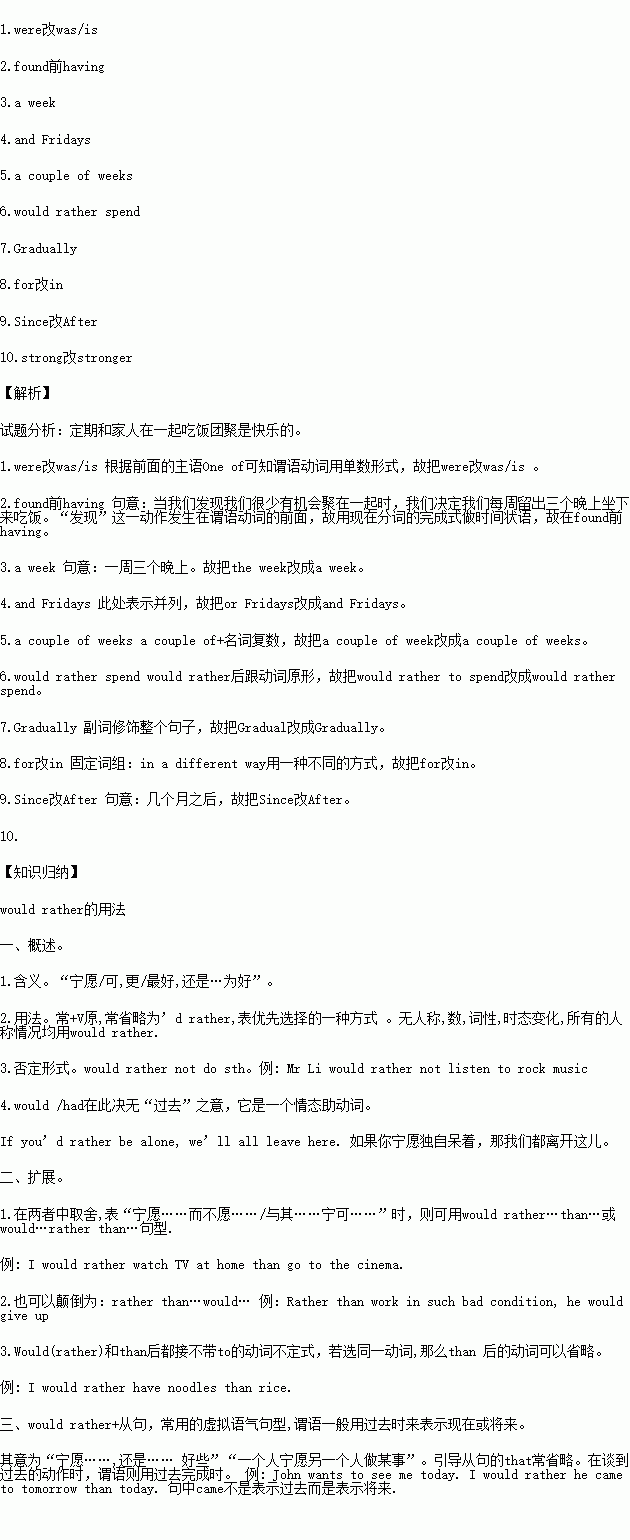
One of my happiest childhood memories were having dinner with my parents and two sisters. As a result, found that we seldom had a chance to get together, we decided we would set aside three evenings the week for a sit-down dinner. First we tried setting three fixed days for our experiment—Mondays, Wednesdays or Fridays. After a couple of week of trying this plan, almost everyone was unhappy. For a while, the kids began to resist the idea. They said they would rather to spend the time with their friends or take part in some activities. Gradual, though, they began to see these evenings together for a very different way. We laughed a lot and we discussed about each other’s problems. Since a few months, we all felt we had been able to build much strong relationships with the family than we had before.
练习册系列答案
相关题目

“Paul must have been trying to carry his waste paper to garbage can and dropped a few pieces.” I______picking them up. _______later I found more pieces. No quiet sighing this time. I _____ ,“Who is throwing garbage?” No answer. Instead, I saw more bits of paper silently floating______from upstairs. Looking up, I saw my seven-year-old son, Paul.

“Stop making a mess.” “It’s not a mess. They’re______ .” “Sorry, what did you say?” I hadn’t heard him clearly.

He didn’t answer me. Paul has autism (自闭症) and_______answers a question, especially when he’s _______attentively on something else. He ran down the stairs. “Where are my other butterflies?” he asked,_______around. Every time Paul _______five or more words together, my heart says a _______of thanks. But lately he seems to _______that the benefits of forming complete sentences when communicating are________of the effort.

Butterflies. Of course. I rushed to_______them from the garbage,_______them off and handed them to my young artist. “Want to see them________again?” he asked with a shy smile. “Oh yes! They’re beautiful.” I whispered. He ran back upstairs to float his _____ down again. They really did look like beautiful butterflies.

That day Paul _______me to look up at ______instead of down at garbage. How many other masterpieces (杰作) do I miss because I’m too caught up in my _______to take time to appreciate what’s right in front of me? Life is not what happens to us. It’s ______we look at it. Now, I look up.

1.A. laughed B. sighed C. amazed D. shouted

2.A. Days B. Years C. Moments D. Weeks

3.A. called out B. turned up C. got in D. added to

4.A. up B. down C. away D. off

5.A. planes B. papers C. leaves D. butterflies

6.A. rarely B. frequently C. willingly D. eagerly

7.A. devoted B. depended C. focused D. addicted

8.A. showing B. looking C. playing D. drawing

9.A. spells B. puts C. pushes D. accumulates

10.A. sound B. remark C. report D. prayer

11.A. refuse B. hear C. mind D. realize

12.A. worthy B. aware C. fond D. typical

13.A. hide B. destroy C. rescue D. remove

14.A. tore B. dusted C. cut D. seized

15.A. throw B. flow C. land D. fly

16.A. masterpieces B. schoolwork C. inventions D. imagination

17.A. reminded B. forced C. intended D. permitted

18.A. mistakes B. weaknesses C. beauty D. scenery

19.A. amusement B. housework C. communication D. homework

20.A. when B. whether C. where D. how

I never thought I would have a life-changing experience at Wal-Mart.

Although my thoughts were only on speed, the checkout line I was standing in wasn't moving as quickly as I wanted, and I glanced toward the cashier. There stood a man in his seventies, wearing glasses and a nice smile. I thought, well, he's an old guy! For the next few minutes I watched him. He greeted every customer before scanning the items. Sure, his words were the usual, “How's it going?” But he did something different—he actually listened to people. Then he would respond to what they had said and engage them in a brief conversation.

I thought it was odd. I had grown accustomed to people asking me how I was doing simply out of robotic conversational habit. After a while, you don't give any thought to the question and just mumble something back. I could say, “I just found out I have six months to live,” and someone would reply, “Have a great day!” But that wasn't the end.

He gave them the change, walked around the counter, and extended his right hand in an act of friendship. He looked the customers in the eyes. “I surely want to thank you for shopping here today,” he told them. “You have a great day. Bye-bye.”

The looks on the faces of the customers were priceless. There were smiles and some sheepish grins. All had been touched by his simple gesture—and in a place they never expected. They would gather their things and walk out, smiling.

Of course, he did the same to me and I got to know his name, Marty.

Who was that guy? It was as if Sam Walton had come back from the dead and invaded this old guy's body. I had never walked away from that shop feeling like that.

1.According to the writer, when common people ask you “How's it going?”, ________.

A.they don't really care what you may answer

B.they are just practicing their conversation ability

C.they are inquiring about your private information

D.they don't expect to hear any negative answers

2.What was most customers' reaction to Marty's behaviors?

A.They thought it priceless. B.They were in some way moved.

C.They thought it awful and odd. D.They felt somewhat offended.

3.What can we infer about Sam Walton?

A.He might be Marty's father or grandfather.

B.He might be friendly and devoted to Wal-Mart.

C.He might have died while working in the market.

D.He might have come back from the dead once before.

4.What does the writer intend to express through the text?

A.Our everyday life is always full of surprises.

B.Most customers enjoy being treated this way.

C.Being different is a good way of doing business.

D.A little positive action can make a big difference.

根据短文内容,从短文后的选项中选出能填入空白处的最佳选项。选项中有两项为多余选项。

Droughts in California

A terrible drought has created trouble in California, USA. A drought is a long period of time with little rain or snow. That means there isn’t enough water. Droughts are natural disasters. But unlike earthquakes or hurricanes(飓风), droughts do not happen suddenly.1.

The drought in the western United States began four years ago. California has been hit hardest. About 95% of the state now has serious drought conditions. About 3,500 people in East Porterville, California, have no running water in their homes. 2. Some people haven’t had running water for years. Rivers and lakes have been drying up, too. That’s a problem for fish and animals. 3. As a result, farms might lose more than $2 billion in 2015. More than 18,000 farm jobs have been lost.

Scientists aren’t sure when the problem will end. A rainy autumn and winter could help. Experts say it will take 11 trillion gallons(加仑) of water to end the drought. 4. They take the water home for washing dishes, cleaning toilets, and more. 5. They’ve stopped watering lawns(草坪) and washing cars. “We need to make the best use of what we have,” explains weather scientist Michael Anderson.

A. Instead, they happen slowly.

B. Without water, farms can’t grow as much food.

C. Future droughts in California are likely to last longer.

D. That’s because the drought has caused their wells to dry up.

E. All across California, people are saving water any way they can.

F. California is a state located on the West Coast of the United States.

G. Many people drive to fire stations to fetch water.

Sunday is more like Monday than it used to be. Places of business that used to keep daytime“business hours” are now open late into the night. And on the Internet, the hour of the day and the day of the week have become irrelevant(不相关的). A half century ago in the United States, most people experienced strong and precise dividing lines between days of rest and days of work, school time and summer time. Today the boundaries still exist, but they seem not clear.

The law in almost all states used to require stores to close on Sunday; in most, it no longer does. It used to keep the schools open in all seasons except summer; in most, it still does. And whether the work week should strengthen its legal limits, or whether it should become more “flexible,” is often debated. How should we, as a society, organize our time? Should we go even further in relaxing the boundaries of time until we live in a world in which every minute is much like every other?

These are not easy questions even to ask. Part of the difficulty is that we rarely recognize the “law of time” even when we meet it face to face. We know as children that we have to attend school a certain number of hours, a certain number of days, a certain number of years — but unless we meet the truant officer (学监), we may well think that we should go to school due to social custom and parents’ demand rather than to the law. As adults we are familiar with “extra pay for overtime working,” but less familiar with the fact that what constitutes(构成)“overtime” is a matter of legal definition. When we turn the clock forward to start daylight-saving time, have we ever thought to ourselves: “Here is the law in action”? As we shall see, there is a lot of law that has great influence on how we organize and use time: compulsory education law, overtime law, and daylight-saving law — as well as law about Sunday closing, holidays, being late to work, time zones, and so on. Once we begin to look for it, we will have no trouble finding a law of time to examine and assess.

1. By saying “Sunday is more like Monday than it used to be”, the writer means that_______.

A. work time is equal to rest times

B. many people have a day off on Mondays

C. it is hard for people to decide when to rest

D. the line between work time and rest time is unclear

2. The author raises the questions in Paragraph 2 to introduce the fact that people __________.

A. fail to make full use of their time

B. enjoy working overtime for extra pay

C. are unaware of the law of time

D. welcome flexible working hours

3.According to the passage, most children tend to believe that they go to school because they ______.

A. need to acquire knowledge B. have to obey their parents

C. need to find companions D. have to observe the law

31. What is the main idea of the passage?

A. Our life is governed by the law of time.

B. How to organize time is not worth debating.

C. New ways of using time change our society.

D. Our time schedule is decided by social customs.

违法和不良信息举报电话:027-86699610 举报邮箱:58377363@163.com

精英家教网