题目内容

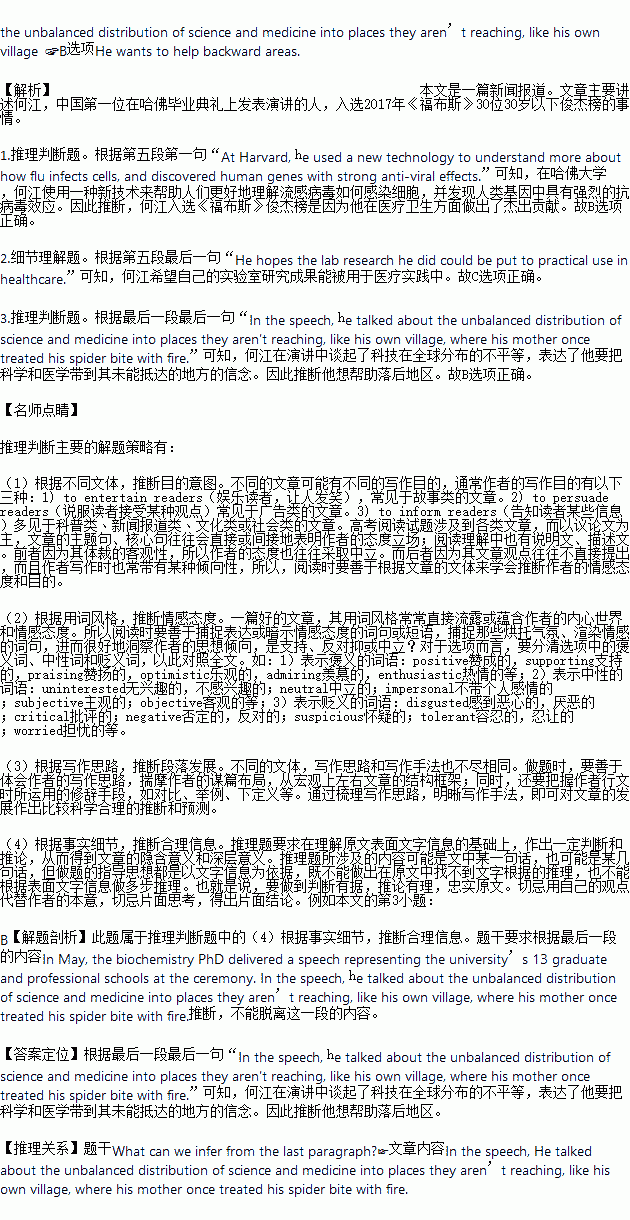
He Jiang, who was the first person from China to deliver a Harvard University commencement (学位授予典礼) address, has made the 2017 Forbes 30 Under 30 List.

Forbes’ 30 Under 30 is a set of lists issued annually by Forbes magazine. On Tuesday, the magazine published the sixth annual 30 Under 30, featuring 600 young inventors and leaders who challenge conventional wisdom and rewrite the rules for the next generation.

The list recognizes 30 game-changers in each of 20 industries. All under 30 years old, the candidates were examined by a group of judges in their fields. “The winners are the people that will run every field for the next 50 years,” said Randall Lane, editor of Forbes.

He, a 29-year-old postdoctoral fellow at the Massachusetts Institute of Technology, was chosen for the healthcare category. He was recommended by his professors at Harvard.

At Harvard, He used a new technology to understand more about how flu infects cells, and discovered human genes with strong anti-viral effects. He is now applying the same techniques to white blood cells. He hopes the lab research he did could be put to practical use in healthcare.

He grew up in a small village with limited educational opportunities. By studying hard, he graduated from the University of Science and Technology of China with a bachelor’s degree in 2009, and was accepted into Harvard’s PhD program on a full scholarship the same year.

In May, the biochemistry PhD delivered a speech representing the university’s 13 graduate and professional schools at the ceremony. In the speech, he talked about the unbalanced distribution of science and medicine into places they aren’t reaching, like his own village, where his mother once treated his spider bite with fire.

1.Why can He Jiang be on the 2017 Forbes under 30 list?

A. He was recommended by Randall Lane.

B. He has made outstanding contributions in healthcare.

C. He made a speech at the Harvard commencement.

D. He changed the regulations for the next generation.

2.What will He Jiang intend to do in the future?

A. Know more about the infection of flu.

B. Apply the same technology to blood cells.

C. Put his research into practice in medical care.

D. Discover human gene’s strong anti-viral effects.

3.What can we infer from the last paragraph?

A. His mother is a doctor. B. He wants to help backward areas.

C. He got a full PhD scholarship. D. His university has only 13 graduates.
练习册系列答案
相关题目

Bali(巴厘岛) is an Indonesia island that is rich in indigenous (本土的) culture.A lot of people say that Balinese culture is unique and that the people of Bali have always been contented with the “now”.If you ask a Balinese person what heaven is like, the probable answer will be "just like Bali".This only goes to show that most Balinese people are happy to be where they are and never worry.

One factor that contributes to this laid-back lifestyle is the culture of close family ties in Bali.In the Balinese culture, support is always available.Balinese extended families are so tightly knit that all members usually reside in the same complex.

Hinduism(印度教)is one of the main religions in Bali.The Balinese culture is based on a form of this religion, which is called “Hindu Dharma”.This religion reached the island during the eleventh century.Most of the family customs and traditions as well as community lifestyles of the Balinese people are influenced by this.The religious influence even expands widely into the arts, which makes Bali distinct(不同于) from the rest of Indonesia.

In spite of the fact that tourists flood to the island every year, the Balinese people have managed to conserve their culture.Almost every native of Bali is an artist in some form or another.Parents and villagers have passed on their skills to their children, who all seem to have inclinations (意愿) either to music, dance, painting, and decor.

Another remarkable mark of the Balinese culture is the series of ceremonies and rituals(仪式) known as the Manusa Yadnya.This marks the different stages of Balinese life.Cremation (火葬) is very popular on this island,and unlike in the West, death is a joyous and colorful event for the Balinese.

1.What do we know about the Balinese according to the first two paragraphs?

A. They lead a very relaxing but unhealthy life.

B. They live in large families and are close to each other.

C. Their family members are distributed in different places.

D. Their extended families live too close together to get along well.

2.The underlined word “conserve” in Para.4 can be best replaced by “____”.

A. preserve B. spread C. Form D. expand

3.What is the text mainly about?

A. The Balinese religion. B. The lifestyle of Balinese.

C. Balinese culture. D. The tourism in Bali.

根据短文内容,从短文后的选项中选出能填入空白处的最佳选项。选项中有两项为多余选项。

Palm oil(棕榈油) is the most widely used vegetable oil worldwide.It’s found in a wide variety of products from of vitamins to chocolate and bread.1. The former makes it easy to spread,while the latter makes it good for our body.

But the oil’s popularity comes at a high price.2. As a result,thousands of acres of rainforests in Indonesia,the world’s biggest palm oil producers,are being destroyed to make room for them.

With half of the world’s palm oil coming from Indonesia,orangutans(猩猩) have suffered a lot.3. What’s worse,in 2015,wildfires endangered one-third of the remaining orangutans.Palm oil farms have also threatened tigers and elephants and caused water and air pollution.

4. However,it’s not easy given that no other natural vegetable oil has both of its qualities.Now,scientists are creating a new oil to replace it by using food waste and M.pulcherrima,a yeast(酵母) that grows on leaves,fruits and flowers.5. Besides, the yeast can be widely produced in any weather.The scientists say their biggest challenge was to find a cheap way to change the sugars in the food waste to a form that the yeast can take in easily.The team is now trying to test if they can produce the oil at a lower cost.

A.Palm trees need lots of land to grow.

B.The easiest solution is to stop using palm oil so widely.

C.The palm oil is so expensive that many families can’t afford it.

D.In the last 20 years,over 80% of their habitat has been destroyed.

E.There are many things we can do to protect the endangered wild animals.

F.The oil is popular because it has a high melting point and contains healthy fats.

G.It eats the sugars from the waste and turns it into thick oil that has similar qualities to palm oil.

My name is Peter, and I use a wheelchair to get around. This year I ____ to be in the School Walkathon.

At the Walkathon last year, I helped hand out drinks to the walkers. The teachers and parents said they couldn’t have ____ without me.

“Are you going to give out drinks ____ this year?” my friend Michael asked.

“I ____ so,” I said. “But I ____ wish I could do laps (跑道的圈) with you.”

Michael told Mrs Hunt that I wanted to ____ the Walkathon. Mrs Hunt looked at me. “It’s not a good course for a wheelchair,” she said. “The hilly part would be too ____.”

“But I could push Peter over the hard bits,” said Michael.

“I’ll ____ it,” said Mrs Hunt.

That afternoon, Mrs Hunt called a class meeting. Michale told everyone about his ____.

“We could all take turns. That way no one would get too ____,” said Olivia. Then everyone said they would take a turn.

When the Walkathon began, I turned my wheels round and round as ____ as I could. When we came to the hilly bit, Michael ____ to push me up it. Olivia was waiting halfway up. “My ____ now,” she said. With all the help my ____ were giving me, I ____ the first lap and did a second lap — and another. I was tired in the ____.

“It’s time to announce the winner of the mystery prize. It goes to ... Peter!” Mrs Hunt said.

I looked at all the things I had ____, and felt extremely ____. But then I remembered that the whole ____ had helped me.

“I want everyone to ____ the prize,” I said. “Let’s keep all the things in our classroom. Then we can all have some fun!”

And that’s what we did.

1.A. need B. agree C. want D. offer

2.A. remembered B. waited C. helped D. managed

3.A. soon B. again C. once D. first

4.A. suppose B. hope C. do D. say

5.A. never B. really C. partly D. still

6.A. lead B. organize C. give up D. join in

7.A. difficult B. serious C. important D. different

8.A. take control of B. have pity on C. think about D. look after

9.A. fear B. idea C. success D. story

10.A. sad B. dirty C. slow D. tired

11.A. fast B. long C. far D. often

12.A. forgot B. avoided C. started D. hated

13.A. break B. decision C. turn D. plan

14.A. teachers B. friends C. parents D. neighbors

15.A. finished B. caught C. prevented D. wasted

16.A. day B. way C. past D. end

17.A. owned B. expected C. won D. discovered

18.A. nervous B. happy C. bored D. young

19.A. class B. family C. school D. world

20.A. share B. receive C. value D. show

违法和不良信息举报电话:027-86699610 举报邮箱:58377363@163.com

精英家教网