题目内容

【题目】阅读材料,回答下列问题。

材料一 德国地处欧洲的十字路口,又在欧洲经济最发达的区域内,邻近法国、荷兰、比利时等九个国家,鲁尔区是其典型的传统工业区。

材料二 辽中南地区是我国著名的传统工业区,是我国重工业、基础工业和国有大中型企业最集中的地区。改革开放以来,虽然辽中南重工业基地在全国经济中所占比重逐步下降,但水资源更加短缺。

材料三 德国鲁尔区工业区和辽中南工业区图。

(1)根据所给材料,分析辽中南工业区和德国鲁尔区发展传统工业条件的异同点。

(2)针对辽中南工业区水资源短缺的现状,可以采取哪些措施既可缓解水资源短缺的状况,又使经济得到持续发展?

(3)列举德国鲁尔区发展过程中遇到的问题。

【答案】(1)相同点(从自然和社会经济条件分析):

煤炭资源丰富、交通便利、市场广阔。

不同点(从自然条件分析):

鲁尔区水资源丰富而辽中南工业区水资源短缺,辽中南工业区铁矿资源丰富而鲁尔区铁矿资源短缺。

(2)合理开发和利用地下水;跨流域调水;修建水库;控制需水量大的重工业企业的发展;提高工业用水的重复利用率;发展第三产业;发展节水农业;加强宣传,提高公民的节水意识。

(3)环境恶化、传统产业的衰落。

【解析】(1)传统工业发展的区位条件包含自然条件、社会经济条件,包含矿产资源、水源;交通、市场、技术、政策等。结合辽中南工业区和德国鲁尔区传统工业发展的具体因素比较总结即可得出结论。

(2)辽中南工业区水资源短缺既有自然原因也有人为原因,与区域产业结构有关。据此为了解决缺水现状并使经济持续发展可以从开源节流、调整产业结构、提高公众意识等方面采取措施。如可以合理开发和利用地下水;跨流域调水;修建水库;控制需水量大的重工业企业的发展;提高工业用水的重复利用率;发展第三产业;发展节水农业;加强宣传,提高公民的节水意识。

(3)德国鲁尔区发展过程中遇到的问题主要是环境恶化、传统产业的衰落导致出现的。

繁荣阶段

衰落阶段

新发展阶段

(区位优势)

(衰落原因)

(整治措施)

煤炭资源丰富

生产结构单一

调整经济结构

铁矿来源方便

新技术革命的冲击

调整工业布局

水源充沛

煤炭地位下降

拓展交通

交通便利

世界性钢铁过剩

发展科技

市场广阔

环境污染、土地紧张

消除污染、美化环境

练习册系列答案
相关题目

【题目】A sign is another kind of language. Here are some of them that you see on the roads.

Number one is a sign with the number thirty on it.When drivers see this sign, they must not go at more than thirty kilometres an hour. We see this sign when we are getting near a town.Number two is a sign that we’re near a crossing.We must drive carefully.Number three is a sign that there is a bend in the road.Again, we must drive slowly and carefully.It is not safe to go round a bend very fast.Number four is a sign that there is another road coming in from the right.There is a junction at this place. Number five is a sign that there is a hill and number six is a sign that the road gets narrow. Drivers must go slowly and carefully.Number seven has the word “SCHOOL” on it. This is a sign that there is a school at the side of the street or the road. Perhaps there are children going to or leaving school.So drivers must look carefully and go slowly. Number eight is a sign with the letter “P” on it.The letter “P”means “Parking”. At some places, there’re the signs “No parking””or “No waiting”. If a driver leaves his car near one of these signs, a policeman may come and write down the number of his car.

【1】At the places where you see Sign 1, ________.

A. you are already out of a town

B. you still have thirty kilometres to go

C. there must be a town thirty kilometres away

D. there must be many houses and buildings not far away

【2】There stands Sign 2 near a place where________.

A. two roads cross B. people can cross the road

C. the roads get narrow D. there are no traffic lights

【3】You have to drive not only slowly but also carefully when you find________.

A. each of the eight signs B. either of Signs 2 and 3

C. all of Signs 3, 5, 6 and 7 D. any of Signs 3, 5, 6 and 7

【4】A driver can leave his car________.

A. near Sign 8 at any time

B. near a sign with “No parking” on it

C. near a sign with “No waiting” if there’re no police there

D. near a sign with “P” on it in the daytime

【5】People put these signs on the roads to________.

A. show drivers the way B. stop cars going too fast

C. make driving even safer D. learn another kind of language

【题目】(2016·苏中五市八校模拟)阅读图文材料,回答下列问题。

材料一 20世纪90年代,在经济全球化的推动下,国际家具行业经历了重大的再分工,家具制造向具有资源、劳动力优势的国家和地区转移和集中,中国凭借劳动力优势成为重要的受益者。但中国家具生产以中低档家具为主,且以来样加工或代工形式生产,工业化水平低,以劳动密集型产业居多。下表示意我国四大家具制造业聚集地分布。

北方地区

主要分布在北京、天津、大连、沈阳、哈尔滨等地

华东地区

主要分布在山东、江苏、上海和浙江等地

西南地区

主要分布在四川、重庆等地

南方地区

主要分布在珠江三角洲地区,占全国产值的30%,出口额的50%

另外中南地区的武汉家具制造业也具有一定的影响力,以西安为中心的西部地区家具制造业发展较快。

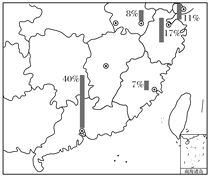
材料二 近年来,我国家具制造业承接发达国家的产业转移,发展迅速,家具出口量迅速增加。伴随着家具制造业的快速发展,国内木材生产不足,我国从东南亚、俄罗斯等国进口原木数量急剧增加。下图示意某年我国部分家具制造业重要省份出口份额所占比例。
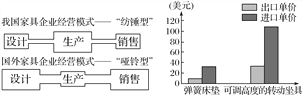
材料三 下面为中外家具企业经营模式示意图和中国家具进口单价对比示意图。
(1)简述我国家具制造业的分布特点和家具制造出口企业空间分布特点。

(2)比较珠江三角洲地区和长江三角洲地区家具制造业优势区位条件的异同。

(3)结合材料分析我国家具制造业存在的问题,并提出应对措施。

(4)目前我国一些家具制造企业选择在森林资源丰富的东北地区和南方低山丘陵地区建厂,请简要分析原因。

违法和不良信息举报电话:027-86699610 举报邮箱:58377363@163.com

精英家教网