单词拼写(共15小题;每小题1分,满分15分)
根据下列句子及所给汉字注释或首字母提示,在句子后边的横线上,写出空缺处各单词的正确形式。(每空只写一词)
【小题1】We should not judge a person by his __________ 外表).      
【小题2】How did the people __________ (反应)to the latest news?     
【小题3】Schools need __________(志愿者)to help children to read.       
【小题4】It was said that the little child had been __________(咬)by the fierce dog.          
【小题5】Police asked __________(过路人)if they had seen the accident.  
【小题6】I like to read books on __________(电子的)music.         
【小题7】We may __________(自信地)look forward to the future.      
【小题8】 Lesinko is quite f_________ with China Central Television. He worked there for 25 years.                                                                 
【小题9】 I don’t like b__________ with the sellers over the price of the goods.    
【小题10】The scientist encourages the young to e__________ unknown fields.
【小题11】The hotel bill c__________ every fee, including the broken glass.
【小题12】The doctor p__________ the operation successfully.           
【小题13】It is a__________ to the weather forecast that we know there will be a heavy snow in 3 days.                                                        
【小题14】Both the Winter and the Summer Olympics are held every four years on a r__________ basis.                                                 【小题15】To be honest, some parents don’t a__________ great importance to their children’s character training.                                            
单词拼写(共15小题;每小题1分,满分15分)
根据下列句子及所给汉字注释或首字母提示,在句子后边的横线上,写出空缺处各单词的正确形式。(每空只写一词)
【小题1】We should not judge a person by his __________ 外表).      
【小题2】How did the people __________ (反应)to the latest news?     
【小题3】Schools need __________(志愿者)to help children to read.       
【小题4】It was said that the little child had been __________(咬)by the fierce dog.          
【小题5】Police asked __________(过路人)if they had seen the accident.  
【小题6】I like to read books on __________(电子的)music.         
【小题7】We may __________(自信地)look forward to the future.      
【小题8】 Lesinko is quite f_________ with China Central Television. He worked there for 25 years.                                                                 
【小题9】 I don’t like b__________ with the sellers over the price of the goods.    
【小题10】The scientist encourages the young to e__________ unknown fields.
【小题11】The hotel bill c__________ every fee, including the broken glass.
【小题12】The doctor p__________ the operation successfully.           
【小题13】It is a__________ to the weather forecast that we know there will be a heavy snow in 3 days.                                                        
【小题14】Both the Winter and the Summer Olympics are held every four years on a r__________ basis.                                                 【小题15】To be honest, some parents don’t a__________ great importance to their children’s character training.                                            

第二节 (共5小题;每小题2分,满分10分)
根据短文内容,从短文后的选项中选出能填入空白处的最佳选项。选项中有两项为多余选项。
Why do some people have many friends while others do not? ___71___ However, it is not so. Let’s look at two psychological experiments which will give you the key to happy interpersonal relations.
The first experiment is called the “Hawthorne effect” after Hawthorne, Illinois(伊利诺斯[美国州名]), where the experiment took place. A group of psychologists examined the work patterns of two groups of workers in the Western Electric Company. ____72_____. The psychologists changed the working conditions for one group twice but left the other group alone. They were surprised to find that productivity increased on both occasions and in both groups. They concluded that the increase in productivity came from the attention given to the workers by the management. It had increased their motivation and so they had worked harder. In other words, if you take an interest in others, they will want to please you and you will have good relations with them.
___73___. After Martin Luther King, Jr was killed in 1960s, a teacher, Jane Elliott, living in an all- white town decided to help her class of young children understand why the Civil Rights Movement had been necessary in America.
She divided the class into two groups: one with blue eyes and other with brown eyes. Other eye colors such as hazel or green were excluded from his exercise. Then she told the class that brown-eyed people were cleverer than blue-eyed ones because of an agent(化学作用) for brown color found in their blood. Blue-eyed people were stupid, lazy and not to be trusted. Jane Elliott did not need to say any more. The brown-eyed students quickly got used to their new role as the leaders of the class. The blue-eyed students became quiet and withdrawn. Then she discovered something very interesting. Four poor brown-eyed readers began to read fluently in a way they had never done before. ___74___. So if you want to be successful and happy, take an interest in others whether they are your classmates or workmates. Congratulate them on their success and sympathize with them in their troubles. ___75___.
A.Before the experiment the management talked to both groups of workers and explained that they wanted to find the best working environment for them.
B.Remember that the way you treat others will decide their attitude and behavior to you.
C.The second experiment shows what happens to personal relations if you are rude to or ignore others.
D.The ones who have more friends usually are those who care about others.
E. Jane Elliott had shown that the way people are treated affects not only their behavior but also their confidence and their performance.
F. You may even imagine that this ability was something they were born with because it seems so effortless to them.
G. The second experiment tells us what teachers said had a great effect on the students.
第三部分:阅读理解(共20题;每小题1.5分,满分30分)
阅读下列短文,从每题所给的四个选项中,选出最佳选项。
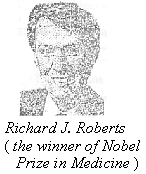
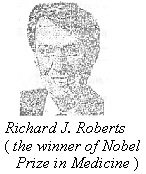
From age eight to eleven, I attended a small school in Bath, England. It was a small school of four classes with about twenty-five children in each class according to age. For the most part, one teacher had to teach all subjects to the children in the class. However, sometimes the headmaster, Mr. Ronald Broaches, would come in and spend an hour or so, teaching some subjects in which he was especially interested. He was a large man with a very happy nature. He had a sense of humor and would delight in telling the children small stories that would make us laugh. He was a very fair man and had a great influence on many of the children. In my own case, I found that he took great interest in me and he quickly found that I enjoyed puzzles. He would often stop me as I was going to class and take a piece of paper out of his pocket, often with a puzzle already on it. The puzzles were usually mathematical or logical. As time went on, they slowly got more difficult, but I loved them. Not only that, they made me interested in math and problem solving that stays with me to this day. They also served to show me that intellectual activity was rewarding when the correct answers were found, but perhaps more importantly it was great fun. To this day, I can remember Mr. Broaches’ cheerful cry of “Well done!” whenever I got a problem right. The simple communication with a man whom I loved greatly has had a deep influence on my life. I shall forever be thankful that our paths crossed. Mr. Broaches died just two weeks after I had won the 1993 Nobel Prize in Physiology or Medicine. Unluckily, I had no chance to speak to him before he died. I learnt later that he had heard of my success and I will always hope that he knew the deep influence he had made on my life.
56. There were ________ children in each class when Richard was in     the school in Bath, England.
A. 4          B. 8        C. 11              D. 25
57. From the text, we can learn that ___________.
A. the puzzles made the students laugh
B. the students were afraid of the headmaster
C. the puzzles made Richard enjoy math
D. the headmaster never taught in the school
58. The writer felt sorry because __________.
A. Mr. Broaches had passed away before he won the Nobel Prize
B. he didn’t express his thanks before Mr. Broaches died
C. he couldn’t find Mr. Broaches after he grew up
D. Mr. Broaches didn’t know his success
59. What is the best title(标题)for the text ?
A. The Story of Mr. Broaches.
B. The Story of Richard J. Roberts.
C. My Early School Life.
D. An Important Teacher in My Life.


第三部分:阅读理解(共20题;每小题1.5分,满分30分)
阅读下列短文,从每题所给的四个选项中,选出最佳选项。
From age eight to eleven, I attended a small school in Bath, England. It was a small school of four classes with about twenty-five children in each class according to age. For the most part, one teacher had to teach all subjects to the children in the class. However, sometimes the headmaster, Mr. Ronald Broaches, would come in and spend an hour or so, teaching some subjects in which he was especially interested. He was a large man with a very happy nature. He had a sense of humor and would delight in telling the children small stories that would make us laugh. He was a very fair man and had a great influence on many of the children. In my own case, I found that he took great interest in me and he quickly found that I enjoyed puzzles. He would often stop me as I was going to class and take a piece of paper out of his pocket, often with a puzzle already on it. The puzzles were usually mathematical or logical. As time went on, they slowly got more difficult, but I loved them. Not only that, they made me interested in math and problem solving that stays with me to this day. They also served to show me that intellectual activity was rewarding when the correct answers were found, but perhaps more importantly it was great fun. To this day, I can remember Mr. Broaches’ cheerful cry of “Well done!” whenever I got a problem right. The simple communication with a man whom I loved greatly has had a deep influence on my life. I shall forever be thankful that our paths crossed. Mr. Broaches died just two weeks after I had won the 1993 Nobel Prize in Physiology or Medicine. Unluckily, I had no chance to speak to him before he died. I learnt later that he had heard of my success and I will always hope that he knew the deep influence he had made on my life.
56. There were ________ children in each class when Richard was in     the school in Bath, England.
A. 4          B. 8        C. 11              D. 25
57. From the text, we can learn that ___________.
A. the puzzles made the students laugh
B. the students were afraid of the headmaster
C. the puzzles made Richard enjoy math
D. the headmaster never taught in the school
58. The writer felt sorry because __________.
A. Mr. Broaches had passed away before he won the Nobel Prize
B. he didn’t express his thanks before Mr. Broaches died
C. he couldn’t find Mr. Broaches after he grew up
D. Mr. Broaches didn’t know his success
59. What is the best title(标题)for the text ?
A. The Story of Mr. Broaches.
B. The Story of Richard J. Roberts.
C. My Early School Life.
D. An Important Teacher in My Life.


第三部分:阅读理解(共20题;每小题1.5分,满分30分)
阅读下列短文,从每题所给的四个选项中,选出最佳选项。
From age eight to eleven, I attended a small school in Bath, England. It was a small school of four classes with about twenty-five children in each class according to age. For the most part, one teacher had to teach all subjects to the children in the class. However, sometimes the headmaster, Mr. Ronald Broaches, would come in and spend an hour or so, teaching some subjects in which he was especially interested. He was a large man with a very happy nature. He had a sense of humor and would delight in telling the children small stories that would make us laugh. He was a very fair man and had a great influence on many of the children. In my own case, I found that he took great interest in me and he quickly found that I enjoyed puzzles. He would often stop me as I was going to class and take a piece of paper out of his pocket, often with a puzzle already on it. The puzzles were usually mathematical or logical. As time went on, they slowly got more difficult, but I loved them. Not only that, they made me interested in math and problem solving that stays with me to this day. They also served to show me that intellectual activity was rewarding when the correct answers were found, but perhaps more importantly it was great fun. To this day, I can remember Mr. Broaches’ cheerful cry of “Well done!” whenever I got a problem right. The simple communication with a man whom I loved greatly has had a deep influence on my life. I shall forever be thankful that our paths crossed. Mr. Broaches died just two weeks after I had won the 1993 Nobel Prize in Physiology or Medicine. Unluckily, I had no chance to speak to him before he died. I learnt later that he had heard of my success and I will always hope that he knew the deep influence he had made on my life.
56. There were ________ children in each class when Richard was in     the school in Bath, England.
A. 4          B. 8        C. 11              D. 25
57. From the text, we can learn that ___________.
A. the puzzles made the students laugh
B. the students were afraid of the headmaster
C. the puzzles made Richard enjoy math
D. the headmaster never taught in the school
58. The writer felt sorry because __________.
A. Mr. Broaches had passed away before he won the Nobel Prize
B. he didn’t express his thanks before Mr. Broaches died
C. he couldn’t find Mr. Broaches after he grew up
D. Mr. Broaches didn’t know his success
59. What is the best title(标题)for the text ?
A. The Story of Mr. Broaches.
B. The Story of Richard J. Roberts.
C. My Early School Life.
D. An Important Teacher in My Life.

第二节完形填空(共20小题;每小题2分,满分40分)
Most people in school liked Gloria. So when she got sick,some boys 21 to visit her. But none of them wanted to 22 any money on a gift to bring along.
Then Willie said,“We can 23 some flowers from a 24. ”
Gloria will not know 25 they come from,and the dead man will not 26them.
Everybody was afraid,27 Willie.So he went alone and 28 some beautiful flowers.Then they went to Gloria’s 29,and the boys acted as if the flowers were from all of them,but 30 did not mind.
After their visit,Willie 31  the other boys,“It is a good thing that I was not afraid. Gloria 32  the flowers. ”
The other boys laughed. Gloria would not have liked the 33  if she had known they had come from a grave(坟墓).
That night,Willie was reading a book 34  his mother came into his room.“Willie,did you and other boys buy some flowers today 35  Gloria?”she asked.“There’s a man 36  asking for you,”she added. “He says that you didn’t 37    the flowers. ”
“What does he look 38 ?”Willie asked.
“That’s hard to say,”Willie’s mother answered. “He is all 39  with mud. ”
Willie,all of a sudden,turned 40 .
21. A. thought               B. asked         C. planned             D. took
22. A. keep                B. cost           C. take             D. spend
23. A. steal                B. make      C. buy               D. plant
24. A. shop                B. store        C. street            D. grave
25. A. how                 B. where       C. when                  D. why
26. A. miss                 B. lose         C. hate               D. love
27. A. beside        B. besides     C. including        D. except
28. A. saw                  B. thought           C. looked into        D. found
29. A. room                B. hospital    C. school               D. library
30. A. Gloria        B. some        C. Willie             D. nobody
31. A. ordered            B. asked       C. said to            D. explained
32. A. refused             B. liked        C. hated             D. missed
33. A. boys          B. flowers     C. secret             D. news
34. A. as             B. when        C. while             D. suddenly
35. A. to             B. for                C. on                 D. with
36. A. inside        B. outside     C. still               D. also
37. A. ask for       B. water       C. like               D. pay for
38. A. as             B. about       C. like                   D. for
39. A. painted        B. dressed     C. wrapped         D. covered
40. A. sad            B. red                C. pale              D. glad 

第二节完形填空(共20小题;每小题2分,满分40分)
Most people in school liked Gloria. So when she got sick,some boys 21 to visit her. But none of them wanted to 22 any money on a gift to bring along.
Then Willie said,“We can 23 some flowers from a 24. ”
Gloria will not know 25 they come from,and the dead man will not 26them.
Everybody was afraid,27 Willie.So he went alone and 28 some beautiful flowers.Then they went to Gloria’s 29,and the boys acted as if the flowers were from all of them,but 30 did not mind.
After their visit,Willie 31  the other boys,“It is a good thing that I was not afraid. Gloria 32  the flowers. ”
The other boys laughed. Gloria would not have liked the 33  if she had known they had come from a grave(坟墓).
That night,Willie was reading a book 34  his mother came into his room.“Willie,did you and other boys buy some flowers today 35  Gloria?”she asked.“There’s a man 36  asking for you,”she added. “He says that you didn’t 37    the flowers. ”
“What does he look 38 ?”Willie asked.
“That’s hard to say,”Willie’s mother answered. “He is all 39  with mud. ”
Willie,all of a sudden,turned 40 .
21. A. thought               B. asked         C. planned             D. took
22. A. keep                B. cost           C. take             D. spend
23. A. steal                B. make      C. buy               D. plant
24. A. shop                B. store        C. street            D. grave
25. A. how                 B. where       C. when                  D. why
26. A. miss                 B. lose         C. hate               D. love
27. A. beside        B. besides     C. including        D. except
28. A. saw                  B. thought           C. looked into        D. found
29. A. room                B. hospital    C. school               D. library
30. A. Gloria        B. some        C. Willie             D. nobody
31. A. ordered            B. asked       C. said to            D. explained
32. A. refused             B. liked        C. hated             D. missed
33. A. boys          B. flowers     C. secret             D. news
34. A. as             B. when        C. while             D. suddenly
35. A. to             B. for                C. on                 D. with
36. A. inside        B. outside     C. still               D. also
37. A. ask for       B. water       C. like               D. pay for
38. A. as             B. about       C. like                   D. for
39. A. painted        B. dressed     C. wrapped         D. covered
40. A. sad            B. red                C. pale              D. glad 
He lived his whole life as a poor man. His art and talent were recognized by almost no one. He suffered from a mental(精神的)illness that led him to cut off part of his left ear in 1888 and to shoot himself two years later. But after his death, he achieved world fame. Today, Dutch artist Vincent van Gogh is recognized as one of
the leading artists of all time.
  Now, 150 years after his birth on March 30, 1853, Zundert, the town of his birth, has made 2003 “The van Gogh Year”in his honor. And the van Gogh Museum in Amsterdam, home to the biggest collection of his masterpieces, is marking the anniversary(周年纪念)with exhibitions throughout the year. The museum draws around 1.3 million visitors every year. Some people enjoy the art and then learn about his life. Others are first interested in his life, which then helps them understand his art.
Van Gogh was the son of a pastor(牧师). He left school when he was just 15. By the age of 27, he had already tried many jobs including an art gallery(画廊)salesman and a French teacher. Finally in 1880, he decided to begin his studies in art.
Van Gogh is famed for his ability to put his own emotions into his paintings and show his feelings about a scene. His style is marked by short, broad brush strokes(笔画).“Instead of trying to reproduce exactly what I have before my eyes, I use color more freely, in order to express myself more forcibly,” he wrote in a letter to his brother in 1888.
Van Gogh sold only one painting during his short life. He relied heavily on the support from his brother, an art dealer who lived in Paris. But now his works are sold for millions of dollars. His portrait of Dr. Gacher sold for $89.5 million in 1990. It is the highest price ever paid for a painting. “I think his paintings are powerful and the brilliant colors in them are attractive to people,” said a Van Gogh’s fan.
【小题1】All through his life, Van Gogh __________.
A.depended on his brotherB.worked hard on art studies
C.was not recognized by people D.expressed himself in paintings
【小题2】 Van Gogh killed himself because of ___________.
A.the poor lifeB.his illness
C.his pain from left earD.the objections from the artists of his time
【小题3】 One of the characteristics of Van Gogh’s paintings is ______________.
A.the likeness between his paintings and the reality
B.the short time for him to complete a painting
C.the various styles mixed together
D.the special strokes he made
【小题4】 The selling of his paintings is considered to be the most successful because ________.
A.more and more people like his paintings
B.people can understand him through his paintings
C.1.3 million people visit his painting museum every year
D.Zundert has made 2003 “The Van Gogh Year” in his honor
【小题5】 We can infer from the passage that _______.
A.his powerful art came from his poor life
B.his fellow townsmen regret treating him unfairly
C.all his paintings were drawn in the last 10 years of his life
D.most of his paintings are kept in the museum of his hometown
 0  84950  84958  84964  84968  84974  84976  84980  84986  84988  84994  85000  85004  85006  85010  85016  85018  85024  85028  85030  85034  85036  85040  85042  85044  85045  85046  85048  85049  85050  85052  85054  85058  85060  85064  85066  85070  85076  85078  85084  85088  85090  85094  85100  85106  85108  85114  85118  85120  85126  85130  85136  85144  159627 

违法和不良信息举报电话:027-86699610 举报邮箱:58377363@163.com

精英家教网