BEING an astronaut sounds cool, doesn't it? In space, they get to do some pretty amazing things, like floating in zero gravity(重力).
However, there are also plenty of things that astronauts can't do because of their weightless environment, and that's very sad. What's worse, they can't even let their sadness show, because it's impossible to cry in zero gravity.
Of course, astronauts can still produce tears. But crying is much more difficult in space, according to The Atlantic(大西洋月刊) in January. Without gravity, tears don't flow(流动) down out of the eyes like they do here on Earth. This means that when you cry in space, your tears have nowhere to go-they just stick(粘) to your eyes.
In May 2011, astronaut Andrew Feustel experienced this during one of his spacewalks. "Tears," he said, "don't fall off of your eyes...They just kind of stay there."
Besides making your vision(视线)unclear, this can also cause physical pain. Back on Earth, tears are supposed to bring comfort to the eyes. But that's not the case in space. The space environment dries out astronauts' eyes, and when tears suddenly wet the eyes, it can cause pain rather than comfort. "My right eye is stinging(刺痛) like crazy," Feustel told his teammate during the walk.
Since gravity doesn't work in space, astronauts need some extra help to get rid of(除去) the tears. Feustel chose to rub his eyes against his helmet to wipe(擦) the tears away. Another choice is to just wait-"When the tears get big enough they simply break free of the eyes and float around," astronaut Ron Parise told The Atlantic.
There are lots of small things-things like crying-that we are so used to on Earth. We usually take them for granted until they become a problem in a totally different environment, like space.  There, astronauts can't talk to each other directly. They also can't eat or drink in normal ways. They can't even burp (打嗝), because there is no gravity to hold the food down in their stomach. If they do burp, they just end up throwing up(呕吐)everything in their stomach, according to the UK National Space Center.
Therefore, perhaps it's only space explorers who can honestly say: "Gravity, you're the best."
小题1:From Paragraphs 2 and 3 , we can know that_______.
A.astronauts are unable to feel sad in space
B.astronauts produce fewer tears in space
C.tears produced in space flow down more slowly
D.tears produced in space don't flow downward
小题2:What effect do tears have on astronauts?
A.They cause physical pain.
B.They bring comfort to them.
C.They make their vision clearer.
D.They float around and cause trouble.
小题3:The underlined phrase "take them for granted" in paragraph 7 means _______.
A.find them important
B.consider them useless
C.need them during an emergency
D.fail to notice their presence(存在)
小题4:The second-to-last paragraph (paragraph 7) is mainly about_______.
A.suggestions of how astronauts can stay comfortable in space
B.other basic things that are difficult to do in space
C.why burping is impossible in space
D.things human can't do without gravity
A kind of little cars may some day take the place of today’s cars. If everyone drives such cars in the future,there will be less pollution from the cars. There will also be more space for parking cars in cities,and the streets will be less crowded. Three such cars can park in the space now needed for one car of the usual size.
The little cars will cost much less to own and to drive. Driving will be safer,too,as these little cars can go only 65 kilometers an hour. The cars of the future will be fine for getting around a city,but they will not be useful for long trips. Little cars will go 450 kilometers before needing to stop for more gas(汽油).
If big cars are still used along with the small ones,two sets of roads will be needed in the future. Some roads will be used for the big,quick cars and other roads will be needed for the slower,smaller ones.
小题1:There is much pollution from the cars today because________.
A.people drive big carsB.the cars go 65 kilometers an hour
C.people drive small carsD.the cars can go 450 kilometers an hour
小题2:The usual size of cars today are________that of future cars.
A.smaller thanB.the same asC.three times as large asD.a little larger than
小题3:We can learn from the passage that________.
A.big cars cost less to own and to drive
B.the cars of the future will be much smaller than today’s cars
C.big cars are not useful for long trips
D.small cars are faster than big ones
小题4:The street will be less crowded in the future because________.
A.there will be fewer carsB.there will be fewer people in the street
C.driving future cars will be safeD.future cars will be much smaller
小题5:Two sets of roads may be needed in the future because________.
A.there will be too many cars in the future
B.more and more people will get around a city
C.big cars will be used along with the small ones
D.it looks more beautiful to have two sets of roads


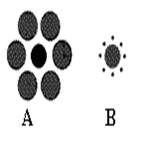
Look at the center circles of Diagram (图) A and Diagram B.  Which of the centre circles looks larger? 
Take a first look and you probably think that the centre circle in Diagram A is smaller than that in Diagram B. In fact , they are exactly the same size.
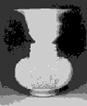
Then look at the picture on the right. What do you see? A vase ? Or two faces? Does the picture change quickly from one to the other again and again? Maybe or maybe not, but you can never see them at the same time. 
"What's happening? Is something wrong with my eyes?" You may wonder at what you see. Don't worry. Here is how it goes:
When we look at things, our eyes send messages to our brains and then our brains interpret (解读) the information. However, sometimes our brains interpret the received information in a wrong way. It seems that our eyes are playing a joke on us. This often happens and we call it "Visual illusion" (视觉错误). 
Movie makers often make use of illusions. They make the objects around actors much smaller or bigger than usual. This makes us believe that the actors are much larger or smaller than they usually are. The movies Jurassic Park and Honey I shrunk the kids just make use of illusions.
小题1:The centre circle in Diagram A looks smaller than that in Diagram B. That's because           .
A. something is wrong with our eyes
B. the two circles are not the same size
C. our brains interpret the information in a wrong way
D. the two pictures change quickly from one to the other
小题2:What's the right order according to the passage?
a. We look at things with our eyes.              b. Our brains interpret the messages.
c. Our brains tell us what we have seen.      d. Our eyes send messages to our brains.
A.adbc
B.cabd
C.acdb
D.bcad
小题3:Movie makers make use of visual illusions to            .
A.help the actors look better
B.make the actors much braver
C.help the actors become stronger
D.make the actors seem different in size
小题4:In the picture on the right, it seems that Line AB is shorter than Line CD, but in fact Line AB is as long as Line CD. Which paragraph can explain what has happened to our eyes?___________
   
A.The second one.
B.The third one.
C.The fifth one.
D.The sixth one.
小题5:The text is probably taken from            .
A.an advertisement
B.a science book
C.a movie magazine
D.a story book
A person has been badly injured in a car accident. It is necessary to give him a transfusion (输血) because he has lost much blood in the accident. However, special care must be taken in selecting new blood for him. If the blood is too different from his own, the transfusion can kill him.
There are four basic blood groups: A, B, AB and O. A single test can tell us a person’s blood group. Everybody is born with one of these four blood groups. People’s blood group, like hair colour, is inherited (继承) from parents.
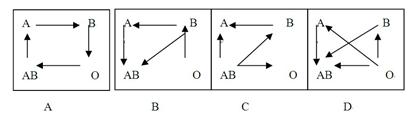
Because the substances contained in each group are different, transfusion must be given carefully. Basically, A and B cannot be mixed. A and B cannot receive AB, but AB may receive A or B. O can be given to any other group, so it is often called the universal donor. On the contrary, AB is sometimes called the universal recipient (接受者). However, before being given the transfusion, patients usually receive only salt or plasma (血浆) until their blood can be matched as exactly as possible. In this way, it is possible to avoid any bad results of the transfusion.
There is a relationship between our blood groups and our nationalities. Among the Europeans, about 42 percent are blood group A while 45 percent are blood group O. The rarest is blood group AB. However, some American Indian groups are nearly 100 percent blood group O.
小题1:Which of the following shows the correct relationship in blood transfusion? (→ =" giving" blood to)

小题2:Usually, before being given a transfusion, ________.
A.a person needs to receive salt or plasma first
B.a person needs to have a good rest
C.a person needs to have a lot of food and water
D.a person needs to find the person with the same blood group as him
小题3:The third most common blood type among the Europeans is _______.
A.AB.BC.ABD.O
小题4:Which is NOT right according to the passage?
A. A person’s blood group depends on his parents.
B. There is only one kind of blood group in a person’s body.
C. About 13 percent of the Europeans have blood group AB.
D. Most of American Indians can be universal blood donors.
小题5:Which is the best title for the passage?  
A.Blood transfusionB.Blood groups
C.Car accidentsD.Blood group and nationalities
When an animal helps another animal, it usually gets something valuable in return. For a long time, many scientists thought that only people could act generously just because it feels good.
However, a new study in Germany suggests that chimpanzees (黑猩猩)also do good things for no real reason. And so do children who are as young as 18 months of age. Maybe it is because humans and chimpanzees share an ancestor(祖先) about 6 million years ago.
People and chimpanzees appear to develop such features(特征) without any other training, says Warneken, a scientist in Germany. Warneken and his partners worked on adult chimpanzees that live on an island in the African country of Uganda. They also worked with 18-month-old children in Germany. The researchers performed three experiments on the adult chimpanzees and two experiments on the kids. In the first animal experiment,a person tried to reach his arm into a cage to get a stick,but he couldn’t reach it. A chimpanzee was in the cage,and it could reach the stick if it wanted to.
Thirty-six chimpanzees took part in this experiment one by one, and no chimpanzee saw what the other chimpanzees had done. Even though the animals hadn’t met the person before, they usually took the stick and gave it to the person. What’s more, they did this whether or not the person offered them bananas as a reward. In a similar experiment, 36 children acted in a similar way. They helped the person reach the stick, whether or not they were offered toys for their help.
Researchers did other experiments on chimpanzees and babies. No rewards were offered in either experiment. And still, both the chimpanzees and children went out of their way to help. Still, the new study is different from earlier findings. Researchers have found that chimpanzees don’t give rewards of food to other chimpanzees, even if it costs them nothing to be generous.
小题1:Warneken and his partners worked with ________.
A.young chimpanzee that live on an island
B.18-month-old children who live in Germany
C.kids who are living with adult chimpanzees
D.adult chimpanzees that live on the African mountain
小题2:A new study in Germany suggests that ________.
A.people also share information for good reason
B.children know something at the age of 18 months
C.chimpanzees do good things for no real reason, too
D.humans should develop their abilities 6 million years ago
小题3: Which of the following is NOT true according to the passage?
A.Thirty-six chimpanzees joined in this experiment one by one
B.No chimpanzee saw what the other chimpanzees had done
C.The animals hadn’t met the person before the experiments
D.Chimpanzee gave the person the stick in order to get a reward
小题4:From the passage we know that ________.
A.both chimpanzees and children can find their way to help others
B.chimpanzees will reward good food to other chimpanzees
C.children is more generous than chimpanzees in some ways
D.both chimpanzees and children can do the difficult experiments
School uniforms are common in primary and secondary schools in many countries. Here’s a list of countries below.

 In Brazil, students wear uniforms in private schools. But in public schools, students don’t have to wear uniforms although they might have one. In general, the uniforms are a pair of blue pants and a white T-shirt with the school symbol printed on it.

 School uniforms are used in Cuba. All students wear school uniforms with the color as a symbol of grade level. Children also wear scarves because they are young pioneers(少先队员).

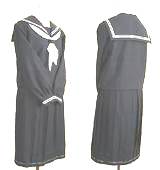
Japan introduced school uniforms in the late 19th century. Today, school uniforms are very common. Many boys wear white shirts, short pants and caps. Girls’ uniforms might include a gray pleated (褶)skirt and a white blouse.

 In Singapore, all students must wear uniforms. Though the colors are different from school to school. The normal uniform for boys is shorts or long pants, with a shirt (often white), while girls wear white pinafores(连衣裙) or skirts.
 
小题1:In Brazil, where is the school symbol?
A.On the pantsB.On the shoesC.On the T-shirtD.On the socks
小题2:In Cuba a student wears the scarf as a symbol of _____.
A.grade levelB.cold weatherC.public schoolD.young pioneer
小题3:A Japanese girl’s uniform is _____.
A.a pair of blue pants and a white T-shirt
B.a gray skirt and a white blouse
C.a white shirt, short pants and a cap
D.a pinafore or a white skirt
小题4:Which is true about the students’ uniforms in Singapore?
A.School uniforms are the same as China’s.
B.Only the students in private schools wear uniforms.
C.Boys’ uniforms are different from girl’s in color.
D.Students usually wear white shirts or skirts.
小题5:On the school day, a student doesn’t wear the uniform. He probably comes from ______.
A.BrazilB.CubaC.Japan D.Singapore
When you watch TV and play video games you make global(全球的) warming worse! It may seem hard to believe, but when electricity is made, so are greenhouse gases(温室气体). This means that every time you use electricity you help make global warming worse!
Cars are also making global warming worse. They burn fossil fuels(化石燃料) in their engines, and send lots of greenhouse gases into the air.
Global warming may be a big problem, but we can all help stop it. People can try to drive their cars less. Or even get ones that run on sunlight! You can also help. Let’s try one of these top ideas:
(1) Try to use less electricity. Turn off lights, your television, and your computer when you’ve stopped using them. To make electricity, fossil fuels are burned in big factories. But burning fossil fuels also makes greenhouse gases. You should also try to watch less TV.
(2) Plant trees. Not only is it a fun thing to do, but it is also a great way to lower the number of greenhouse gases in the air. Trees take carbon dioxide out of the air when they grow.
(3) Don’t throw away your rubbish, try to recycle it. If rubbish is not recycled, it is put in the ground. There it rots(腐烂) and makes a greenhouse gas called methane(甲烷).So try to recycle cans, bottles, plastic bags and newspapers. It’ll make you feel great! And it’ll help the Earth.
小题1:If we _____, we may make global warming worse.
A.use less electricityB.drive a car on sunlight
C.plant treesD.throw away rubbish
小题2:We may use more electricity by______.
A.turning off lightsB.shutting down computers
C.turning up CD playersD.turning off TV
小题3:______ will make global warming worse.
A.MethaneB.CansC.NewspapersD.Bottles
小题4:Using less electricity does good to global warming because_______.
A.the less electricity is used, the more greenhouse gases are produced
B.the more electricity is used, the more greenhouse gases are produced
C.more electricity is used, less greenhouse gases are produced
D.less electricity is used, more greenhouse gases are produced
小题5:Which is the following is NOT TRUE according to the passage?
A.Driving cars on sunlight helps to stop global warming.
B.When cars burn fossil fuels, they produce greenhouse gases.
C.When trees grow, they send carbon dioxide into the air.
D.By planting more trees, we can lower the number of greenhouse gases in the air.
 0  61303  61311  61317  61321  61327  61329  61333  61339  61341  61347  61353  61357  61359  61363  61369  61371  61377  61381  61383  61387  61389  61393  61395  61397  61398  61399  61401  61402  61403  61405  61407  61411  61413  61417  61419  61423  61429  61431  61437  61441  61443  61447  61453  61459  61461  61467  61471  61473  61479  61483  61489  61497  159627 
违法和不良信息举报电话:027-86699610 举报邮箱:58377363@163.com

精英家教网