Like most cultures around the world, the Zulu people of Africa tell stories that have animals as heroes. These stories are meant to entertain, but they are also used to teach important lessons to children. This is one of those stories.
One hot afternoon, Jackal was walking along the rocky road sniffing (嗅) the ground. He was hoping to smell a mouse or a lizard (蜥蜴), or something else that would be good to eat. He was so much lost in sniffing that he wasn’t really paying attention to what was around himself.
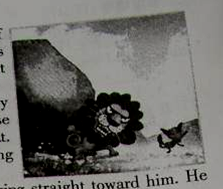
Suddenly, Jackal looked up to see his neighbor, Lion, walking straight toward him. He did not have enough time to get away. Jackal had played many tricks (捉弄) on Lion over of something quickly.
“Help! Help!” cried Jackal as he quickly jumped upon a large rock hanging over the road. “The rocks are falling down, and I can’t hold them much longer. We shall both be crushed (压碎) if you do not do your best to hold these rocks back, Lion”
At once, Lion pushed his strong shoulder against the rocks to keep them from moving any further. “I’ll just run over here to get something to stop the rocks,” shouted Jackal as he ran away to safety. Lion stayed leaning against the unmoving rocks for quite a long time before he realized that Jackal had tricked him yet again!
小题1:Why was Jackal sniffing the ground?
A.To play with Lion.B.To push upon a rock
C.To run after a mouseD.To look for something to eat.
小题2:What does the underlined word ‘leaning’ mean?
A.supportingB.sleepingC.runningD.sitting
小题3:Why did Jackal cry for help?
A.Because Lion was rushing to him.
B.Because he was caught under a rock.
C.Because he got an idea to get away from Lion.
D.Because he saw a large rock moving toward him.
小题4:What lesson does the story teach us?
A.Trust your friend, trust yourself.
B.Work hard, and you’ll succeed.
C.Help others when they are in trouble.
D.Try to find a quick way out when in trouble.
When I was in primary school, I had a big argument with a boy in my class. l can't   31   what it was about, but I have never forgotten the   32  I learned that day.
I was sure that I was right and he was wrong.   33  , he strongly believed that I was wrong and he was right. The teacher decided to teach us a lesson. She   34  a good idea. She brought both of us to the front of the class and placed him on one side of her grey desk and me on  35    In the middle of the desk was a large, round object.  It was   36  for me to see that it was black.  She asked the boy what color the object was.  "  37," he answered in a loud voice.
I couldn't   38  that the object was whites considering that it was certainly black! One more argument started between the boy and me, this time   39  the color of the object.
The teacher told me to go stand where the key was standing and told him to come stand where I had been. We changed   40  , and then she asked me what the color of the object was. I 41  answer, "White. " It was then that I knew what was wrong. It was an object with two   42   colored sides, and from .his side it was white.   43  from my side was it black.
My teacher taught 'me a very important 1.esson that day: You must "  44  in other person's position (位置) and look at the  45  through their eyes in order to truly understand their ideas.
小题1:A. understand              B. remember              C. explain
小题2:A. class                  B. subject                C. lesson
小题3:A. Therefore              B. Also                  C. However
小题4:A. came up with           B. went on with           C. got along with
小题5:A. another                 B. other                  C. the other
小题6:A. hard                    B. clear                  C. lucky
小题7:A. Black                  B. White                C. Grey
小题8:A. realize                 B. describe                C. believe
小题9:A. like                    B. against                 C. about
小题10:A. places                  B. objects                  C. opinions
小题11:A. could                  B. should                  C. had to
小题12:A. similarly               B. differently              C. brightly
小题13:A, But                   B. Still                    C..Only
小题14:A. appear                  B. stand                  C, hide       
小题15:A. situation                 B. discussion               C. solution
Are you nervous when you stand in front of the public? Are you afraid to make a speech?
Li Jun, a middle school boy, felt shy when he was making a speech the other day. Li had thought it would be quite easy to speak in front of   1  classmates.
"I was wrong. It was very different and much  2  than talking to my classmates during playtime," Li said. "I tried, but it was really difficult to speak. I felt like a mute (哑巴) and wanted to leave the classroom   3  "
Li is not alone. Many middle school students now have the same   4  : they can talk about their ideas freely   5  their best friends after class, but can't speak in public. According to Zhou Hong, a teacher from a university, the main reason is that schools in China pay more attention to writing instead of  6 .
Zhou hopes schools can give students more chances to open their   7 , such as speech competitions, English corners and class discussions. Students can join in any one they want to. 8  he also gives some advice to students. "During your free time you should  9  more. When you're speaking in public, take it easy. Just imagine you're talking to nobody and speak up your ideas clearly," Zhou said. "That   10  a fine public speech and you'll feel confident. "
小题1:
A.herB.myC.yourD.his
小题2:
A.harderB.easierC.better'D.later
小题3:
A.slowlyB.quicklyC.sadlyD.happily
小题4:
A.answerB.subjectC.problemD.question
小题5:
A.exceptB.besideC.fromD.with
小题6:
A.listeningB.speakingC.readingD.singing
小题7:
A.mouthsB.eyes C.mindsD.hearts
小题8:
A.ButB.SoC.AndD.Or
小题9:
A.playB.practiceC.writeD.watch
小题10:
A.reportsB.keepsC.hearsD.makes
A punctual person is in the habit of doing a thing at the correct time and is never late for anything.
An unpunctual man never does what he has to do at the right time. He is always in a hurry and in the end loses both time and his good name. A lost thing may be found again, but lost time can never be got back. Time is more useful than material things. In fact, time is life itself. An unpunctual man is always wasting his most important things as well as others'. An unpunctual person is always saying unhappily that he finds no time to answer letters or return calls. But the man who really has much to do is very careful of his time. He knows that he can not finish all his work unless he carefully does every piece of work.
Being unpunctual is the sign of disrespect (不尊重_) towards others. If a person is invited to
dinner and arrives later than the time when he should be there, he keeps all the other guests (客人)
waiting for him. Usually this will be thought as a great disrespect to the host and all the other guests.
Not like a punctual person, an unpunctual one can't do his duty wonderfully, whether it is public or personal. Imagine how it would be if those who should do important tasks failed to be on time. A man who is known to be often unpunctual is never believed by his friends or fellow men.
小题1:The Chinese meaning of the word "punctual" in this passage is probably “      ”.                                                                      
A.听话的B.守时的C.守纪律的D.能干的
小题2:Which of the following is TRUE according to the passage?
A.An unpunctual person often has more time.
B.An unpunctual person has more work to do.
C.A punctual person often has a busy life.
D.A punctual person often does his work wonderfully.
小题3:When you are invited to dinner, you'd better arrive there        .
A.in a hurryB.after the host
C.at the decided timeD.before other guests
小题4:From the passage, we learn that an unpunctual man usually          in the end.
A.saves time for others
B.leaves his family and friends
C.gets his chances and knowledge
D.loses his time and good name

Dear Mike,
I am sorry you are having difficulty with your English class. Every teacher wants his or her students to study hard especially in class. So I think you should have a talk with your English teacher and tell her what you were doing with Tom that day. If she knows your worries, maybe she will help you with your English. And she will be pleased to hear you want to learn English well. I believe when students are not trying as hard as they can, a teacher is forced(被迫)to take actions.
Yours,
Editor
小题1:What’s wrong with Mike?
A.He meets trouble with his parents.
B.He doesn’t know how to get on well with his classmates.
C.He has a hard time with his English class.
D.He is always speaking in class.
小题2:What happened in that English class?
A.Mike couldn’t answer the question. So the teacher asked him to stand.
B.Mike had an argument with Tom about the question.
C.Tom asked Mike a question, and the teacher thought they were speaking.
D.Mike felt uncomfortable because he was ill.
小题3:In the editor’s opinion, why did the English teacher punish(惩罚) Mike?
A.Because the English teacher didn’t think Mike was studying hard in class.
B.Because Mike answered the question wrong.
C.Because Mike was bad at English.
D.Because Mike had a fight with other students.
小题4:What does the underlined phrase“ take actions” mean in Chinese?
A.采取行动B.参加活动C.帮助D.表演
小题5:What can we learn from the letters?
A.Mike wants to have a talk with his English teacher.
B.Mike wants the editor to say something to his English teacher.
C.The editor gave Mike some advice, but it didn’t work.
D.Mike dislikes English classes now, but he wants to learn English well.
 0  61124  61132  61138  61142  61148  61150  61154  61160  61162  61168  61174  61178  61180  61184  61190  61192  61198  61202  61204  61208  61210  61214  61216  61218  61219  61220  61222  61223  61224  61226  61228  61232  61234  61238  61240  61244  61250  61252  61258  61262  61264  61268  61274  61280  61282  61288  61292  61294  61300  61304  61310  61318  159627 
违法和不良信息举报电话:027-86699610 举报邮箱:58377363@163.com

精英家教网