Here are some facts about homes in the United States and the people who live in them. In the early 1990s, about 50% of the Americans owned their homes and the rest rented(租) their homes. The rented homes were usually apartments(公寓).
74% of the people in the US make their homes in or around cities. 26% live in the country. Dogs live in about 40% of all homes in the US. About half that number have cats.
Families in the US are becoming smaller. On the average(平均), 2.64 people lived at home in the early 1990s. In the1960s, the average was 3.5.
Half of the teenagers in the US have their own bedrooms.
An American moves, on the average, twelve times in his or her life. In Japan a person moves about five times, and in England a person moves eight times.
【小题1】Most Americans live ________, according to the passage.
| A.in or around the cities | B.in cities | C.around cities | D.in the country |
| A.About 40%. | B.About 20%. | C.About 74%. | D.About 26%. |
| A.more than 3 | B.only 3.5 | C.less than 2 | D.about 2.64 |
| A.All of the people | B.Most of the children |
| C.Half of the teenagers | D.Only some of the teenagers |
| A.In the early 1990s, most of the Americans owned their homes. |
| B.Families in the US are becoming bigger and bigger. |
| C.A Japanese moves more often than an American. |
| D.An American moves more often than an Englishman. |
It’s so beautiful outside that spending the day in the office would be very boring. So why not take the vacations(假期)off? A new survey(调查)found that 31﹪of U.S workers don’t always take all of their vacation days. Americans have 12 vacation days on average(平均)each year, but they give back an average of 3 vacation days each year.
So why don’t they use up their vacation days? Some say they would rather get money back for their unused days; some busy workers say they just can’t leave their work. Americans have fewer vacation days than workers in any other country surveyed.
The French take their vacations seriously. French workers get an average of 39 vacation days, and 40﹪ plan to take at least one there-to-four-week vacation.
Workers in Sweden receive an average of 25 vacation days a year, but they can’t find time to use them all. More workers there return vacation days than any other country surveyed.
British workers have the longest working week in Europe(欧洲),with 23 vacation days --the shortest vacation. So they feel overworked.75﹪ say their weekends or vacations are too short and 40﹪ would sacrifice a day’s pay(工资)for one more vacation day.
【小题1】____________ U.S workers don’t always take all of their vacation days.
| A.All | B.Most | C.Some | D.Few |
| A.9 | B.12 | C.15 | D.23 |
| A.America. | B.France. | C.Sweden. | D.great Britain. |
| A.Use up. | B.Put up. | C.Take up. | D.Give up. |
| A.Some American workers are too busy to leave their work. |
| B.French workers can take one Three-to-four week days. |
| C.Swedish workers can enjoy all of their vacation days. |
| D.British workers have the shortest vacation days of all the countries surveyed. |
Street art is a very popular form of art that is spreading quickly all over the world. You can find it on buildings, sidewalks, street signs and trash cans(垃圾桶) from Tokyo to Paris, from Moscow to Cape Town. Street art has become a global culture and even art museums and galleries(画廊) are collecting the works of street artists. 
Street art started out very secretly because it was criminal to paint public and private things without permission(允许).
People often have different opinions about street art. Some think it is a crime and others think it is a very beautiful new form of culture.
Art experts say that the street art movement began in New York in the 1960s. Young adults painted words and other images on walls and trains. This colorful style of writing became known as graffiti(涂鸦). Graffiti art showed that young people wanted to be against society. They didn’t want to accept rules and travelled around cities to create paintings that everyone could see. In many cases, they had trouble with the police and the local government.
One well-known New York street artist is Swoon. She cuts paper images of people and puts them on walls or sets them up on sidewalks. Swoon didn’t start her career as a street artist. She studied art, but as time went on, got bored with the works she saw in museums and galleries. People in New York enjoy Swoon’s strong and imaginative style. Some museums have already bought some of her works.
Advertising companies also use street art in their ads because it gives people the feelings of youth and energy.
In Today’s world the Internet has a big influence on street art. Artists can show their pictures to the audience all over the world. Many city residents, however, say that seeing a picture on the Internet is never as good as seeing it live.
The street art movement lives with the energy and life of a big city.
【小题1】What can we learn from Paragraph1?
| A.Street art is an old culture. |
| B.Street art is of great artistic value. |
| C.Many big cities are famous for street art. |
| D.Street art has been accepted by more and more people. |
| A.they can’t make a living by themselves. |
| B.it was criminal to paint pubic and private things without permission. |
| C.the local government doesn’t like them. |
| D.they are threatening (威胁) public safety. |
| A.her works are full of imagination |
| B.her works can be seen everywhere |
| C.she is good at cutting paper images of people |
| D.her works are collected by some museums |
| A.on the Internet |
| B.by painting them on walls |
| C.through exhibitions in galleries |
| D.by drawing them on famous buildings |
| A.It is closer to people. |
| B.They want to be against society. |
| C.It makes cities more beautiful. |
| D.They are tired of various rules. |
If they eat up their food, students can collect coupons(优惠券) and exchange them for small gifts, such as books, magazines, mobile phone covers and hand warmers.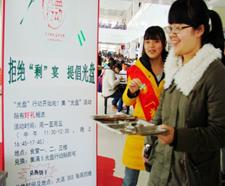
“It’s been such a surprise,” said Liang zhaoyun,19, a student at a university in Shanghai, “It has given us one more motivation to finish our food.”
The measure is part of a national “eat-up” campaign(行动) which is organized by students to deal with food waste on campuses(校园).
Why only on campuses? You might ask. Because according to a report by Xinhua News Agency, students waste twice as much food as the national average(平均).
The campaign on campus food waste is receiving attention across the country.
“The aim of the campaign is not only to encourage students to finish their food. We hope it can also encourage students to choose a more environment –friendly and healthy lifestyle,” said Tao Siliang, Secretary of the Youth League Committee at Shanghai University.
Some school food is poorly prepared, so students do not like to finish it all. Some schools have taken notice of this and they are taking measures to improve it.
“I’m glad that we’ve reduced food waste since the ‘eat-up’ campaign began. But if we call on students to waste less food, we should also improve the service and food standard on campuses.” said Tao.
【小题1】From Paragraph1, we know that the students will get a coupon .
| A.when they eat school food | B.after they exchange gifts |
| C.if they finish all their food | D.if they collect the waste |
| A.动力 | B.机会 | C.试验 | D.条件 |
| A.students get a good education | B.schools offer small gifts |
| C.students waste too much food | D.school food is more delicious |
| A.improve the school food standard |
| B.encourage a greener and healthier lifestyle |
| C.receive attention from the society |
| D.further improve the service in universities |
| A.Enjoy Your Food | B.Reduce Waste on Campus |
| C.Meals in Universities | D.“Eat-up” Campaign on Campus |
Without proper planning, tourism can cause problems. For example, too many tourists can crowd public places that are also enjoyed by the local people of a country. If tourists create too much traffic, the local people become unhappy. They begin to dislike tourists and to treat them impolitely. They forget how much tourism can help the country’s economy(经济). It is important to think about the people of a destination country and how tourism affects them. Tourism should help a country keep the customs and beauty that attract tourists. Tourism should also advance(推进) the well-being (health and happiness) of local people.
Too much tourism can be a problem. If tourism grows too quickly, people must leave other jobs to work in the tourism industry. This means that other parts of the country’s economy can suffer.
On the other hand, if there is not enough tourism, people can lose jobs. Businesses can also lose money. It costs a lot of money to build large hotels, airports, air terminals, first-class roads and other support facilities needed by tourist attractions. For example, a major international-class tourism hotel can cost as much as 50 thousand dollars per room to build. If this room is not used most of the time, the owners of the hotel will lose money.
Building a hotel is just a beginning. There must be many support facilities as well, including roads to get to the hotel, electricity, sewers to handle waste, and water. All of these support facilities cost money. If they are not used because there are not enough tourists, jobs and money are lost.
【小题1】What is probably the reason if local people dislike tourists?
| A.Tourists come to enjoy the customs and beauty. |
| B.Local people lose jobs. |
| C.A lot of hotels are built. |
| D.Too many tourists cause traffic problems. |
| A.Make plans properly. |
| B.Help the country’s economy. |
| C.Build fewer hotels. |
| D.Advance the well-being of local people. |
| A.businesses will lose money |
| B.other parts of the country’s economy will make more money |
| C.local people will be happier |
| D.more local people will work for tourists. |
①public places ②hotels ③airports ④roads ⑤electricity ⑥sewers
| A.①②③④⑤ | B.②③④⑤⑥ | C.①②③⑤⑥ | D.①③④⑤⑥ |
| A.whether people need to build more hotels |
| B.whether people need to plan tourism properly |
| C.how to deal with the problems above |
| D.how to prevent tourism growing too quickly |
Chinese Premier Wen Jiabao promised that the country would take actions to improve school bus safety on Sunday, a day after China saw its second terrible school bus accident in November, 2011.
“School buses should be safe mobile campuses(校园) for students,” the premier said at a national meeting on women and children, “Society(社会) should remember in mind that children should be the first to enjoy all kinds of social caring and the last ones to suffer from any disaster.”
School buses have become a hot topic in China since the deaths of 21 people, including 19 pre-school students, in a traffic accident between a truck and a school-owned minibus in Gansu province on Nov. 16, 2011. The nine-seat minibus was carrying 64 people at the time of the accident, according to the reports.
The second accident, in which a school bus in the northern province of Liaoning rolled over on Friday, left 35 people injured, according to China Daily.
“In recent days, a series of big accidents involving school buses has led to great anger among the people. These accidents have also made me uncomfortable,” said Mr Wang, an old teacher from Jiangsu. And he also thought that school bus safety must become a serious problem for schools and the government.
Premier Wen has already asked the government to develop new safety standard (标准) for school buses and made sure to help local government with safe buses for school-age children.
【小题1】How many seats did the minibus in Gansu province have before it was turned into a school bus?
| A.64 | B.21 | C.9 | D.19 |
| A.倒车 | B.翻车 | C.撞车 | D.飞车 |
| A.nervous | B.angry | C.stressed | D.tired |
| A.21 pre-school students died in the school bus traffic accident in Gansu. |
| B.35 people were hurt in the school bus accident in Liaoning. |
| C.Mr. Wang thought school bus safety was a serious problem. |
| D.The government has been asked to develop new safety standard for school buses. |
Today we can use the Internet for many things: shopping, business, writing letters, talking to people, getting information and so on. In recent years, a new kind of English has grown on the Internet. There's no real word for it yet, so we call it e-talk.
People don't like typing too much. To save time, they turn phrases into a few letters, acronyms(首字母缩略词). Acronyms are often used in chat rooms. Some are as follows:
BRB (be right back), BTW (by the way), LOL (laughing out loud), IMO (in my opinion)
People also use many abbreviations. They are shortened forms of words. Some common abbreviations include info (information), pic (picture), puter (computer), sec (second), etc.
We usually don't see people when we communicate on the Net, so people have new ways to show feelings. Most people use their keyboards to draw "feelings", such as:
:-) (happy) ;-) (joking) :-( (sad) :-O (surprised)
These days, many public discussions have picture feelings, for example:
(happy) (sad) (angry) ( (cool)
There are even whole new words, like "newbies"(someone who is new on a chat board or forum). When you write something bad about someone else, it's called "burning" the person.
It takes time for people to get used to e-talk. Also, different groups on the Net have their own special ways of communicating. Newbies sometimes have to ask other people what they mean. As the Internet grows, e-talk will continue to grow and change.
【小题1】Why do people type acronyms?
| A.To type them quickly. | B.To make jokes. |
| C.To make newbies puzzled. | D.To show their feelings. |
| A.The person is happy about getting a new computer. |
| B.The person has to go away from their computer. |
| C.The person is sad that his computer is having problems. |
| D.The person is angry at somebody. |
A. LOL B. BRB. C.
 D.
D. 
【小题4】E-talk will probably____________.
| A.stay the same |
| B.keep changing |
| C.be used by people on the telephone |
| D.be easy for newbies to understand |
| A.E-talk | B.Picture Feelings |
| C.How to Use Abbreviations | D.The Changing Internet |