阅读理解
Stephen Hawking was born in Oxford, England on.8th January, 1942. He went to school in St Albans, a small city near London. Although he did well, he was never top of his Class.
After leaving school, Hawking went first to Oxford University where he studied physics, and then he went to Cambridge University where he studied cosmology
(宇宙论). As he him-self admits, he didn't work hard. He was a very lazy student, and did very little work. How-ever, he still got good marks.It was at the age of 20 that Hawking first noticed something was wrong with him. He started to bump
(撞下)into things. When he visited his family at Christmas time, his mother was so worried that she made him see a doctor. Hawking was sent to hospital for tests. Finally, the result came back. Hawking had motor neuron disease, an incurable illness which would make him unable to speak, breathe or move without the help of a machine. Doctors said they had no way to help him. He would die before he was 23.At first, Hawking became very depressed. After a while, though, he began to see his life in a different way. As he later wrote,
“Before my illness was diagnosed, I had been very bored with life. There had not seemed to be anything worth doing. But shortly after I came out of hospital, I suddenly realized that there were a lot of worthwhile things I could do.”Hawking married, found a job at Cambridge University, and had three children. He also went to do some of the most important scientific research.Today, Hawking still works at Cambridge University as a professor. He strongly believes that his story shows that nobody, how had their situation is, should lose hope.
“Life is not fair,” he once said.“You just have to do the best you can in your own situation.”(1) AS a university student, Stephen Hawking ___________.
[
]A
.worked very hardB
.studied math and physicsC
.was the best student in his classD
.was lazy and did very little work(2) Hawking first noticed something was wrong with him when _________.
[
]A
.he was sent to hospital for testB
.his mother made him see a doctorC
.he was twentyD
.he visited his family at Christmas time one year(3) In this passage the word
“incurable”means“___________.”[
]|
A .无法治愈的 |
B .难以确诊的 |
|
C .常见的 |
D .可以治愈的 |
(4) When Hawking was first diagnosed with motor neuron disease, he ___________.
[
]A
.made up his mind to get marriedB
.made up his mind to get marriedC
.thought that nothing in life was worth doingD
.became very sad(5) What would be the best title for this passage?
[
]|
A .Motor Neuron Disease |
B .Life is Fair |
|
C .Professor Stephen Hawking |
D .A Lazy Boy |
阅读理解
Have you ever heard your own voice?
“Of course,” you say.Has anyone else ever heard your voice? Again you say,
“Of course.”But that's not quite true. Nobody else has ever heard your voice---the way you hear it.
When you are talking, you set up sound waves. The air outside your head carries the sound waves to your outer ears. But, of course, the sound of your voice begins inside your head. The bones of your head pick up the sound waves, too. They carry the sound waves straight to your inner ears. You get the sound from the outside and inside, too. Other people get just the sound waves from the outside. That is why they don't hear your voice the same as you do.
(1) You _________ hear your voice the way others hear it.
[
]|
A .can't |
B .seldom |
C .sometimes |
D .always |
(2) Sound travels in the form of ____________.
[
]|
A .bones |
B .air |
C .waves |
D .voice |
(3) When you talk, sound waves are set up inside _________.
[
]|
A .your inner ears |
B .your outer ears |
|
C .your head |
D .your heed bones |
(4) The underlined phrase
“pick up”means ______.[
]|
A .raise |
B .gain |
C .select |
D .pull |
(5) The passage is mainly about
[
]A
.waves in the airB
.the way you hear your own voiceC
.voice going far and wideD
.the different way people hear their voices阅读理解
Every object has weight. But the center of its weight is not always in the middle of the object, If the top of an object is heavier than its bottom, it will fall over easily. We say that its center of gravity
(引力)is high. But if the bottom is heavier, it won't fall easily. Then we say that its center of gravity is low.Look at the first picture, lifts empty box must fall over, bemuse its center of gravity (C) is not above the line of its bottom (AB).
Now look at the second picture. There is some heavy iron at the bottom of this box. It will not fall, because its center of gravity is above its bottom.
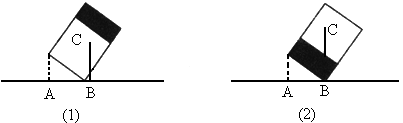
(1) Please point out which box will not fall?
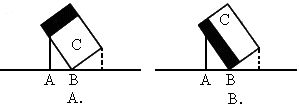
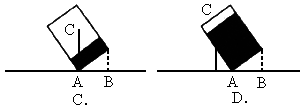
(2) From the passage, we can infer that the Leaning Tower of Pisa does not fall is because_______.
[
]A
.the top of the tower is heavier than its bottomB
.the bottom of the tower is not heavier than its topC
.its center of the gravity is still above the line of its bottomD
.its center of the gravity is not above the line of its bottom(3) If an object has a low center of gravity, _______.
[
]|
A .it won't fall |
B .it won't fall easily |
|
C .it is certain to fall over |
D .its top must be heavier |
(4) Which of the following is TRUE according to the passage?
[
]A
.The center of the weight is always in the middle of the objectB
.The center of the weight is always on the objectC
.The center of gravity is not always in the middle of the objectD
.The center of the gravity is always high(5) The passage is mainly about _______.
[
]|
A .why things fall over |
B .a low center of gravity |
|
C .a high center of gravity |
D .that everything has weight |
Sunday wants to write about West Hill in Sunshine Town for her history project. She is interviewing Mr.Hu, a 60-year-old man, who lives in West Hill. Read their conversation.
|
Sandy: |
How long have you lived in West Hill, Mr.Hu? |
|
Mr.Hu: |
I’ve lived here all my life. I met my wife here and we got married. This area was called Taihe Village before. |
|
Sandy: |
When did they change the name? |
|
Mr.Hu: |
5 When the West Hill underground station was built, the government started to take down the wooden houses in this area. Since June 2000, Taihe Village has become history. |
|
Sandy: |
What do you miss most about Taihe Village? |
|
Mr.Hu: |
10 I miss many things about Taihe Village. I was a dentist and everyone in Taihe Village knew me well. Now, I'm old and I can only sell medicine to people in the street. In the past, there were many stone and wooden houses around here. Also, there were big trees in the village. The air was very fresh. |
|
Sandy: |
Did you have noise pollution from cars and trains? |
|
Mr.Hu: |
15 Yes, but not very serious. |
|
Sandy: |
I’ve heard that the food stalls were very famous here. Is it true? |
|
Mr.Hu: |
20 Yes. The food stalls sold very good snacks but they all moved. That's why it was easy to find mice here before. Everyone in the village was used to seeing mice. We weren’t surprised to see mice in the street at night. |
|
Sandy: |
That's terrible! |
|
Mr.Hu: |
25 We're glad that it has improved so much but I really miss everything here in the past. Many of my friends moved because the government gave them new flats in new towns. I sometimes feel lonely. Every time I see a chessboard, I think about them. |
|
Sandy: |
Mr.Hu, thank you so much for the information. Although the village has disappeared, it is still beautiful in your heart. |
(1) What was West Hill called in the past?
A. Taihe Village. B. Taihua. C. Huhe Village.
(2) When did the government take down all the wooden houses completely in Taihe village?
A. In 1998. B. In 1999. C. In 2000.
(3) Was there noise pollution in Taihe Village?
A. Yes, a lot. B. Yes, a bit. C. No, never.
(4) Why were there mice in Taihe Village?
A. There were no cats.
B. There were many food stalls.
C.The houses were dirty.
(5) What did people sell in the food stalls in West Hill?
A. Snacks. B. Medicine. C. Chessboards.
(6) What did Mr.Hu do with his friends?
A. They watched TV. B. They played chess.
C. They played football.