 s
hard to get a clear result.
s
hard to get a clear result.Cooking and Learning
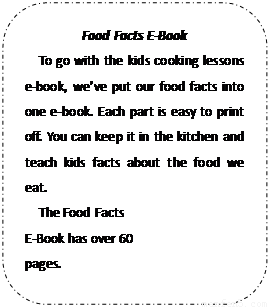
In this E-book package, we have four e-books.

Fun with Food
This fun e-book is filled with

 exercises --- photo
tests,
exercises --- photo
tests,
word exams, riddle games,
coloring pages and exercises
on learning more about food.
 |
 |
1. Kids can ________ by reading Fun with Food.
A. do science experiments B. get cooking experience
C. cook well in the kitchen D. play some riddle games
2. ________ has over sixty pages.
A. Fun with Food B. Kids Cooking Lessons E-Book
C. Food Facts E-Book D. Kids Food Science Experiments
3.Kids Cooking Lessons E-Book is popular because ________.
A. there is a unit for each age group B. there are a lot of photo tests in it
C. kids can learn more about science D. each part is very easy to print off
 Recent research from
the Pew Internet Project suggests that 90% of Americans aged from 12 to 17 use
the Internet, and 51% of those teens use social networks. However, there are
many possible problems with social networking
sites and the teenagers who use them.
Recent research from
the Pew Internet Project suggests that 90% of Americans aged from 12 to 17 use
the Internet, and 51% of those teens use social networks. However, there are
many possible problems with social networking
sites and the teenagers who use them.
Apart from the social advantages, social networking sites can be used to record school research, develop artistic talents and experiment with other forms of subject creation. They provide a way to communicate with others who share the same interests and to get helpful advice on ongoing projects.
Along with these advantages come some dangers. For example, most social networking sites are open to all, especially MySpace, which is the most popular social network among teens in America. It means that they could be put in unpleasant and frightening situations.
A greater danger is that teens may become objects of the people with secret purposes. The secrecy of some social networking sites makes it easy for dangerous people to find young teens and invite them into dangerous conversations. It’s easy for them to pretend as teens and draw children into dangerous real-world communication as well. Then further hurt might be on its way.
Another danger is identity stealing, which can happen when teens share too much information about their names, dates of birth and locations.
Therefore, it’s very important to make sure teens are safe when they use social networks.
Many of the same rules that work for online chat work for these sites:
※ Don’t use your real name.
※ Don’t give out personal information to people you don’t know. A last name and a town
are enough for a bad guy to find where you are.
※ Don’t believe that people are who they say to be.
※ Immediately end any communication that makes you uncomfortable and report it to a
parent.
Only if you are sure of your safety, can you enjoy the fun brought by social networking. Besides, trying to deal with all problems on your own can lead to terrible results. Remember, asking your parents or school officials for help doesn’t mean you are unable to do anything but wiser than many others.
1.How many dangers of using social networks are mentioned in the passage?
A. 2. B. 3. C. 4. D. 5.
2.The writer takes MySpace as an example to show that ________.
A. students could be put into unreal situations on the Internet
B. teenagers are facing unknown dangers on the social networks
C. Internet provides more social websites to American teenagers
D. social networks are very popular among teenagers in America
3.We can infer from the passage that ________.
A. the dangers are similar when chatting online and surfing social networks
B. more than half American teenagers aged from 12 to 17 use social networks
C. teens who ask for help are wiser when meeting problems on social networks
D. there are more disadvantages than advantages for teens to use social networks
A small town named Bundanoon in Australia has decided to stop the sale of bottled water(瓶装水). They say that bottled water can cause environmental problems. Too many resources(资源) are used to make bottled water. When people finish drinking the water, the bottles will be thrown away and go into dustbins. So they require local people in the town to stop buying bottled water and use tap water to drink. Visitors are encouraged to get water from water stations in the main streets, and fill the water in bottles that can be used again. The decision has been supported(支持) by all the shopkeepers in the town. Bundanoon is the world’s first town that has got its shop selling bottled water. Probably we should follow the example. Let’s stop buying bottled water and use tap water![来源:ZXXK]
|
Australian Town Bans(禁止) Bottled Water |
|
|
Where bottled water is first banned |
A small town with the ____61_______ Bundanoon |
|
___62_____ bottled water is banned |
To help solve environmental problems |
|
What local people use for ______63____ |
Tap water, not bottled water |
|
The place which visitors get water ___64 |
Water stations in the main streets |
|
Other people who have supported the plan |
______65____ the shopkeepers in the town |
假设你将代表初三毕业生在毕业典礼上发言,请你用英语写一篇发言稿。
要点如下:
|
回顾 |
校园很美丽;每学期有丰富多彩的活动,例如,去年地震过后,学校组织了捐款活动;老师教学生动有趣;三年来学到很多,进步大。 |
|
感谢 |
老师的培养,父母的支持,同学的帮助 |
|
祝愿 |
我希望…… |
1. 发言稿须包括所有内容要点,要求语句通顺、意思连贯;
2. 最后一个要点适当发挥1~2句;
3. 词数80个左右,发言稿的开头已给出,不计入总词数。
Good afternoon, everyone! It is a great honour for me to make a speech on behalf of the graduating class of 2012. __________________________________________________________________________________________________________________________________________________________________________________________________________________________________________________________________________________________________________________________________________________________________________________________________________________________________________________________________________________________________________________________________________________________________