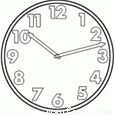
Once, a circle lost a piece of its own. The circle wanted to be whole, so it went around, looking for its   41   piece. But because it was not complete, it could only roll (滚) very slowly. It enjoyed the flowers and the sunshine   42   the way. It talked with worms. It found lots of different pieces, but   43   of them fit. So it left them all by the side of the road and kept on   44   for the lost piece. Then one day the circle found a piece that fit   45  . The circle put the piece into   46   . It could be whole with nothing lost. It was so happy and began to roll. As it was a perfect circle, it could roll very fast, too fast to see flowers or talk to worms. It realized how different the world was when it rolled so quickly. It felt so sad   47   it stopped, left its found piece by the side of the road and rolled very slowly.

         Sometimes we are perfect when we lose something. A man who   48   everything is poor in some ways. He will never have hopes, dreams or something   49  . He will never know someone loves him or someone is giving him something he has always wanted or never had.

         We couldn’t be perfect. But we must be brave enough to love, strong enough to forgive, kind enough to share   50   with others and clever enough to know there is enough love  around us and then we can always have a wonderful time in our life.

1.A. miss                               B. lose                                   C. missing           D. losing

2.A. at                                             B. of                             C. in                              D. along

3.A. none                             B. all                             C. every one               D. each

4.A. look                               B. looking                    C. to look                     D. looked

5.A. perfectly                      B. perfect                             C. part                          D. partly

6.A. it                                             B. itself                                  C. them                        D. themselves

7.A. which                                     B. whether                           C. that                          D. what

8.A. own                               B. has                                    C. owned                     D. have

9.A. bad                                B. worse                               C. good                        D. better

10.A. kindness                     B. sadness                            C. happiness               D. illness


FUN TIME

Are you tired of the puzzles you usually do? Sudoku is a new choice. Sudoku consists of the Japanese characters Su (meaning “number”) and Doku (meaning “single”), but it was not invented in Japan. It was created by Howard Garnes in 1979. The puzzle was first introduced into Japan by Nikoli Puzzle Company in 1984. In 1986, Kaji Maki, the president of Nikoli made the rules strict and clear. Soon in the same year Sudoku became popular in Japan. In November 2004, The Times, a British newspaper, first printed it in the newspaper. It became an international hit in 2005. Now Sudoku becomes very popular all over the world.

The rule of the puzzle is to fill in the grids (格子) so that every row, every line and every 3×3 box has the numbers 1 to 9. Here is a Sudoku. Please relax and enjoy. It’s fun!


9

2

4

7

6

3

1

5

8

5

3

6

8

9

1

4

2

7

X

7

8

2

5

4

9

6

3

7

1

9

3

4

2

5

8

6

4

8

3

6

1

5

2

7

9

2

6

5

9

8

7

3

4

1

3

9

7

4

2

Y

6

1

Z

6

5

2

1

7

9

8

3

4

8

4

1

5

3

6

7

9

2


根据以上杂志专栏内容,回答下列问题。

1.Who created Sudoku?

A. Howard Garnes.             B. Sudoku.                           C. Kaji Maki.                D. Nikoli.

2.Which is true about Kaji Maki according to the reading material?

A. He was the boss of Nissan Company.

B. He helped to make Sudoku popular in Japan.

C. He was the president of The Times.

D. He is an American.

3.Which is NOT true about Sudoku?

A. Sudoku wasn’t invented in Japan.

B. It was The Times that first printed Sudoku in the newspaper.

C. Each grid has more than one number.

D. It became popular around the world in 2005.

4.In the puzzle above, what should “X” be?

A. 5.                                       B. 4.                                      C. 3.                              D. 1.

5.What should “Z” be in the puzzle?

A. 8.                                       B. 5.                                       C. 2.                              D. 4.

 

 0  31217  31225  31231  31235  31241  31243  31247  31253  31255  31261  31267  31271  31273  31277  31283  31285  31291  31295  31297  31301  31303  31307  31309  31311  31312  31313  31315  31316  31317  31319  31321  31325  31327  31331  31333  31337  31343  31345  31351  31355  31357  31361  31367  31373  31375  31381  31385  31387  31393  31397  31403  31411  159627 

违法和不良信息举报电话:027-86699610 举报邮箱:58377363@163.com

精英家教网