
To most of us, school means classes, teachers, schedules, grades and tests. But for the children at Sudbury Valley School in Massachusetts, school is very different.
Firstly, there are no lessons. All the children, aged between 4 and 19, do whatever they want. There are no teachers, only “staff members”. The idea behind this is that you do not need to make children learn, because children want to learn anyway. “You do not need to say to a three-year-old, ‘Go explore your environment.’ You can’t stop them!”says Daniel Greenberg, a founder of the school. “But if you make children do what you want all day… they will lose all taste of learning.” At Sudbury Valley School, you will find children talking, reading, painting, cooking, working on computers, studying French, playing the piano, climbing trees, or just running around. Two boys spent three years just fishing!
The other way that Sudbury Valley School is different is that the children can decide the rules. Every week, there is a school meeting where both children and staff have one vote (投票)each—even the four-year-olds. They decide the school rules, how to spend the school money, and even which staff they want and do not want anymore.
When the school first opened in 1968, people said it would never work. But today, the school has 200 students, and 80% of its students go on to college. Even the two boys who went fishing all the time have successful careers today. One of them is a musician and the other is a computer scientist.
【小题1】What's special about the school?
| A.There is nobody but students there. |
| B.All the students are of the same age. |
| C.There are no classes for the students. |
| D.There are no rules in the school. |
| A.They learn everything there from the staff members. |
| B.They grow up there without learning anything. |
| C.They spend all the time with their parents. |
| D.They do whatever they are interested in. |
| A.learn best when they are doing what they want |
| B.are too young to learn anything by themselves |
| C.can look after themselves without any help |
| D.can't go to college without any hard work |
| A.the writer doesn't like the idea of the school |
| B.the school is quite successful in its work |
| C.most of the parents don't believe in the school |
| D.younger students learn better there than older ones |
A. family B. money C. lifestyle d. job
Do you sometimes argue about what seems to you to be a simple fact? Do you argue whether it’s cold outdoors or whether the car in front of you is going faster than the speed limit (限速)?
If you get into such arguments, try to think about the story about the six blind men and the elephant. The first blind man who felt the elephant’s trunk (象鼻) said it was like a snake. The second who felt the elephant’s side said it was like a wall, while the third said it was like a spear( 矛 ) as he touched the animal’s tusk. The fourth, who took hold of the elephant’s tail, insisted that it was like a rope. The fifth man said it looked like a tree as he put his arms around one of the elephant’s legs. The last, who was tall and got hold of the elephant’s ears, said it was like a huge fan.
Each man’s idea of the animal came from his own experience. So if someone disagrees with you about a “simple fact”, it’s often because his experience in the matter is different from yours.
To see how hard it is for even one person to make up his mind about a “simple fact”, try this simple experiment. Get three large bowls. Put ice water in one. Put hot water in the second. Put lukewarm water (温水)in the third. Now put your left hand in the hot water. Put your right hand in the lukewarm water. Your right hand will tell you the water is cold. Your left hand will tell you it is hot.
【小题1】There were _______ blind man who were trying to tell what an elephant was like in the story.
| A.two | B.four | C.five | D.six |
| A.heavy | B.thin | C.tall | D.strong |
| A.your left hand | B.your right hand | C.the water | D.the bowl |
| A.People’s wrong ideas. |
| B.People’s different experience. |
| C.Simple facts are different sometimes. |
| D.People often disagree with each other. |
| A.learn from the blind men |
| B.not agree about simple facts |
| C.never think about simple facts |
| D.never decide anything with one side |
As we know, there are differences between western culture and Chinese culture. We can see differences when we pay attention to the words that are used. Let’s look at the words about describing animals. Most phrases in Chinese about the dog. For example, “ a homeless dog”, “a running dog”, and “ a dog catching a mouse”, have negative meanings.
But in western countries, dogs are considered honest and good friends of humans. In English, people use dogs to describe positive behavior. For example, ”You are lucky dog” means you are a lucky person. And “Every dog has its day” means__________. To describe a person’s serious illness, they say “sick as a dog”. The word “dog-tired” means “ very tired”. The words about animals are used in positive or negative ways in different cultures. We can learn about many differences in cultures by comparing how certain words are used.
【小题1】The correct Chinese meaning about “ a homeless dog” is “_________”.
| A.猎犬 | B.看门狗 | C.丧家犬 | D.家养犬 |
| A.they have different culture |
| B.they think dogs are honest and good friends of humans |
| C.they like dogs very much |
| D.dogs are very active |
| A.every dog will die one day |
| B.each person has bad luck at times |
| C.each person has good luck at times |
| D.every dog has good luck at times |
| A.In English people use the dog to describe positive behavior. |
| B.Most phrases in Chinese about the dog have negative meaning. |
| C.We should pay attention to the words about animals that are used. |
| D. “Sick as a dog” is used to describe a healthy person in western countries. |
| A.Dogs |
| B.Western Culture |
| C.Chinese Culture |
| D.Different Countries Have Different Culture |
Dear Linda,
I’m glad to hear from you and I would like to be your pen friend. In your letter, you said you wanted to know something about my school life(生活).
I walk to school at 7:30 every morning because the school is near our house. When I get to school at about 7:45, I often do the cleaning with my classmates. After that we do some reading for half an hour. We have four lessons in the morning. I often have my lunch at 12:00 at school. We usually have two lessons in the afternoon. The school is over at about 5:00 and then I go home.
My favorite subject is Chinese. I like all the teachers because they are friendly. I am keen on sports and I enjoy playing football best. I’m a member of our school football team. What about your school life?
Best wishes!
Dick
【小题1】It often takes Dick about _____ to walk to school every morning.
| A.half an hour | B.15 minutes(分钟) | C.10 minutes | D.5 minutes |
| A.does morning exercises | B.does some reading |
| C.has classes | D.does the cleaning |
| A.Two. | B.Four. | C.Six. | D.Eight. |
| A.On foot. | B.By bike. | C.By bus. | D.In Linda’s car. |
| A.Dick goes to school at 12:00 at noon |
| B.Dick doesn’t like studying Chinese |
| C.Dick’s favourite sport is playing football |
| D.Dick’s Chinese teacher is not friendly to him |
Ⅰ栏是5个人的不同情况,Ⅱ栏中是7种不同的建议,请将它们配对。其中有两项是多余的。
| ( ) 1. It takes me much time to remember the new words,but I nearly forget all of them after a few days. ( ) 2. I’m bad at reading English articles,because there are too many new words in them. ( )3. I can’t write down the words when I am listening,although I can hear every word clearly. ( )4. I’m good at English, but I’m afraid to speak English with others. ( )5. I can understand my English teacher in class, but I always find that it is hard for me to finish the exercises by myself. | A. Try to review (复习) the things that you learn in a day. Ask your teachers or your classmates more about your questions. B. Don’t stop to think when you hear the new words. You don’t need to know every word in the articles. C. You don’t need to know each word when you are reading. Sometimes you can guess the meeting of the mew words, and then you can get the main (主要的) ideas. D. you should do more exercises and try to write down all the words you hear. I think you will make progress (取得进步). E. Review the words again and again until you remember them. F. Don’t spend all your time on study. Try to relax yourself. G. Don’t worry. Try to speak English more with your good friends first. When you can do it well, speak to others. |
Dear sir ,
I have travel every day from Souk Road to the airport. Two buses travel along the routes: the(路线): the number 49 and the number 16. But by the time the number 16 bus reaches Souk Road, it is always full, so I can’t get on it, I have to wait for the number 49 because sometimes there are empty seats on it.
The timetable says that there are buses from Souk Road to the airport every ten minutes. If this is true, why do I have to wait half an hour for a bus nearly every day?
The rules say that if there are empty seats on a bus, the bus must stop at every stop where people are waiting Why do the half-empty buses go straight(一直)past me when I am standing at bus stop?
The rules say that no bus may carry more than 40 seated passengers and 20 standing passengers. Yesterday I was the first to get off the bus when it reached the airport. I counted the other passengers as they got off. There were 129 people.
It is clear that our bus companies break the rules and think little of their passengers. Can nothing be done to make your service(服务) better?
Yours
Tired passenger
【小题1】This passage is __________.
| A.a message | B.a talk | C.a story | D.a letter |
| A.it arrives on time | B.it is not always full |
| C.it travels faster | D.it has fewer seats on it |
| A.Ten minutes | B.One hour | C.Half an hour | D.Nearly a day |
| A.twenty | B.forty | C.sixty | D.one hundred and twenty-nine |
| A.the bus service was poor |
| B.no passengers took their buses |
| C.no buses except the No. 49 bus passed Souk Road |
| D.the writer was always the first to get on bus |
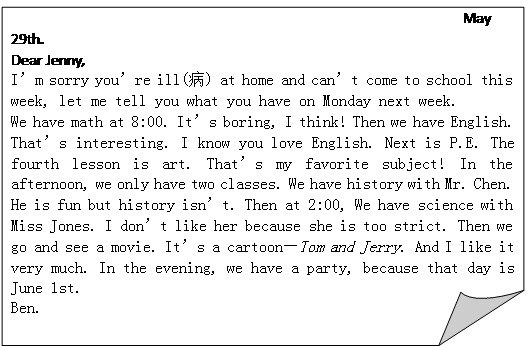
【小题1】 Mr. Chen is their _______ teacher.
| A.English | B.history | C.science | D.P.E |
| A.Three. | B.Four. | C.Five. | D.Seven. |
| A.P.E | B.art | C.English | D.math |
| A.a cartoon | B.a comedy | C.a thriller | D.an action movie |
| A.May 29th | B.Friday | C.June 1st | D.Saturday |