It was the last day of final examinations at a large college. On the steps of one building, a group of engineering students were discussing the exam that was ahout to begin. On their faces was confidence. This was their last exam before they graduated(毕业)and found jobs.
Some talked of jobs they already had,others of jobs they would get. With four years of college study,they felt ready and able to conquer(征服)the world.
The coming exam,they knew,would be easy. The professor(教授)had said they could bring any books or notes they wanted,but they couldn’t talk to each other during the test.
They walked into the classroom. The professor passed out the papers. The students’ smiles became wide as they saw that there were only five essay-type questions.
Three hours passed and the exam came to an end. Then the professor began to collect the papers. The students no longer looked confident. They seemed worried. No one spoke as the professor faced the class with the papers in her hand.
She looked at all the worried faces in front of her, and then asked,“How many students completed all five questions?”
Not a hand was put up.
‘‘How many of you answered four?” Still no hands.
“Three?Two?”The students moved restlessly in their seats.
“One,then. Certainly somebody finished one.”But the class stayed silent. The professor put down the papers.“That is just what I expected,”she said.
“I just wanted to make sure you realize that even though you have studied engineering for four years, there are still many things about the subject you don’t know. Instead of testing you on what you learned in this class, I’ve given you questions that skilled engineers face in the world outside the classroom. You can’t expect to be an expert(专家)on the day you graduate. You have to learn as you go.”
Then,smiling, she added,“You will all pass this course, but remember that your education has just begun.’’
【小题1】What does the underlined word“restlessly”mean in the passage?
| A.confidentIy | B.proudly | C.excitedly | D.nervously |
| A.To make the students realize that they still had much to learn after graduation. |
| B.To find out whether the students could put what they had learned into practice. |
| C.To show that she had much more knowledge than her students in engineering. |
| D.To examine whether the students learned what they had been taught in her class. |
| A.A Playful Joke | B.A Lucky Chance |
| C.A Strange Professor | D.A Special Exam |
The high school years are a key period. The things we learn during this time really shape our lives. Liu Changming, principal of Beijing No. 4 High School made 18 suggestions for students just starting high school on how to get the best out of high school. Here are ten of them.
1) Read 50 books. But choose them from ten different fields.
2) Help a person. Look for a classmate, an elderly person, in fact anyone who could benefit(获益)from your help. You’ll find you benefit too!
3) Research. Research a particular area, such as science, history or art.
4) Make a foreign friend. Try to befriend someone from a foreign country. It’s an ideal way to learn about a foreign country.
5) Publish(出版)an article. Whether it appears in a newspaper, your school magazine or in your own blog, an article will be something to look back on in pride in later years.
6) Take up a new sport. Choose one you’ve never played before. If you find you like it, you’ll have a hobby for life
7) Join a club. Work ing hard in a club or other activities will give you a life outside of your studies.
8) Find a part-time job. Try and do the job for at least a month.
9) Find a person to learn from. Choose someone with unusual experience or special talent. Try to learn all you can from him or her.
10) Learn to cook four Chinese dishes. Learning how to cook is not only a practical skill but a way of building a bridge to other people.
【小题1】 According to the passage, by making a foreign friend you can ______.
| A.learn about another culture | B.practice spoken English |
| C.discuss the international situation | D.share your happiness and sadness |
| A.to help your parents with housework | B.to kill time |
| C.to have communication with others | D.to make friends |
| A.You should read fifty books of the same field. |
| B.Do a part-time job for less than a month. |
| C.Try to publish an article to make you famous. |
| D.You can benefit a lot by helping others. |
| A.make contributions to society | B.achieve greet progress in high school |
| C.love high school life | D.finish high school |
To most of us, school means classes, teachers, schedules, grades and tests. But for the children at Sudbury Valley School in Massachusetts, school is very different. 
Firstly, there are no lessons. All the children, aged between 4 and 19, do whatever they want. There are no teachers, only “staff members”. The idea behind this is that you do not need to make children learn, because children want to learn anyway. “You do not need to say to a three-year-old, ‘Go explore your environment.’ You can’t stop them!”says Daniel Greenberg, a founder of the school. “But if you make children do what you want all day… they will lose all taste of learning.” At Sudbury Valley School, you will find children talking, reading, painting, cooking, working on computers, studying French, playing the piano, climbing trees, or just running around. Two boys spent three years just fishing!
The other way that Sudbury Valley School is different is that the children can decide the rules. Every week, there is a school meeting where both children and staff have one vote (投票)each—even the four-year-olds. They decide the school rules, how to spend the school money, and even which staff they want and do not want anymore.
When the school first opened in 1968, people said it would never work. But today, the school h as 200 students, and 80% of its students go on to college. Even the two boys who went fishing all the time have successful careers today. One of them is a musician and the other is a computer scientist.
【小题1】What's special about the school?
| A.There is nobody but students there. |
| B.All the students are of the same age. |
| C.There are no classes for the students. |
| D.There are no rules in the school. |
| A.They learn everything there from the staff members. |
| B.They grow up there without learning anything. |
| C.They spend all the time with their parents. |
| D.They do whatever they are interested in. |
| A.learn best when they are doing what they want |
| B.are too young to learn anything by themselves |
| C.can look after themselves without any help |
| D.can't go to college without any hard work |
| A.the writer doesn't like the idea of the school |
| B.the school is quite successful in its work |
| C.most of the parents don't believe in the school |
D.younger students learn bet ter there than older ones ter there than older ones |
A. family B. money C. lifestyle d. job
Children arc children after all, and most of them speak their mind. When they are just toddlers(幼儿), they are all lovely and lively. And it's so interesting to watch them speak like a grown-up. But as they grow, these same kids seem annoying and ill-mannered if they try to be a grown-up.
Conflicts(矛盾)go between parents and children. It's hard to tell who are right and who are wrong. A child of 7-8 always finds some reasons to have a conflict with it's parents. Whether it is about some toy, studies, a party or a company, there is always a difference between them. And it becomes worse when they answer you back. Scientists tell us that children should be treated with care. Yes, sure they should respect their elders.
We are partly responsible(有责任的)for this. At an early age we encourage children to behave like adults, just because we find it funny. The kids on the other hand consider this same behavior as normal and get used to it. And when it is not funny for us any more, we expect them to stop it, but by then it is already too late. Only when they reach a certain maturity will the children realize that answering back and being rude are not acceptable(可接受的).Until then, most of the time their behavior is difficult to change, unless by force(暴力).And use of force is against the every good idea, as it weakens the child's confidence.
So it is one thing to bring a child into this world but quite another to make them into well mannered citizens. The best way is to be a goo d example ourselves, as our children are the mirrors of us adults.
【小题1】_______are all lovely and lively.
| A.Children | B.Toddlers | C.Kids | D.Grown-ups |
| A.fathers and mothers | B.parents and children |
| C.parents and toddlers | D.parents and parents |
| A.学期 | B.阶梯 | C.知识 | D.成熟 |
| A.Answering back . | B.Being rude. |
| C.Using force. | D.Respecting elders. |
| A.Children often copy what their parents do. |
| B.Children can not change their behavior. |
| C.Children's behavior develops in their own way. |
| D.Children's behavior is not acceptable. |
| A.to show the importance of good examples |
| B.to give examples on educating children |
| C.to show the growth of children |
| D.to show the behavior of children |
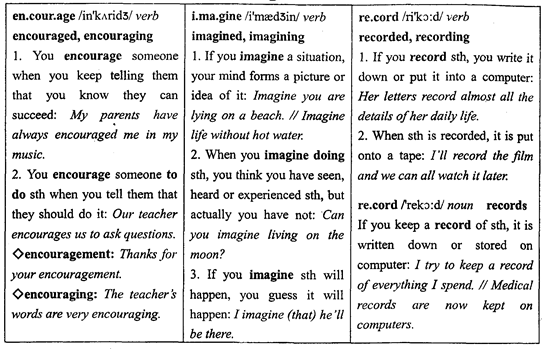
【小题1】We may see this in a _______.
| A.newspaper | B.magazine | C.textbook | D.dictionary |
| A.encourage | B.record | C.imagine | D.encouragement |
| A.Three. | B.Four. | C.Five. | D.Six. |
The word "record" in the above sentence has the same meaning as in "_______".
| A.I try to keep a record of everything I spend. |
| B.Medical records are now kept on computers. |
| C.I'll record the film and we can all watch it later, |
| D.Her letters record almost all the details of her daily life. |
Homework should be done as soon as you get home from school. If you have after-school activities, the homework should be done first. At the same time, it is fine to allow(允许)for a snack break and also to allow for stretching(拉伸的)breaks.
Also, you should remember that it is your duty to do your homework. Next time, when you want to depend on(依靠) Mom and Dad for help, please try to find the answer yourself, because you will learn much, much more that way.
When you have a question, especially something about a science or math, don’t always turn to your teacher! It is a good idea to try to find the answer yourself. If this doesn’t work, you can also look at the materials in the back of the book. They may guide you to the pages you should look at to help you understand the problem.
Finally, while doing homework, don’t think about or do other things. Keep working. Setting a time limit(限制) often helps with this. Different ages decide different amounts of time. 10-15 minutes is good for a child that’s aged 6-8. A time of 20-30 minutes is about right for a child aged 9-12. Kids can keep studying for 30-45 minutes from the ages of 13 to 15. This, of course, depends on your abilities to pay attention and stay on tasks.
【小题1】In the first paragraph, the writer mainly tells us that ______.
| A.doing homework is the first thing you should do at home |
| B.after-school activities can’t affect doing homework |
| C.parents can help kids with their homework at night |
| D.kids need a good rest after school |
| A.students should ask the teacher more questions |
| B.thinking over the questions before asking others is important |
| C.problems can’t be solved without a teacher’s help |
| D.students shouldn’t always look at the materials in the back of the book |
| A.not to look away while doing homework |
| B.to do homework by themselves |
| C.not to turn to teachers when doing homework |
| D.to do their homework quickly and in the right way’ |