阅读短文,根据短文内容,从短文后的五个选项中选出能填入空白处的最佳选项。选项中有一项为多余选项。(共8分,每小题2分)
|
|

Earth Hour started in Sydney on March 31st, 2007. It calls on families and buildings to turn off the lights from 20:30 to 21:30 on the last Saturday night of March. In 2007 more than 2.2 million homes and businesses turned off their lights. 60 And it was supported by 50 million people from thirty-five countries. On March 28, 2010 over 2100 cities in another eight countries took part in it. 61
In 2012 in China, there were many cities taking part in this activity, especially some large
cities, such as Beijing, Shanghai.... In those cities, many people turned off lights in the hour. 62 In colleges some students held some activities to make all the students leave their dormitories.
It was 20:30, Beijing time. In Beijing some people were taking a walk with their
families or friends. 63 And in Ningbo some young people were holding a party in a park,
singing and dancing. The people from the three cities felt very relaxed.
Earth Hour has a variety of activities, but the final goal is the same. That is focusing on (聚焦) climate change and protecting the environment for individuals.
| A. Many people would feel bored without lights. B. Earth Hour came to China on that day, too. C. And without lights, they could also enjoy themselves. D. In Shanghai some people were having a nice talk with their friends. E. A year later, on March 29, 2008 Earth Hour became a global activity. |
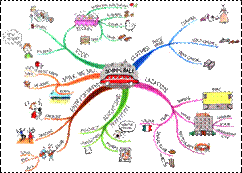 Tony Buzan’s grades were going down at university. Disappointed with his low marks, he went to the library to find a book on how to use his brain. He was directed to the medical section. Confused, he said to the librarian, “I don’t want to take my brain out, I just want to learn how to use it.” Her reply was simple: “There’s no book on that.”
  ter, Buzan has become the world’s leading speaker on the brain and learning. In the late 1960s, he invented the mind map, a visual representation of thought processes.
Stay as safe as possible during an earthquake. Be aware that some earthquakes are actually foreshocks(前震) and a larger earthquake might occur. Reduce your movements to a few steps to a nearby safe place.
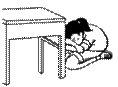
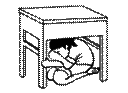
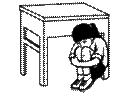
If you are indoors, do “duck, cover and hold”. Duck or drop down to the floor, under something strong, such as a table or a desk, cover your head and face with your arms and hands and hold on to that table or desk so that it does not move away from you as the ground shakes. Do this until the shaking stops and it is safe to move. Stay inside to avoid being injured by falling glass or building parts. If there isn’t a table or desk near you, cover your face and head with your arms and crouch(蜷缩) in an inside corner of the building.
Stay clear of windows, fireplaces, and heavy furniture that may fall over. Stay inside until the shaking stops and it is safe to go outside. Research has shown that most injuries occur when people inside buildings attempt to move to a different location inside the building or try to leave.
If you are outside, get into the open and stay there. Move away from trees, buildings, signs and power lines. Once in the open, stay there until the shaking stops. The greatest danger exists directly outside buildings, at exits and alongside exterior walls. Ground movement during an earthquake is seldom the direct cause of death or injury. Most earthquake-related casualties(伤亡) result from collapsing walls, flying glass, and falling objects.
If you are driving, you may not realize what is going on at first because the car may feel like it is going to blow up. Stop the car in as clear and open an area as possible and stay in it until the shaking stops. If it is a really bad quake, turn on the radio to find an emergency channel to get information. Follow the directions of people directing traffic.
If you are in a mountainous area, watch out for falling rock and other debris that could be loosened by the earthquake.
If you are at the beach, move quickly to higher ground or several hundred yards inland.
53. Which of the following pictures means “duck, cover and hold”?
|
|
|
|
|
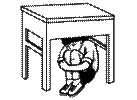
A B C D
54. Which of the following statements is TRUE according to the text?
A. Ground movement during an earthquake is the main reason of death.
B. You should keep your windows, fireplaces and heavy furniture clear.
C. Stop your car in the clear area and get out of it if an earthquake happens.
D. Run away from the beach as quickly as possible if an earthquake happens.
55. The passage is mainly about ___________during the earthquake.
A. ways of keeping you safe B. the importance of keeping safe
C. ways of finding safe places D. researches on how to keep safe
|
|
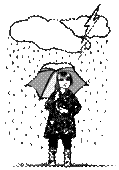
A little girl walked to and from school every day. Though it was not fine and clouds appeared in the sky that morning, the little girl made her daily trip to school as usual. When school was over, winds became stronger and it began to rain.
The mother of the little girl felt worried that her daughter would be afraid and that lightning might frighten(惊吓) her child. Following the bright light of lightning, the mother quickly got into her car and drove to her child’s school.
As the mother drove along the road, she saw her little girl walking alone in the rain. To her great surprise, she found that when a lightning came, her daughter stopped, looked up and smiled. Another lightning came and then another followed. With each lightning, the little girl stopped, looked up and smiled.
Inside the car, the mother asked her daughter, “What were you doing? Why did you look up and smile when the lightning came?” The little girl answered with a smile, “Mum, you know, God was looking at me. Each time I felt a little afraid walking in the rain, God would take a picture of me. I knew he was playing a game with me.”
50. The little girl went to school __________ every day.
A. by car B. on foot C. by bus D. by bike
51. At first, the mother felt worried because .
A. she couldn’t look after her daughter
B. her daughter hadn’t taken her umbrella
C. she had something more important to do
D. her daughter might be afraid of lightning
52. According to the article, we can know that the little girl was .
A. proud B. shy C. brave D. nervous