阅读下面的短文,并完成短文后的任务。

Draw a giraffe in your mind. How did you draw your giraffe? Does it have a long neck? Does it have long legs? Is it really tall? When people think of giraffes, they think of their long necks. A long neck and four long legs make the giraffe the tallest land animal on earth. A giraffe is 1.8m tall when it is born, and some giraffes get up to 6m tall when they are all grown up

  座 号

 
But did you know that giraffes also have long tongues? Have you seen the tongue of a giraffe before? A giraffe has a very long tongue which can hold and wrap (包) around objects. The tongue is designed for feeding, but it can be used in many different ways. For example, a giraffe can close its nose with its long tongue completely to keep out sand and dust. Also, a giraffe’s tongue is long enough to clean its owner’s ears as well!

The tongue is black in colour to protect it from getting sunburnt (晒伤). It is nearly 56cm long. Giraffe only eat plants, and a full grown giraffe can eat 33kg of leaves a day. When giraffes look for some tall trees to eat, they sometimes fight with elephants for food. Giraffes use their tongue to eat leaves from some tall trees. The giraffe’s tongue is a helpful tool for reaching leaves and breaking off branches.

任务一:根据短文内容回答下列问题。(注意:每题答案不超过10个单词)

86. What is this article mainly about?

_________________________________________________________________________

87. What does a giraffe feed on?

_________________________________________________________________________ 

88. What color is the tongue of a giraffe? Why?

________________________________________________________________________ 

89. Give two examples of the use of the giraffe’s tongue.

(1) ___________________________________ (2) __________________________________

任务二:将文中划线的句子翻译成汉语。

90. ________________________________________________________________________

根据短文内容,用方框中所给词语的适当形式填空,使文章通顺、完整。(每词限用一次)

first,  use,  be,  another,  buy,  open,  whenever,  talk,  but also,  touch

“Thank you” is widely                 (76) in a modern society. It is a very good manner. You should say “Thank you”                 (77) others help you or say something kind to you. For example: when someone                 (78) the door for you, when someone says you have done your work well, when someone says you have                 (79) a nice shirt, or your city                 (80) very beautiful, you should say “Thank you”. “Thank you” is used not only between friends,                 (81) between parents and children, brothers and sisters, husbands and wives.

“Excuse me” is                 (82) short polite usage. We use it as the same as “Thank you”. When you hear someone say so behind you, you’d got to know that somebody wants to walk past you without                 (83) you. It is not polite to interrupt (打断) others while they are                 (84). If you want to have a word with one of them, please say “Excuse me”                 (85), and then begin to talk. You should also do so when you want to cough or make any unpleasant noise before others. Let’s say “Thank you” and “Excuse me” on the right occasion. 

The Piccadilly line to Heathrow (伦敦西斯罗机场) is not only the fast way to travel but also the cheapest. So the next time you’re flying to Heathrow, make sure you fly Piccadilly line.

Your Piccadilly flight features (特点):

l       Departures (发车) from 36 stops on the Piccadilly line, or from over 200 stations only one change way

l       Service every 5 minutes to and from Heathrow throughout the day

l       Journeys from central London taking less than 50 minutes

l       Only £3.70 for a single adult fare (费用)

l       See tables below for journey times                                                                                           

Fares to and from London

Adult single £3.70

Child single £1.50

If you are traveling as a group, then you are allowed to use the family travel card, which means each adult can travel for £3.40, and each child for £0.80.

Traveling to Heathrow

Monday - Saturday

Sunday

From

Journey

time

Frequency

(频率)

First

train

Last train

First train

Last train

Earls Court

39mins

5mins

05:55

00:43

07:15

23:49

Piccadilly Circus

49mins

5mins

05:45

00:32

07:05

23:38

Traveling from Heathrow

Monday - Saturday

Sunday

To

Journeytime

Frequency

First train

Last train

First train

Last train

Earls Court

34mins

5mins

05:13

23:49

05:57

23:30

Piccadilly Circus

45mins

5mins

05:13

23:49

05:57

23:30

66. At what time does the first train leave Earls Court on Sunday?

A. 07:15                  B. 05:55                C. 05:13                       D. 05:57

67. If your father wants to take the train, how much should he pay?

A. £1.50                  B. £3.40                C. £3.70                             D. £5.20

68. If you miss a train, how long will it take to wait for another?

A. 39 minutes          B. 49 minutes         C. 50 minutes               D. only 5 minutes

69. The last train to Piccadilly Circus on Wednesday leaves at ______.

A. 00:32                  B. 00:43                C. 23:49                       D. 23:30

70. If you travel with your mum and dad as a child, what is your best choice?

A. All pay full fare.                               B. Use the family travel card.

C. Each pay for his or her own.             D. Look for free tickets.
What does it feel like to break a bone (骨头)? It’s different for everyone, but the pain is often sharp (严重). If the break is small, however, the person may not feel much pain at all. If you think that you or someone else has broken a bone, the most important things to do are to stay calm, make the hurt person comfortable, and call the doctor. Do not move the injured body part since movement could make it worse.

To treat the break, the doctor will need to take an X-ray. This gives the doctor the information he or she needs to set (接上) the bone: to put it back to its normal place. If the bone is large or it is broken in more than one place, the doctor may need to use metal pins (钢钉) to set it. After the bone has been set, the next step is usually putting on a cast, the special, hard thing that will keep the bone in place for a month or two.

Your bones are excellent at healing themselves. Broken bones will produce many new cells (细胞) and tiny blood vessels (血脉). These cover both ends of the broken part, and close up the break until the bone is as whole and strong as before.

61. Which of the following is the best title for the passage?

A. How to Know if a Bone is Broken

B. How Broken Bones Heal Themselves

C. Common Causes (原因) of Broken Bones

D. What You Should Know about Broken Bones

62. When someone breaks his bone, the following should be done except ______.

A. asking the doctor for help      B. comforting the hurt person      

C. moving the injured part         D. staying calm

63. Which is the correct order to treat the break?

  a. take an x-ray b. use metal pins to set it c. put it back to its normal place d. put on cast

A. a→b→c→d   B. a→c→b→d    C. a→d→c→b       D. d→a→b→c

64. The underlined word “heal” in Paragraph 3 is closest in meaning to “______”.

A. break again     B. become worse C. wound or hurt     D. become healthy again

65. Where would you probably read this passage?

A. In a story book. B. On a poster.   C. In a health care book.    D. In a chemistry book.

A group of people asked this question to a group 4-to-8-year-old children. “What does love mean?” The answers were surprising. The children would answer like they did below.

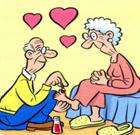
“When my grandmother hurt her knees (膝盖), she couldn’t bent (弯腰) over and paint her toenails (脚指甲) any more. So my grandfather does it for her all the time, even when his hands hurt too. That’s love.”

                         Rebecca–age 8

“Love is when someone hurts you. And you get so mad but you don’t shout at them because you know it would hurt her feelings.”

                       Samantha–age 6

“Love is what makes you smile when you’re tired.”

                       Terri–age 4

“I let my big sister pick on (捉弄) me because my mum says she only picks on me because she loves me. So I pick on my baby sister because I love her.”

                       Bethany–age 4

“I know my older sister loves me because she gives me all her old clothes and has to go out and buy new clothes.”

                       Lauren–age 4

“Love is when Mommy gives Daddy the best piece of chicken.”

                       Elaine–age 5

“My mommy loves me more than anybody. You don’t see anyone else kissing me to sleep at night.”

                       Clear–age 5

“You really shouldn’t say ‘I love you’ unless you mean it. But if you mean it, you should say it a lot. People forget.”

                       Jessica–age 8

56. The passage mainly tells us about ______.

A. what “life” means to children      B. what “family” means to children

C. what “friends” means to children       D. what “love” means to children

57. Who told us the love between mum and dad?

A. Clear.         B. Elaine.        C. Rebecca.          D. Lauren.

58. Which of the following is NOT true?

A. Rebecca’s grandmother ever couldn’t bend over.

B. Bethany is willing to be picked on by any other person.

C. If Samantha becomes angry, she will not shout at others.

D. Lauren prefers to wear her sister’s old clothes.

59. What does Jessica mean about love?

A. Too much love is no love.         B. You should say love more often.  

C. You mean what you think.        D. Say love more often if you have it.

60. What is love according to Terri?

A. Love is the care between husband and wife.      

B. Love is a rest when you are tired.

C. Love is what cheers you up when you are tired.   

D. Love is a kiss from parents.

A teacher stood in front of his history class of twenty students just before handing out the final exam. His students sat quietly and waited for him to speak.

“It’s been a pleasure teaching you this term,” he said. “You’ve all worked very hard, so I have a pleasant surprise for you. Everyone who chooses not to take the final exam will get a ‘B’ for the course.”

Most of the students jumped out of their seats. They thanked the teacher happily, and walked out of the classroom. Only a few students stayed. The teacher looked at them. “This is your last chance,” he said. “Does anyone else want to leave?” All the students there stayed in their seats and took out their pencils.

The teacher smiled. “Congratulations (祝贺),” he said. “I’m glad to see you believe in yourselves. You all get A’s.”

51. This story most probably took place    .

A. at the beginning of the term        B. in the middle of the term

C. at the end of the term            D. at the beginning of the school year

52. Most of the students got Grade ______.

A. ‘A’           B. ‘B’          C. ‘C’          D. ‘F’

53. Why did some students stay in their seats?

A. Because they wanted to take the exam.

B. Because the teacher told them to stay in their class.

C. Because they were afraid to leave.

D. Because they didn’t have anything to do.

54. The teacher gave the students who stayed in the classroom A’s because ______.

A. the teacher liked them

B. they were cleverer than the other students

C. they believed in themselves

D. they studied hard

55. The underlined word “them” in Paragraph 3 refers to “______”.

A. students staying in their seats   B. students leaving the classroom

C. their seats                  D. all the students


Jack  41 in a small town in England. He always stayed in England 42  his holidays, but last year he thought, “I’ve never been to  43 countries. All my friends go to Spain,  44   they like it very much, so this year I’m going there, too.” So he got on a  45 to Spain and  46 at the airport of the capital, Madrid, and stayed in a hotel for a few days. On the first morning he went  47 for a walk. In England people drive on the left, but in Spain they drive on the right. Jack forgot about this, and  48 he was walking on a busy street, a bicycle knocked him down.

Jack  49 on the ground for a few minutes and then he sat up and said, “Where am I?”

Just then an old man selling maps went past him. When he heard Jack’s words, he said to him  50 , “Maps of the city, sir?”

41. A. flew          B. lived         C. went        D. dropped

42. A. for           B. off        C. with            D. into

43. A. all                B. both         C. other         D. any

44. A. and              B. but          C. though          D. however

45. A. bus           B. plane         C. train         D. bike

46. A. reached        B. left          C. arrived           D. stayed

47. A. down         B. up           C. away         D. out

48. A. before         B. while         C. since         D. after

49. A. lay               B. stood        C. fell          D. jumped

50. A. once again      B. on time       C. at times       D. at once

 0  21392  21400  21406  21410  21416  21418  21422  21428  21430  21436  21442  21446  21448  21452  21458  21460  21466  21470  21472  21476  21478  21482  21484  21486  21487  21488  21490  21491  21492  21494  21496  21500  21502  21506  21508  21512  21518  21520  21526  21530  21532  21536  21542  21548  21550  21556  21560  21562  21568  21572  21578  21586  159627 

违法和不良信息举报电话:027-86699610 举报邮箱:58377363@163.com

精英家教网