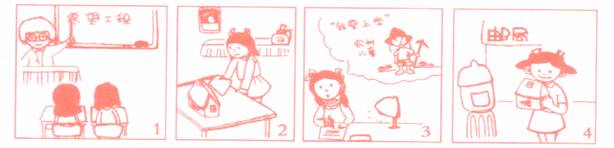
(一)交际应答。录音中有五个句子,每个句子听一遍,然后从每小题A、B、C中选出能对每个句子做出适当反应的答语。

1.A.Yes, please.                    B.Good idea.                        C.Of course, it is.

2.A.Certainly you are.           B.Sure. Hold on, please.        C.I’ll do that.

3.A.Oh, they are over there.  B.I’m glad you’ve found it.   C.Go straight and turn left.

4. A.OK, I wil.                            B.Yes, I think so.                  C.Good for you.

5.A.Never mind.                   B.You are welcome.                     C.I’m sorry.

(二)情景反应。录音中有五组对话,听对话两遍后,从每小题A、B、C中选出能回答所给问题的正确答案。

6.When will Mrs White come back?

A.Right now.                       B.Quite soon.                       C.At four.

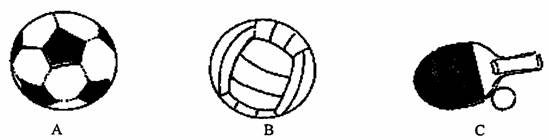
7.What sport does the woman like?


8.What does the woman prefer to do?

A.To see the new play.                 B.To do some shopping.               C.To visit the museum.

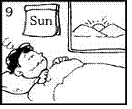
9.What are the man and woman doing?

A.They are looking for a CD player in a shop.                  

B.They are learning how to press the button.

C.The man is teaching the woman how to use the CD player.

10.Why was Frank on the news last night?

A.He walked along the beach at night.

B.He swam alone in the cold water.

C.He got the boy out of water and saved him.

(三)对话理解。录音中有一段对话,听对话两遍后,从每小题A、B、C中选出能回答所给问题的正确答案。

11.Where could the dialogue happen?

 A.In a shop.                       B.In a library.                       C.In a hospital.

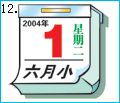
12.Why did the young man go to see the doctor?

A.He didn’t know where to begin his talk.

B.He felt difficult to fall asleep.

C.He felt unhappy most of the day.

13.How long has the young man been ill?

A.For about two years.                B.For about three weeks.                    C.For about six months.

14.In what season did the young man feel worse?

A.In Spring.                                B.In Autumn.                              C.In winter.

15.What did the doctor ask the young man to do?

A.To take some medicine.            B.To burn away his worries.         C.To take more exercises.

(四)短文理解。录音中有一篇短文,听短文两篇后,从每小题A、B、C中选出能回答所给问题的正确答案。

16.What happened to the three boys in a cold day?

A.They lost their way.

B.They couldn’t find the big house.

C.They had to spend the night in the open air.

17.What did the three boys ask the farmer to do?

A.To give them some water and food.

B.To let them stay in his house for a night.

C.To tell them the way to walk out of the forest.

18.Why did one of the boys have to sleep in the big house?

A.The farmer didn’t like the third boy.

B.One of the boys made a loud noise when he slept.

C.There wasn’t enough room in the farmer’s house.

19.Who was the first to sleep with the horses?

 A.Mike                              B.Jack                                        C.Tom

20.Why were all the horses outside at the house door?

A.Because someone drove them out of the house.

B.Because the smell in the big house was really terrible.

C.Because the horses didn’t like to stay with people at night.


Liu Xiang was the first Asian to win the men\'s 110m hurdles (跳栏) at the Olympic Games in Athens. After that he became an idol(偶像) to the young people.
When Liu Xiang crossed the finish line far ahead of the other players,  in a world record-equaling time of 12. 91 seconds, many fans burst into tears. It was Liu\'s first Olympics and he won the gold medal.
"I never thought I could run under 13 seconds, and I never thought I would break the Olympic record, "said Liu in tears, "I am very, very excited. This is a wonder. I\'m proud not just for myself
and for Chinese but for Asia. My race went wonderfully from start to finish. Liu added,  It is an amazing(惊奇的) experience being the Olympic champion. I want to thank my coach and my friends for all their help. I think today we Chinese have showed the world we can run as fast as anybody else. "
When Liu was a grade four student in a primary school,  he was chosen by the Junior Sports School of Putuo District in Shanghai to practice jumping. But when a bone test showed he would not become a tall man,  Liu was asked to give up practising after one year although he had won the national championship for his age group. Liu\' s parents also wanted him to give it up and study more at school,  but Liu decided to continue practising jumping.
In 1998 when Liu Xiang,  aged 15,  met the famous coach Sun Haiping,  his career changed greatly. Sun believed Liu Xiang was a rising star and after visiting Liu\'s parents sev¬eral times,  finally he persuaded them to let Liu practice the 110m hurdles.
Since his return from Athens,  Liu Xiang has been at the centre of a media circus(媒体焦点). He has been to many press appearances and meetings. After Liu got the gold medal,  he became well known all over the world. But Liu thinks 2004 is just the beginning,  and he ex¬pects to be at his peak(顶峰) in the sunmmer games in Beijing in 2008. Liu Xiang said,  "For some players,  it\'s just a job. For me, it\'s what I love. "
   1. At what age did Liu Xiang win the Olympic championship?
        A. 12         B. 15        C. 21        D. 22
   2. What does the underlined word "persuaded" mean in Chinese?
       A.支持      B.说服    C.教育    D.阻止
    3. Why did Liu Xiang give up jumping? Because________.
       A. a bone test showed he wouldn\'t become tall enough to be a high jumper
       B. his parents stopped him from jumping
     C. he was satisfied(满足) after winning the national jumping champion for his age group
      D. the famous coach Sun Haiping changed his and his parents\' ideas
   4. What does Liu Xiang think of being a sports player?
        A. It is just a job for him.          B. It can bring him a lot of money.
        C. It is what he loves.             D. It can bring him a lot of honour(荣誉).
   5. From the story,  we know that________.
       A. Liu Xiang was not the first Chinese to win the sprint(疾跑) gold medal in Athens
       B. if Liu Xiang reached the finish line in 13 seconds, he would break the world record
       C. the Chinese people can run as fast as the people in the other country
       D. Liu Xiang didn\'t want to take part in the Olympic Games in 2008


On Sunday morning, a strong earthquake hit Indonesia and then big tsunamis(海啸) followed. They soon went on to other countries in the south and southeast Asia as well as East Africa.
Tsunamis are especially dangerous for children. By Wednesday,  nearly 60 000 people died because of the tsunamis. 30% of them were children,  and most of them were 5 to 12 years old.
In open seas tsunamis are only one or two metres high. When they are near land, they are as high as 10 metres,  Houses and cars near the sea can be taken away by these big waves. Because tsunamis move fast and can travel to another side of the sea within one day, they may affect(影响)a lot of places.
The Pacific Ocean(太平洋)has a lot of strong tsunamis because of the size of the ocean and large earthquakes there. China doesn\'t see tsunamis often because its sea floor is quite flat(平的). Islands around China also help the country avoid from them.
What should you do when there\'s a tsunamis? Move to a safe place. If you are near the sea and you feel the earth shake, move to higher ground. Stay away from rivers and streams(溪流).
Reported by "China Daily" on Friday, December 31st, 2004.

1. The big Asian tsunamis first happened________.

A. on Friday morning               B. on the morning of December 26th
C. on December 31st, 2004          D. three days ago

2. Which places did the big tsunamis hit?
A. All the coastal(海岸的) countries.
B. Only in Indonesia and Sri Lanka.
C. South and southeast Asia as well as East Africa.
D. Vietnam(越南)and India.

3. Why does the Pacific Ocean have a lot of strong tsunamis?
A,  Because there are few islands in the ocean.
B,  Because of the strong wind on the sea.
C,  Because there are many Asian countries around the Pacific Ocean.
D. Because of the large earthquakes and the size of ocean.

4. Which of the following is wrong?
A. In open seas tsunamis are one or two metres high.
B. Tsunamis can\'t travel to another side of the sea within 24 hours.
C. Most of the children who died in tsunamis were under 5-12 years old.
D. China\'s sea floor is quite flat and tsunamis seldom happen.

5. You should________ when there\'s a tsunamis according to the passage.
A. listen to a weather report
B. try to find out what will happen
C. run to the policeman for help
D. get to a higher and safer place as soon as possible

听力测试

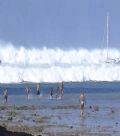
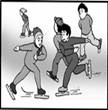
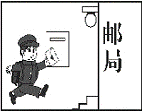
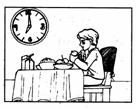
(一)听句子,选择与画面一致的选项。每个句子听一遍:

1. ( A  B  C )        2. ( A  B  C )      3. ( A  B  C  )      4. ( A  B  C  )

(二)、请听句子,选出恰当的答语。每个句子听一遍:

(    )5. A. It’s Sunday.            B. It’ April 21.                           C. It’s half past eleven.

(    )6. A. It’s very hot.           B. It’s very heavy.          C. It’s very large.

(    )7. A. Yes, please.              B. You are welcome.      C. Sorry, I can’t.

(    )8. A. No, it isn’t.             B. Yes, it is.                   C. Thank you.

(    )9. A. About 40 minutes.                

B. About half an hour’s walk.

         C. About 5 meters long.

(    )10. A. I think it is interesting.

B. I like a story. 

C. I’m reading.

(三)听对话,宣战正确答案。每组对话听两遍。

(    )11. When was Edison born?

A. In 1874.  B. In 1931.  C. In 1847.

(    )12. Why wasn’t the boy at school yesterday?

A. He had to look after his mother.

B. He had to look after his father.

C. He was ill in bed.

(    )13. What’s the woman’s telephone number?

A. 3897244.  B. 3879224.  C. 3789244.

(    )14. Why was the girl late again for school?

A. She was ill.  B. She got up late.  C. She met a traffic accident.

(    )15. When does the dialogue happen?

A. During class.  B. After class.  C. Before class.

(    )16. What does the girl’s mother do?

A. A nurse.  B. A doctor.  C. A worker.

(    )17. What size does the man wear?

A. The large size.  B. The small size.  C. The medium size.

(四)对话理解: 对话听两遍:
听第一段对话,回答第18-21小题。
(    )18. What’s wrong with the boy?
     A. He’s got a headache. B. He’s got a high temperature.
     C. He’s got a cold.
(    )19. How long has he been like this?
     A. For one day. B. For two days. C. For three days.
(    )20. Is he seriously ill?
      A. Yes, he is. B. Yes. But he will be well soon. C. No, he isn’t.
(    )21. How many times should he take the medicine a day?
      A. One time. B. Two times. C. Three times.
听第二段对话,回答第22-25小题。对话听两遍:
(    )22. Where does the man want to go?
      A. London. B. Hong Kong. C. America.
(    )23. When will he go there?
      A. June 29th. B. June 30th. C. July 1st.
(    )24. When will the earliest flight leave?
      A. At 7:00 in the evening. B. At 8:00 in the morning.
      C. At 7:00 in the morning.
(    )25. Does it stop in Beijing?
      A. Yes, it does. B. No, it doesn’t. C. We don’t know.
(五)听短文回答问题,短文听两遍。
(    )26. Where did Mr. White work?
      A. France. B. America. C. England.
(    )27. Why was Mrs. White angry?
      A. Her husband wouldn’t go to see their son.

B. Her husband was hit by a car.

C. Her husband didn’t love her.
(    )28. How did Mr. and Mrs. White go to Paris?
      A. By ship. B. By train. C. By plane.
(    )29. Mr. White didn’t know how they had got to Paris because _____ on their way.
      A. he was asleep

B. he was thinking about his work

C. he was worried about his son
(    )30. From this passage we know_____.
      A. Mr. White loved nobody except himself 

B. Mr. White couldn’t get on well with anybody

C. Mr. White was always interested in his work

听力测试

(一)听句子,选择与画面一致的选项。每个句子听一遍。

1. ( A  B  C )      2. ( A  B  C )      3. ( A  B  C  )    4. ( A  B  C  )

(二)请听句子,选出恰当的答语。每个句子听一遍。

(    )5. A. It’s my pleasure.                  B. I’m sorry to hear that.            C. Never mind.

(    )6. A. I’m not sure.                      B. Yes, please.                                                   C. That’s too much.

(    )7. A. Nice to meet you.               B. See you later.                        C. What a good idea!

(    )8. A. Yes, I agree with you.           B. Certainly, This way, please     

C. Yes, it’s very nice of you.

(    )9. A. What are you going to do?

B. I think so. Why?

C. Oh, what shall I do?

(    )10. A. It’s cheaper than yours.                   B. Fifty yuan.                 C. It’s expensive.

(三)对话问答:选择正确答案对话听两遍。

(    )11. Who is going to visit her friends this afternoon?

A.   Betty.  B. Betty’s sister. C. Bob’s sister.

(    )12. Why did the girl get up so early?

A.To catch the early bus.

B. To prepare for an English exam.

C. To prepare for a math’s exam.

(    )13. Where was the man last Sunday?

A. He was with his friend.  

B. He took a walk with his friend.

C. He went shopping with his friend.

(    )14. Where does the dialogue take place?

A. In a classroom. B. In a store.  C. In a computer room.

(    )15. What’s the woman?

A. A shop assistant.  B. A librarian.  C. A customer.

(    )16. When does the dialogue probably happen?

A. In the morning.  B. In the evening   C. At 7:45 a.m.

(    )17. What place is the woman looking for?

A. A hotel.  B. A cinema.  C. A hospital.

(四)对话理解:
听第一段对话,回答第18-21小题。对话听两遍。
(    )18. What are they talking about?
        A. The moon. B. Animals. C. Plants.
(    )19. How far is the moon away from the earth?
        A. Three hundred metres.
        B. Three hundred and eighty thousand kilometres.
        C. It’s not very far
(    )20. Why can nothing live on the moon?
        A. People don’t like to live there. B. There’ no air or water.
        C. There’s no light.
(    )21. What’s the weather like tonight?
        A. Cloudy. B. Rainy. C. Clear.

听第二段对话,回答第22-25小题。对话听两遍。
(    )22. Where are they talking?
        A. At home. B. At the cinema. C. At a shop.
(    )23. How much rice did the man buy?
        A. One bag. B. Two bags. C. One bottle.
(    )24. How many kinds of things did the man buy?
        A. Four. B. Five. C. Three .
(    )25. How much did all the things cost?
        A. $13. B. £300. C. $30.

(五)听短文回答问题,短文听两遍。
(    )26. Where was the telephone?
       A. It’s in London’s school.                     B. It’s in her office.                        C. It’s in her home.
(    )27. Who made the first telephone call?
       A. A man.                                 B. Linda’s father.           C. Linda’s mother.
(    )28. How many telephone calls did the man make in the story?
       A. One.                                    B. Two.                                                            C. Four
(    )29. Who made telephone call three minutes later?
       A. The man.                             B. Linda’s father.           C. Linda’s mother.
(    )30. How many persons are there in the story?
       A. Two.                                               B. Three.                                              C. Four.

Korean culture is really exciting right now. The Korean Wave is sweeping Asian countries including China. Young people are going crazy about Korean TV dramas, Korean pop songs, taekwondo(跆拳道)and the Korean language.

The Korean Wave started a few years ago with the TV series “Winter Sonata”. This love story is still popular. People, especially girls, like the beautiful story and handsome actors like Bae Yong Jun (裴勇俊).

In the music world, Korean girls are making themselves heard in China. You can often find big Korean names like Baby Vox, S. E. S and Finkle at the top of the Chinese music charts (排行榜).

The Korean Wave has also made young people want to try the clothes and hairstyles of pop stars, too. Not only that. Now some girls in China are having plastic surgery(整容)to change the way they look. People say some beautiful Korean stars have had plastic surgery. These stars don’t make plastic surgery look shameful(丢面子的).

Are all the faces of beautiful Korean girls not real? Find out for yourself when you next visit South Korea.

1. What does the Korea Wave refer to? It refers to         .
A. Korean TV dramas                           B. Korean culture
C. Korean language                            D. Korean actors

2. When did the Korean Wave start? It started with         .
A. the Korean pop songs                        B. Taekwondo
C. the TV series “Winter Sonata” D. the Korean food

3. Who is the famous actor in Korean dramas?
A. Bae Yong Jun    B. Baby Vox     C. S. E. S        D. Finkle

4. Korean stars often change their looks by         .
A. singing pop songs                           B. acting in TV dramas
C. trying different food                D. having plastic surgery

5. Which of the following is NOT true according to the passage?
A. Winter Sonata tells a very famous love story.
B. Young people like Korean pop stars’ clothes and hairstyles.
C. Chinese girls also want to try plastic surgery.
D. Korean pop stars think plastic surgery is shameful.

先阅读短文,然后从短文后每小题的A、B、C、D中选出最佳答案。

    Do you need money? Write a 1etter to Mr.Percy Ross. he will give you some money.

Mr.Ross is a   2  man,and he likes to give people money.   3   does he give people money? People write letters to Mr. Ross. In their letters, they tell him why they need money. Mr. Ross gets 12,000 letters a week. He and his 12 assistants  4   all of the letters.Then Mr.Ross sends money to  5  of the people., Who can get money from Mr.Ross sends usually money to old people.sick people and poor children.A mother wrote  Mr.Ross,“I have two daughters,ages one  6  eight.I give the baby one bottle of milk every day.I want to give her two bottle  milk every day.  7  I don,t have enough money.I also want to give my  8  daughter ice cream sometimes.Can you help me?”Mr.Ross sent thea check.“This check will buy much more than milk and ice cream。”he wrote.

Who  10  get money from Mr.Ross? Mr.Ross usually doesn’t send money to  young,healthy people.A 16一year—old boy wrote,“I need$900 to buy a good used  car.I really need it because I 1ike a girl.She doesn't like me 11  I don,t have a car.”Mr.Ross wrote the boy,“You don't 12  a car.You need a different girlfriend.’’   13  does Percy Ross give people money?  When Mr.ROSS was a boy。he was  very  14  .He worked hard,and now he is a successful businessman.He wants to  15  poor people.And Mr.Ross is getting older.He wants to give all of his money  away before he dies.He says。“Who will get my money? I want to decide.”

1.A.And       B.Maybe     C.For sure        D.So

2.A.rich       B.poor       C.young          D.hardworking

3.A.When     B.Why       C.Where          D.How

4.A.read       B.write      C.return           D.1ooked at

5.A.all        B.none       C.some           D.one

6.A.and       B.or         C.to              D.in

7.A.because    B.but        C.so             D.since

8.A.younger    B.youngest   C.oldest          D.older

9.A.man       B.woman    C.daughter        D.baby

10.A.will      B.mustn't    C.can't           D.so

11.A.because   B.before    C.unless          D.so

12.A.have     B.buy      C.afford           D.need

13.A.Why     B.When    C.How            D.Where

14.A.small    B.rich      C.poor            D.strong

15.A.save     B.raise     C.become         D.help

 0  21318  21326  21332  21336  21342  21344  21348  21354  21356  21362  21368  21372  21374  21378  21384  21386  21392  21396  21398  21402  21404  21408  21410  21412  21413  21414  21416  21417  21418  21420  21422  21426  21428  21432  21434  21438  21444  21446  21452  21456  21458  21462  21468  21474  21476  21482  21486  21488  21494  21498  21504  21512  159627 
违法和不良信息举报电话:027-86699610 举报邮箱:58377363@163.com

精英家教网