Choose the best answer and complete the passage (选择最恰当的选项完成短文)
Would you like to be comfortable talking to other people? Holding conversations may help.
Holding conversations may not seem like a skill. _______ , everyone talks to other people frequently(频繁地).
But talking to new people makes many people nervous.
Here are some ways to make conversations more fun and less awkward(尴尬的).
Body language
As strange as it may seem, much _______happens without any words.
The way you stand and act tells people a lot about you. When you’re talking with someone, stand up straight and look them in the eye. This shows that you’re confident. And if you’re nervous, acting like you’re confident can help you feel more confident. When you’re listening, look at the other person. Lean forward to show that you’re interested in what they’re saying.
Back and forth
A good conversation is not a _______, which means that both people need to participate. If you’re doing all the talking , pause to give the other person time to speak. If they don’t say anything, try asking them a question.
Questions can also help if you’re struggling(挣扎)to think of something to say. If you ask the other person a question, they’ll talk for a while. Maybe they’ll say something relate with and can reply to. People are generally _________to find others with similar interests.
When you ask questions, try to come up with open-ended ones. That means questions where the answer is more than just “yes” or “no.” Open - ended questions in English tend to start with who, what, when, where and why.
Don’t fear _________.
Don’t panic if the conversation has quiet moments. Every conversation has some. Think of them as opportunities to change the subject to something you’re interested in. You could also comment on(评论)something you’ve done recently. Or once again, you can ask a question about the other person.
So if you’re shy, be brave, ask a question, and start a conversation. As with any skill, you will_______on holding conversations with time.
1.A.Above all B.In brief C.After all D.Even though
2.A.emotion B.communication C.information D.situation
3.A.dialogue B.game C.discussion D.speech
4.A.difficult B.faithful C.excited D.honest
5.A.conclusions B.questions C.conversations D.silence
6.A.increase B.improve C.better D.rise
Read the passage and fill in the blanks with proper words.
A local primary school is considering using tablet computers(平板电脑)in all classrooms from next year. The following text has been written by a teacher at the school.
Should we use tablet computers in the classroom?
The use of tablet computers(or simply“tablets”)in the classroom has become an increasingly popular choice in many primary schools across the country, including many in our local area. It is important that we consider this opportunity, but we must also be a 1. of the problems.
On one hand, there are many a2.to use tablets in the classroom.
Firstly, tablets could improve productivity( 效 率 )during the school day. Because of their familiarity with computers and mobile phones, many of our students can type faster than they can write by hand. T3. , using tablets in the classroom could reduce the time it takes for them to complete tasks. Additionally, there are endless tablet functions(功能)which could provide interesting teaching a4.. For example, we could play computer games to teach Maths, or make simple flashes to show how magnets behave. Also, students could take photos outdoors and then use them for writing tasks.
However, we must also consider the possible problems with introducing tablets to our classrooms. Some students may play with the tablets instead of f 5. on their work. Another problem is that, while many students can use tablets already, many of our teachers are not good at it and would need to be trained. We may also have problems with the tablets breaking, which would be very expensive to r6. . This is in addition to the cost of buying the tablets in the first place.
All in all, even though using tablets in the classroom may have many problems, it seems that it would be a wonderful opportunity for students and teachers at our school. There are a lot of costs indeed, but it would c7.prove to be a worthwhile investment(物有所值的投资).
Answer the questions.
Dear Grandma and Grandpa,
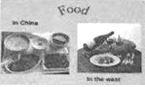
As you may have heard from my parents, I’m in China right now on a cultural exchange program. I’m enjoying my time here very much. I have made new friends here, many of whom are locals. Through my interaction(相互交流)with them, I’ve noticed some interesting cultural differences. One of the most obvious( 明 显 的 )cultural differences is the size of food portions in restaurants. Back home in America, the food portions are usually larger than those I’ve seen in China. We’re even used to seeing super-sized dishes in some restaurants.
However, in Asia, food portions are generally not extremely large. I’m must encouraged to eat until I’m full and enjoy different kinds of food. Eating out in Asia is often a big social affair(社交活动). People here eat out a lot. There are all kinds of restaurants. And there are food stands and food carts-even on the sidewalk(人行道).
Another interesting aspect of eating out is the way food is served. Back home in America, each diner orders their own meal. When people eat out in Asia, they usually order food to share. Nearly every time I eat out with friends in China, each of us has our own bowl of rice or noodles, and we share the rest of the dishes. This is an excellent way to try new foods! One thing that makes me confused is the way people pay for food at a restaurant.
In the U.S. we often ask for separate(分开的)checks, so we each pay for our own meal. But here, if diners decide to pay separately, they typically don’t request separate checks. Instead, they give money to one person who pays the bill. People also don’t tip the server. Instead, there is often a service charge added to the bill.
I hope you are doing well. I’ll write you again!
Love, Margare
1.Margaret has made many local friends during her cultural exchange program, hasn’t she?
__________________________________________________
2.What’s the culture difference in the size of food portions between China and America?
____________________________________________________
3.Why do people in Asia like eating out a lot?
___________________________________________________
4.What does Margaret think of the way food is served in China?
____________________________________________
5.How do people usually pay the bill in America?
_________________________________________________
6.Do you like the way of eating out in China or in America? Why?
______________________________________________________
Writing.
write at least 60 words about the topic“A thank-you letter to ”.(以“给……的一封感谢信”为题写 一篇不少于 60 个词的短文。信件格式已给,标点符号不占格。)
在日常的生活与学习中有许多人曾经帮助或鼓励过我们,令我们时常心存感激。请选择一个对象写一封感谢信,并结合你们之间的真实经历谈一谈你为何要感谢他/她,说一说你当时的感受以及此时此刻想对他/她说的话。
(注意:短文中不得出现任何真实人名、校名及其它相关信息,否则不予评分。)
The following is for reference only.(以下表达仅供参考)
have difficulty in…
encourage me to…
It was…of you to…
Which of the following underlined parts in different in pronunciation?
A.recent B.method C.respect D.enemy
My mother was angry me because I opened her computer but couldn’t put it back.
A.for B.to C.with D.by
My cat is great: she plays much than my big, noisy dog.
A.quietly B.more quietly C.most quietly D.the most quietly
sick need to be looked after, so money must be spent on hospitals.
A.A B.An C.The D./
I’ve got two cars. of them is in very good condition, I’m afraid.
A.Both B.Neither C.All D.None
My neighbor doesn’t seem very . She always ignores my greeting and avoids me.
A.politely B.happily C.patiently D.friendly