Anxiety is a feeling of uneasiness and worry. Anxiety can show up in a lot of ways. For example, trouble concentrating(专心), an upset stomach or sleeplessness. And anxiety can be one of the most serious challenges that students face today. Yet, it can also be one of the most hidden and unknown.

Perhaps you've seen the increase in anxiety in your classroom and school, maybe around testing seasons, or even your classmates experiencing hurt. You know anxiety is more than just“worries”. Anxiety can influence classroom performance just as much as any other learning disability.

According to the Child Mind Institute, health-care providers have seen a 17 percent increase of anxiety in children over the past 10 years. But there aren't many more students seeking help and care. In fact, less than one percent of students will seek anxiety treatment.

Students who are worried and anxious aren't doing it on purpose. The nervous system acts automatically(自动地), especially when it comes to worry. That's why phrases like "just relax" or "calm down" aren't helpful. But with practice, students can learn to slow down their anxious brains. Here are two helpful suggestions.

Firstly, practice deep breaths. When people slow down their breathing, they slow down their brain. Slow, deep breaths are the key. It works every time.

Secondly, take a break and go outside. Being out in nature can also calm an anxious brain. Sometimes just a change of scenery is what makes the difference. Breathing the cool air or making time to notice singing birds can also calm an overactive worrier. As students, you can observe the environment carefully. How many different kinds of trees do you see? How many different bird songs do you hear? How many different colors are in the grass? That can help you turn the focus away from your worries.

Don't set anxiety up as something you want to get rid of. It's a part of your life, and it will not go away completely. What you should do is to face it bravely and learn to deal with it.

1.According to the writer, __________ can help students turn the focus away from their worries.

A.getting hurt B.going to the park

C.having a test D.having less sleep

2.What can we learn from the passage?

A.Half of the students want to have good anxiety treatment.

B.Students can get rid of their anxiety by relaxing themselves.

C.Students can practice slow and deep breaths to reduce anxiety.

D.Students need to have anxiety to help them get good test marks.

3.What is the passage mainly about?

A.Creating anxiety. B.Increasing anxiety.

C.Experiencing anxiety. D.Dealing with anxiety.

Does Success Come with a High EQ or IQ?

Most students feel that their IQs are what determines(决定) how well they are going to do in life. When they see other students doing better than them, they usually believe that those students have a higher IQ and that there is nothing they can do to change facts. However, new research into EQ suggests that success is not simple the result of a high IQ.

While your IQ tells you how intelligent you are, your EQ tells you how well you use your intelligence. Professor Salovey who invented the term EQ suggests that when predicting someone's future success, their character, as measured(测量)by EQ tests, might actually matter than their IQs.

It is generally believed that people with high EQs are open to new ideas and have positive attitudes towards life. They are also less likely to be troubled by problems.

People generally believe that a person's IQ is determined by birth. However, most social scientists agree that EQ has a lot to do with education. Some are trying to study the possibility of improving a person's EQ, especially in terms of "people skills", such as understanding and communication.

Professor Mayer, recognized by many as a leading expert in the study of changes to people's EQs, recently said the results of a study on senior high school students. When normal students were introduced to students with disabilities, they found that, afterwards, the normal students were more willing to help people with difficulties. They also showed a better understanding of the disabled students' feelings compared to students who had not been involved in the study. There was also an obvious change in the disabled students' attitudes. They became more positive about life and more willing to try new things.

The results of the study show that EQ is important. To get ahead in the world and lead a happy successful life means getting on with other people and being able to understand and react to the situations in the best way possible. This requires a high EQ, the higher the better. And the fact that it might be possible to raise EQs means that schools need to make sure that their students are receiving the education they really need, and know that their futures are not entirely determined by their IQs.

1.According to the passage, people with high EQs ________________.

A.hate trying new things B.are determined by birth

C.are more understanding D.need to improve their IQs

2.What does the phrase "react to" in Paragraph 6 probably mean?

A.Try to refuse to accept. B.Show some disinterest in.

C.Help others to explain. D.Behave differently in.

3.According to the passage, Professor Mayer probably agrees that ___________________.

A.students with low EQs are more creative and positive toward their lives

B.it is possible for disabled students to improve their EQs with education

C.it is difficult for people with high EQs to solve problems in the best way

D.students with high IQs will be easier to succeed than students with high EQs

4.What is the writer's main purpose in writing the passage?

A.To discuss the meaning of EQ.

B.To stress the importance of EQ.

C.To introduce the discovery of EQ.

D.To question about the tests of EQ.

The Blood Group Alphabet

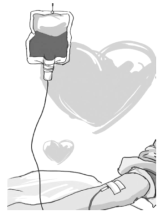
Sometimes people lose too much blood from injuries or accidents. To save their lives, doctors must replace the lost blood. In an operation called a transfusion, doctors put blood given by healthy people into the veins(静脉)of the sick or injured person. But they must be careful. Although all blood looks the same, there are really different types of blood. Someone getting the wrong type of blood in a transfusion may become very sick or even die.

All blood is made up of red and white cells, and a liquid(液体)called plasma(血浆). It is the red cells that cause blood to be different types. On the outside of the red cells of some people's blood are proteins(蛋白质). Doctors group these proteins into two different classes, A and B. People with the A protein have Type A blood, while people with the B protein have B type blood. If someone happens to have both proteins, that person has Type AB blood. Some people don't have either protein, and their blood is called Type O.

If a person receives a transfusion of the wrong type of blood, the body senses the strange protein on the new blood cells. So the body destroys the new blood, and the patient goes into shock. For example, people with Type A blood will become very sick if they are given Type B protein because their bodies try to destroy the strange Type B protein. People with Type O blood have no proteins on their cells, so their bodies will destroy both Type A and Type B blood. They can only receive Type O blood. But people with Type AB blood have both proteins, so they can receive Type A, Type B and Type AB blood. These people are called Universal Receivers. People of any type can receive Type O blood because it has no protein for the body to fight against. So Type O people are called Universal Donors.

Doctors are always careful to test blood for its type before it is used in a transfusion. Although the wrong type of blood can be harmful, the right type can save a life.

1.What is the blood made up of?

__________________________________________________________________________

2.How many classes do doctors group the proteins into?

__________________________________________________________________________

3.What type of blood does the person have if someone doesn't have either protein?

__________________________________________________________________________

4.Why can people with Type O blood only receive Type O blood?

__________________________________________________________________________

5.Are Type AB people called Universal Donors?

__________________________________________________________________________

 0  133221  133229  133235  133239  133245  133247  133251  133257  133259  133265  133271  133275  133277  133281  133287  133289  133295  133299  133301  133305  133307  133311  133313  133315  133316  133317  133319  133320  133321  133323  133325  133329  133331  133335  133337  133341  133347  133349  133355  133359  133361  133365  133371  133377  133379  133385  133389  133391  133397  133401  133407  133415  159627 
违法和不良信息举报电话:027-86699610 举报邮箱:58377363@163.com

精英家教网