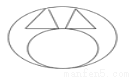
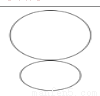
A teacher from America visited a school in China. In one class, she watched sixty children learn to draw a cat. The teacher drew a big circle on the blackboard, and sixty children copied it on their paper. The teacher drew a small one on the top of the big one and then put two small triangles (三角形)on the top of it. The children drew in the same way. The lesson went on until there were sixty-one cats in the classroom. Each student’s cat looked exactly the same as that on the blackboard.

The visiting teacher watched the lesson and was surprised because the teacher methods were different from those in her country. A children’s art lesson in her country produced a lot of pictures, and each one is quite different from the others. Why? What makes this difference in educational methods? In a classroom in any country, a teacher teaches more than art or history or language.

In a country such as the United States or Canada, students are asked to work and find answers by themselves. The students are helped to learn to have their own ideas. In countries such as China and Japan, students often work together and help each other in the classroom, but the teachers teach, and the students listen. The students are asked to memorize a lot. They have to learn the same textbook, do the same homework and give the same answers.

1.Which of the following looks the cat on the blackboard?

A. B. C. D.

2.The students in ______ are helped to find answers by themselves.

A. Japan B. China C. America D. Japan & China

3.The word “memorize” means _______ in the passage.

A. remember B. forget C. give D. read

4.Which of the following is true?

A. There are sixty-one students in the class.

B. All the students in the class are good at drawing cats.

C. The visitor was surprised at the art lesson.

D. The students in China and Japan are helped to learn to have their own ideas.

5.The writer of the passage thinks that the students should ________.

A. have the same answers as their teacher B. learn knowledge by themselves

C. learn the same textbook. D. be asked to memorize a lot

Interesting festivals in the world

Throwing tomatoes—Spain(西班牙)

Spain takes “tomatoes fights” to a whole new level. But the tomatoes are being thrown, not eaten. The festival takes place during the last Wednesday in August. Trucks(卡车)carry tomatoes into the square. People rush to the tomatoes and throw them into the crowd.

Rolling cheese—England

This festival is celebrated on the last Monday in May. It takes place on Cooper's Hill. A large wheel of cheese(奶酪)is rolled down Cooper's Hill. The festival is actually a race where people run down the hill after the rolling cheese. The first person to cross the finish line at the bottom of the hill wins the cheese.

Burning man—The United States

The Burning Man Festival lasts a week, it is from the Monday before labor Day to Labor Day(which falls on the first Monday in September in America). The festival takes place in the Black Rock Desert. The best part of the festival is the burning of a large sculpture(雕塑)of a man.

Pouring water—Thailand

The Songkran Festival is the celebration of the New Year in Thailand. Rather than a single day, Thailand celebrates the New Year from April 13th to April 15th. Thai people run after each other, pouring water. Songkran is one of the most important reasons why foreigners travel to the beautiful land.

1.What about are these passages?

A. Games. B. Activities C. Matches. D. Festivals.

2.Where will you probably go to enjoy one of the festivals above in May?

A. Spain. B. England. C. The United States. D. Thailand.

3.Which festival is held in Black Rock Desert?

A. Throwing tomatoes. B. Rolling cheese. C. Burning man. D. Pouring water.

4.Which of the following is TRUE according to the passage?

A. The tomatoes are thrown into crowd to eat.

B. Not all the festivals above fall on the single day.

C. Burning a large real man is the best part of the festival.

D. Songkran is the only reason for attracting lots of tourists.

5.The passage is most probably taken from ______.

A. a tour guide B. a science report C. a story book D. a fashion magazine

My name is Adam Rouse. I'm 19 years old and I used to be a drug-addict. I first started using drugs when I was15. I bought cannabis(大麻) from a man in the street. I continued to buy cannabis from the same man for about six months. One day, he offered me some crack cocaine(可卡因). When I went back to the man again, I wanted more crack cocaine. But he asked me for a lot of money. I didn't have enough money so he didn't give me any drugs. I was in terrible pain.

The next day, I broke into a house and stole a television and a video recorder. I took them to the drug dealer(贩卖者). He told me to take them to a shop in a nearby street. The man in the shop gave me some money. I took the money to the drug dealer and he gave me some more crack cocaine.

By this time, I was addicted to crack cocaine. If I didn't have any drugs, I was in terrible pain. And I had to steal something every day to pay for the drugs. One day, the police took me to the police station.

The next day, a doctor came to see me. He told me that I could die if I didn't stop taking crack cocaine, so I took his advice and stopped immediately. Now I work in a centre for drug addicts, helping others to stop taking drugs.

1.What does the underlined word mean?

A. 精神病者 B. 吸毒成瘾者 C. 卖毒者 D. 管理员

2.How long did the writer continued to buy cannabis from the same man?

A. For two years B. For three months C. For six years D. For half a year

3.What did the man offer the writer?

A. money B. food C. the drug D. fruits

4.How did the writer get the money for the drug?

A. stole some things B. worked hard than before

C. borrowed from his friends D. ordered his parents

5.What does the writer do now?

A. continue to take drugs B. become a dealer

C. make a living for stealing D. work in a centre for drug addicts

There is a song we all can sing —March of the Volunteers (《义勇军进行曲》). It’s our national anthem (国歌). Now, there is a law to protect the song.

On Sept 1, the government passed the National Anthem Law. It states how we should sing or play the song, requiring (要求) all Chinese to respect it. The law will take effect from Oct 1.

According to the law, the song will only be allowed to play at nine situations, such as major sporting events, award ceremonies and flag-raising ceremonies. It shouldn’t be used at personal funerals (葬礼) or as background music in public places.

Moreover, the law requires Chinese to be serious when singing the song. We can neither joke about the song nor change the song’s words or music. If someone breaks the law, he or she can be detained (拘留) for up to 15 days or held criminally liable (负刑事责任).

Many foreign countries also have laws for their national anthems. For example, US people should put the right hands over their hearts while singing the song. In Russia, the national anthem must be played on television and radio before the start and the end of broadcasting(广播).

1.What is the National Anthem Law about?

A. It is to protect all the songs in China. B. It asks people to respect the national anthem.

C. It asks all the Chinese to love our country. D. It encourages people to sing the song more.

2.During which of the following situations are you NOT allowed to play the national anthem?

A. A major sporting event. B. Award ceremonies.

C. Flag-raising ceremonies. D. As background music in public places.

3.The people ______ put their right hands over their hearts while singing the national anthem.

A. in China B. in Japan C. in the US D. in Russia

4.What is NOT true about the Chinese National Anthem Law?

A. It requires Chinese to be serious when singing the song.

B. Anyone can’t joke about the song, or he or she may be detained for up to 15 days.

C. That someone changes the song’s words or music means breaking the law.

D. At the start of broadcasting the national anthem must be played on television.

5.What is the main idea of the passage?

A. A new law was passed to protect the Chinese national anthem.

B. What people should do to respect other countries.

C. Why citizens should protect their national anthem.

D. How different countries take action to respect their national anthems.

 0  129352  129360  129366  129370  129376  129378  129382  129388  129390  129396  129402  129406  129408  129412  129418  129420  129426  129430  129432  129436  129438  129442  129444  129446  129447  129448  129450  129451  129452  129454  129456  129460  129462  129466  129468  129472  129478  129480  129486  129490  129492  129496  129502  129508  129510  129516  129520  129522  129528  129532  129538  129546  159627 

违法和不良信息举报电话:027-86699610 举报邮箱:58377363@163.com

精英家教网