题目内容

Interesting festivals in the world

Throwing tomatoes—Spain(西班牙)

Spain takes “tomatoes fights” to a whole new level. But the tomatoes are being thrown, not eaten. The festival takes place during the last Wednesday in August. Trucks(卡车)carry tomatoes into the square. People rush to the tomatoes and throw them into the crowd.

Rolling cheese—England

This festival is celebrated on the last Monday in May. It takes place on Cooper's Hill. A large wheel of cheese(奶酪)is rolled down Cooper's Hill. The festival is actually a race where people run down the hill after the rolling cheese. The first person to cross the finish line at the bottom of the hill wins the cheese.

Burning man—The United States

The Burning Man Festival lasts a week, it is from the Monday before labor Day to Labor Day(which falls on the first Monday in September in America). The festival takes place in the Black Rock Desert. The best part of the festival is the burning of a large sculpture(雕塑)of a man.

Pouring water—Thailand

The Songkran Festival is the celebration of the New Year in Thailand. Rather than a single day, Thailand celebrates the New Year from April 13th to April 15th. Thai people run after each other, pouring water. Songkran is one of the most important reasons why foreigners travel to the beautiful land.

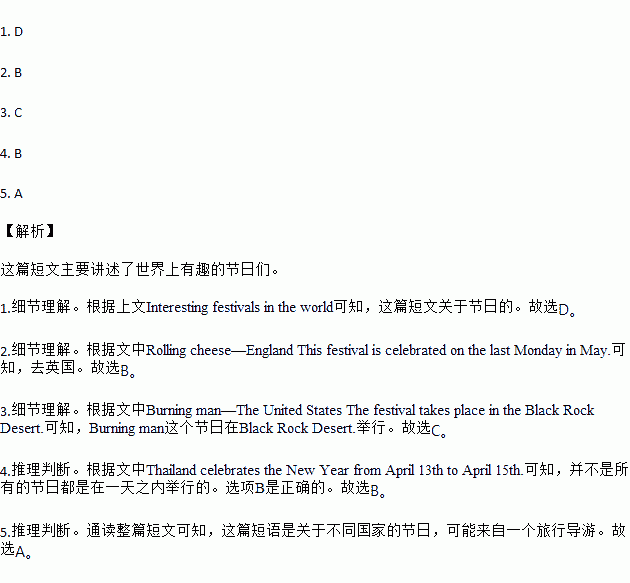
1.What about are these passages?

A. Games. B. Activities C. Matches. D. Festivals.

2.Where will you probably go to enjoy one of the festivals above in May?

A. Spain. B. England. C. The United States. D. Thailand.

3.Which festival is held in Black Rock Desert?

A. Throwing tomatoes. B. Rolling cheese. C. Burning man. D. Pouring water.

4.Which of the following is TRUE according to the passage?

A. The tomatoes are thrown into crowd to eat.

B. Not all the festivals above fall on the single day.

C. Burning a large real man is the best part of the festival.

D. Songkran is the only reason for attracting lots of tourists.

5.The passage is most probably taken from ______.

A. a tour guide B. a science report C. a story book D. a fashion magazine
练习册系列答案
相关题目

Once there was an English prince called Henry. He liked to study languages, but smiles never came on his face. His father, the king tried to make him happy in every possible way. Yet the young prince was not happy.

One day the king had an interview with a man named Sir Arthur. Sir Arthur told the king, “I have a method to make Prince Henry happy, but you have to send him to the countryside”. At first, the king refused. But Sir Arthur insisted on taking the prince to the country. Finally, the king agreed.

Prince Henry and Sir Arthur went to Sir Arthur’s house. His big yard was divided into two parts— inside yard and outside yard, and the outside yard was a big garden with a flowerbed. Sir Arthur told Henry, “Do you know my flowerbed can talk, and it has a secret?” The prince thought it very strange. Sir Arthur went on, “It tells the secret only to those who watch it every day. If you learn the secret, you will be happy.”

Prince Henry looked, but there was no flower, not even a leaf upon it. Then he circled the flowerbed every day. Even when a storm came, he didn’t go inside, so he caught a cold.

Many days passed. The flowerbed was wet, and the warm sun shone upon it. At last, one fine morning, he saw tiny plants coming up.

Day after day he saw that these plants made lines, and that the lines formed some letters. He thought about the spelling and tried to translate them into his own language. At last, he got it: DO SOMETHING GOOD TO SOMEONE EVERY DAY.

1.Why was Prince Henry sent to the countryside?

A. Because his father wanted him to experience the life.

B. Because he wanted to experience a different life.

C. Because his father wanted to make him happy:

D. Because he wanted to become happy again.

2.What happened at the end of the story?

A. Prince Henry was told the secret of the flowerbed.

B. Prince Henry wasn’t happy with the secret of the flowerbed.

C. Prince Henry could hear what the flowerbed said.

D. Prince Henry got the secret of the flowerbed on his own.

3.What can we learn from the passage?

A. Prince Henry wasn’t happy if he was not allowed to study languages.

B. The king disliked Sir Arthur’s idea and he didn’t follow his advice.

C. Prince Henry was OK when he watched the flowerbed.

D. Sir Arthur was a helpful man and he finally succeeded in helping Prince Henry.

4.What does the story want to tell us?

A. It’s easy to be happy.

B. Helping others is useful.

C. Everyone should do something good.

D. Doing something good can make us happy.

How do ants know when another ant is dead? Ed Wilson, now the most famous ant scholar in the world, wanted to know.

When Ed Wilson was a young assitant professor at Harvard in 1950s , he found that when ants die, they just lie there, sometimes upside down, feet in the air, while their sister ants- almost all ants in a colony are ladies—walk right by without a look. Unitl about two days later, the dead body starts to send out a chemical signal that changes the living ants’ behaviour greatly.

All of a sudden what was once a pile of gunk(黏糊糊的东西) on the floor becomes a “Problem to Be solved”. Once the signal is in the air, any ant that happens to pass by picks up the dead body and carries it through her colony to a refuse pile and puts it on a pile of also dead ants.

Ed, who would continue the study of ants by studying their ability to communicate with smell, decided to find out what things equal “I am dead.” to an ant. Finally, after much checking and mixing, Ed discovered that a kind of acid was all the ants have to think “DEAD!” One day he took a drop of the acid and put it on an ant that had the bad luck of walking by. Then the next ant that came near grabbed it, put it on its back and put it into the refuse pile though the ant was still alive.

Though it tried to clean itself over and over, the minute it returned to the colony, it was caught and carried back on the pile. At last, it took the ant about an hour or two to get clean enough to return to regular business.

1.The author says the question was no one on everybody’s lips because ____.

A. it is easy to answer B. it is a foolish and difficult question

C. it is less talked about D. only scientists ask such a question

2.The underlined word “a refuse pile” probably means the place where _____.

A. injured ants were treated B. other ants lived

C. food was stored D. dead ants were buried

3.What caught Ed Wilson’s attention when he was at Harvard in the 1950s?

A. An ant wasn’t carried away immediately when it died.

B. Ant died with feet in the air.

C. Sister ants didn’t look after each other at all.

D. Ant’s dead bodies didn’t catch others’ attention.

4.The ant with acid tries to clean itself over and over ____.

A. to avoid being killed by the acid

B. to avoid being treated as the dead ant

C. to find out more food than anyone else

D. to find out where it got the acid

5.Which of the following can be the best title for the passage?

A. Dead is what you smell, not what you see

B. It’s funny to carry a living ant.

C. The secret in an ant colony

D. Study ants’ ability to communicate

违法和不良信息举报电话:027-86699610 举报邮箱:58377363@163.com

精英家教网