10.Early last year,two young brothers in Jiangsu Province (11)C badly burned while playing.The"game"they were playing was(12)Athey had watched in the cartoon Pleasant Goat and the Big Big Wolf (《喜羊羊和灰太狼》).The brothers were (13)D two little goats while their friend was playing a bad wolf.Their friend tied them (14)B a tree and set fire to the grass around them.
The sad story is an example of how many children follow the violence(暴力) they see on television,especially cartoons.It is(15)C that violent cartoons can make children more aggressive(具有攻击性的).In a survey,researchers(16)D the children after watching non-violent and violent cartoons.They found that the kids who watched violent cartoons fought with others and (17)Aclass rules more often.
Children under the age of seven are too (18)A to understand that the violence on TV can bring(19)B real harm.It is parents'job(20)B them understand it.
The sad story is an example of how many children follow the violence(暴力) they see on television,especially cartoons.It is(15)C that violent cartoons can make children more aggressive(具有攻击性的).In a survey,researchers(16)D the children after watching non-violent and violent cartoons.They found that the kids who watched violent cartoons fought with others and (17)Aclass rules more often.
Children under the age of seven are too (18)A to understand that the violence on TV can bring(19)B real harm.It is parents'job(20)B them understand it.
| 11.A.are | B.is | C.were | D.was |
| 12.A.something | B.anything | C.everything | D.nothing |
| 13.A.eating | B.buying | C.watching | D.playing |
| 14.A.with | B.to | C.in | D.at |
| 15.A.report | B.reporter | C.reported | D.reporting |
| 16.A.advised | B.asked | C.called | D.compared |
| 17.A.broke | B.followed | C.obeyed | D.made |
| 18.A.young | B.old | C.small | D.little |
| 19.A.him | B.them | C.we | D.you |
| 20.A.help | B.to help | C.helping | D.helped. |
9.The way in which we communicate with others can be greatly improved by building a better vocabulary.In our personal life,we communicate and share experiences with others.However,how well we do it depends on(取决于) our ability to express ourselves through spoken and written language.Luckily,increasing(增加) our word power can make us own the skills we need to communicate better with others and can also help us get better results in our study.
When you see a new word,whether through reading or hearing someone say the word,just be ready to take out your dictionary and look it up-learn about the word and anything that relates(与…相关)to it.If you understand the word,you'll hopefully remember it well.
Meanwhile,you'd better write down words to learn.You can go through the dictionary,magazine and newspaper or even take down the unknown words you hear.Try to review them every day-look at the words and speak them out loudly.Copy the words over and over again,along with their meanings,and you will surprisingly remember them in no time.
You can also do word searches,crossword puzzles or other word games.Playing these games,you are more likely to come across new words,and when you are caught in new words,study them.The more words you have in your brain's word bank,the better you will become at these word games.You will be remembering,learning and having fun,too.
Finally,reading is also believed to be an excellent way to learn new words and build up your vocabulary.Read things you are interested in,because in this way,you are less likely to become bored.But don't skip over(忽略) those words you don't know.Instead,you should remember and use them in your own daily conversations.Use them more,and you'll surely have a better chance of remembering them.
When you see a new word,whether through reading or hearing someone say the word,just be ready to take out your dictionary and look it up-learn about the word and anything that relates(与…相关)to it.If you understand the word,you'll hopefully remember it well.
Meanwhile,you'd better write down words to learn.You can go through the dictionary,magazine and newspaper or even take down the unknown words you hear.Try to review them every day-look at the words and speak them out loudly.Copy the words over and over again,along with their meanings,and you will surprisingly remember them in no time.
You can also do word searches,crossword puzzles or other word games.Playing these games,you are more likely to come across new words,and when you are caught in new words,study them.The more words you have in your brain's word bank,the better you will become at these word games.You will be remembering,learning and having fun,too.
Finally,reading is also believed to be an excellent way to learn new words and build up your vocabulary.Read things you are interested in,because in this way,you are less likely to become bored.But don't skip over(忽略) those words you don't know.Instead,you should remember and use them in your own daily conversations.Use them more,and you'll surely have a better chance of remembering them.
| Topic:Increasing Your Vocabulary | |
| (34)Importance/Advantages/Value/Reasons of building up vocabulary | ●Improve your ability to express yourselves and communicate better with others. ●Be (35)helpful/useful to your study. |
| Suggestions on remembering new words | 1.Remember every new word you meet with by (36)understanding it. ●Learn about the word and anything that relates to it by looking it up in your dictionary. |
| 2.Make a (37)list of new words to learn. ●Review the words every day by looking at and speaking them out loudly. ●Copy the words and their meanings over and over again. | |
| 3.Do word games. ●Play these games,come across new words and study them with fun. | |
| 4.Learn words through reading. ●Read things you (38)like/enjoy/love ●Do not skip over new words,but remember and use them more. | |
7.If you are cycling in foreign countries,you will need to know what these traffic signs and signals mean.
21.What are cyclists required to do when they see the sign  ?C
?C
A.To ride against traffic.
B.To ride on the left side of the road.
C.To ride on the bike lane.
D.To ride on the right side of the road.
22.Which of the following signs has the same meaning as the sign ?B
?B

23.What should cyclists do when they see the sign ?A
?A
A.They should be careful when they cycle on the rough road.
B.They should take the rough road and fall off their bikes.
C.They should move into the road to go around a work area.
D.They should take another route instead of the closed roadway.
1 | A sign like this one means that there is a bike lane(车道).If there is such a sign,you are required to use the bike lane. If there is not such a sign,you should ride with traffic as far to the right side of the road as possible. |
2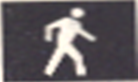 | This signal means you can cross the street along with pedestrians(行人).It has a green picture of a person walking instead of using the word"walk". |
3 | This signal is the"don't walk"sign.It is a picture of a red hand,meaning you should stop.You should wait to cross the street until the green picture of the person walking is showing. |
4 | Car drivers and bikers must come to a complete stop at"STOP"signs. |
5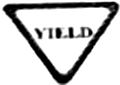 | A"YIELD"sign means to slow down and be ready to stop. If there are pedestrians or vehicles in or near the crossroad,you must stop.If there is no traffic in or near the crossroad and it is safe,you may go through. |
6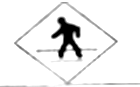 | This signal means you are coming to a zebra crossing.Car drivers and bikers must stop to allow people in the zebra crossing to cross the street. |
7 | When people are working on the roads,parts of the road are often dug up or rough(不平整的).Be careful when you are cycling.Rough roads could make you fall off your bike. |
8 | A detour is a way of getting around a roadway that is closed.Roads are usually closed because of road work or dangerous conditions.If you must take a detour,be careful about the roads you aren't used to. |
 ?C
?CA.To ride against traffic.
B.To ride on the left side of the road.
C.To ride on the bike lane.
D.To ride on the right side of the road.
22.Which of the following signs has the same meaning as the sign
 ?B
?B
23.What should cyclists do when they see the sign
 ?A
?AA.They should be careful when they cycle on the rough road.
B.They should take the rough road and fall off their bikes.
C.They should move into the road to go around a work area.
D.They should take another route instead of the closed roadway.
2.Laboratory work is your chance to learn science firsthand.It can be fun but you must be careful to prevent injury.Listen closely when your teacher reads and explains the rules before your first lab lesson.
61.Your teacher will probably tell you the rules aboveA the first lab lesson.
A.before B.since C.during D.after
62.Before every experiment,you shouldC.
A.taste the chemicals first
B.clean al the apparatus
C.read all instructions carefully
D.report al the accidents to the teacher
63.When you are not sure how to use all apparatus,C.
A.try them on your own
B.read the rules carefully
C.ask your teacher for help
D.put them back
64.It is clear that you canD.
A.bring food into the lab
B.enter the lab anytime
C.smell chemicals as you like
D.learn science directly in the lab
65.If you get chemicals on the clothing,you can find ways to solve it in the partB.
A.Before the Experiment
B.First Aid
C.During the Experiment
D.After the Experiment.
0 115166 115174 115180 115184 115190 115192 115196 115202 115204 115210 115216 115220 115222 115226 115232 115234 115240 115244 115246 115250 115252 115256 115258 115260 115261 115262 115264 115265 115266 115268 115270 115274 115276 115280 115282 115286 115292 115294 115300 115304 115306 115310 115316 115322 115324 115330 115334 115336 115342 115346 115352 115360 159627
| LABORATORYRULES | |
| Throughout the lesson | •Do not enter the science lab without the teacher's permission.No food or drinks are to be allowed in the science lab. |
| Before the Experiment | •Read all instructions carefully before every experiment. •Prepare all apparatus(仪器)and arrange them so that you will not knock them over while doing the experiment. |
| During the Experiment | •If you are unsure of how to use any apparatus or how to operate,ask your teacher for help. •Never smell or taste chemicals unless your teacher gives permission. |
| After the Experiment | •Wash all apparatus after use and return them to the places where they were. •Throw waste materials in proper waste baskets. |
| First Aid | •Report all accidents to your teacher immediately. •If you spill( 溅 出 )any chemicals onto your body or clothing,wash with plenty of water and report to your teacher. |
A.before B.since C.during D.after
62.Before every experiment,you shouldC.
A.taste the chemicals first
B.clean al the apparatus
C.read all instructions carefully
D.report al the accidents to the teacher
63.When you are not sure how to use all apparatus,C.
A.try them on your own
B.read the rules carefully
C.ask your teacher for help
D.put them back
64.It is clear that you canD.
A.bring food into the lab
B.enter the lab anytime
C.smell chemicals as you like
D.learn science directly in the lab
65.If you get chemicals on the clothing,you can find ways to solve it in the partB.
A.Before the Experiment
B.First Aid
C.During the Experiment
D.After the Experiment.