


阅读理解。

Jokes are things that we say to make other people laugh. Sometimes a joke is just a short sentence, while other times it can be a story that can take a while to tell. An example of a simple joke is:

People who tell jokes are welcomed everywhere bacause everyone likes hearing a good joke. Here

is another example of a jokes:

We say a joke is “corny” if it is stupid . An example of a corny joke is:

But some people may think a corny joke actually a good joke. Telling a good joke depends not only on the joke itself but also on the way it is told. Some people have a skill for telling jokes. And some people simply do not know how to tell jokes. Every language and culture has its own funny jokes. As a result, many jokes lose their humor if they are translated into a different language.

Some jokes depend on making fun of other people to be funny. However, these jokes may hurt people’s feelings.

Sometimes jokes are told about certain races and religions (宗教). These are called “recial” and “religious” jokes, and they can be burting people, too. Jokes about the supposed special things of the members of one sex are sometimes considered to be “sexist (性别歧视的) rubbish”. Jokes that hurt people’s feelings are not really funny.

Have you heard a good joke lately? Can you tell your classmates one that will make them laugh?

1.People who are good at telling jokes are usually _____ .

A. serious B. crazy

C. famous D. popular

2.A “corny” joke is one that is _____ .

A. very funny B. stupid or not funny

C. very short D. very harmful

3.Some jokes depend on _____ to be funny.

A. how long the sentences are

B. the age of the person who tells the joke

C. where we ate standing when telling the joke

D. the listener’s understanding of the language and culture

4.Which of the following is the writer’s opinion?

A. Jokes that hurt people’s feelings are not really funny.

B. Some people simply do not know how to tell jokes.

C. Every language and culture has its own jokes.

D. Some people may think a corny joke is good.

阅读理解。

I have spent almost a third of my life in China, living and working in this beautiful country. In a sense, China has been and is still my second home But in those past years I had never been to Quzhou.

Some days ago, for the first time in my Chinese life, I stepped into the beautiful city of Quzhou. My impressions of Quzhou city were as I always thought: green countryside, rainy sky, wet air. That was what I imagined for years the south of China would be. When we finally arrived, I was impressed by the elegant (优雅的) city.

Next day we were taken to visit some places not far away from the city. I was not aware of the direction of our short trip, but when we arrived at Lanke Mountain and got out of the car, I thought that we had been taken to a fairyland (仙境) : the light rain over the green and thick plants, the silvery sky like a heavy blanket and the mystery (神秘) of this mountain made me feel like being part of a picture.

Jiulong Lake was our next step. The mystic atmosphere (气氛) of this place was so strong that I decided to watch the view standing at the top when I stepped into the small boat to sail upstream. Sometimes we were so close to the mountain that we could clearly see the red soil under the plants. I was thinking of the joy to be in a place like Jiulong Lake and how it would be to live among those hills for a while.

The final leg of the day’s journey was a primary school. We were welcomed by the smiles on the faces of many young pioneers. The energy of the hundreds of kids made me feel younger for a while, so educated, so polite and so warm that I had no doubt about the future generations of Quzhou people. The people seem to me the best of Quzhou and they will remain in my memories forever.

1.From the passage, we can know the writer _____ .

A. will come to work in Quzhou

B. will leave China soon

C. has lived in China for a long time

D. has just come to China

2.The writer visited _____ places the next day in Quzhou.

A. two B. three

C. four D. five

3.In the writer’s eye, Quzhou is _____ .

A. green, rainy, wet and elegant

B. green, large, modern and mystic

C. small, warm, dry and elegant

D. beautiful, dry, modern and mystic

4.What does the writer mean by saying the underlined sentence in Paragh 4?

A. He disliked Jiulong Lake.

B. He hoped to leave there soon.

C. He would swim in Jiulong Lake.

D. He loved Jiulong Lake very much.

阅读理解。

The Year of the Goat was a main reason for the low newborns in 2015, a report said.

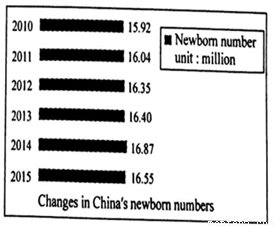
There were 16.55 million babies born in China last year, about 320,000 fewer than 2014, the Year of the Horse, it said.

China began to allow couples where one partner was an only child to have a second child in late 2013, which made 11 million couples eligible (符合条件的).

People expected the policy to result in 1 million more births compared with 2014. However, that did not happen. There is an old Chinese saying that 9 out of 10 people born in the Year of the Goat are unlucky in their lives.

It was reported that the decline (下降) was mainly because of the Year of the Goat. China will likely welcome 17.5 to 21 million newborns yearly in the next five years.

In 2015, the number of wowen aged 15 to 49, considered to be of childbearing age, fell by 5 million from 2014, In addition, the group between 20 and 29 years old, who are main childbearing people, has declined by 1.5 million, the report said.

Among babies born last year, the number of first children dropped by 850,000 from 2014, or 4.1 percent, it said.At the same time, the number of the second children increased by 450,000.

The number of Chinese wowen of childbearing age reached the highest point in 2011 and then began to decline.

1.You can probably read this passage in a(n) _____ .

A. advertisement B. newspaper

C. guidebook D. novel

2.According to the report, the number of newborns declined in 2015 compared with 2014 mainly because of _____ .

A. the Year of the Horse B. the Year of the Goat

C. the working conditions D. the living conditions

3.The number of Chinese wowen of childbearing age reached the highest poilt in _____ .

A.2011 B.2012

C.2013 D.2014

4.From 2010 to 2014, the newborn numbers in China _____.

A. declined every year B. kept the same

C. increased every year D. doubled

 0  108842  108850  108856  108860  108866  108868  108872  108878  108880  108886  108892  108896  108898  108902  108908  108910  108916  108920  108922  108926  108928  108932  108934  108936  108937  108938  108940  108941  108942  108944  108946  108950  108952  108956  108958  108962  108968  108970  108976  108980  108982  108986  108992  108998  109000  109006  109010  109012  109018  109022  109028  109036  159627 

违法和不良信息举报电话:027-86699610 举报邮箱:58377363@163.com

精英家教网