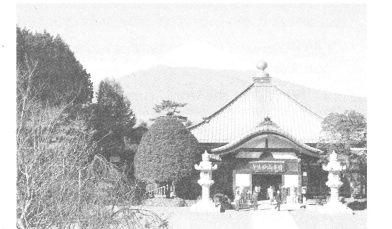


(B1  Millie's parents are going on a holiday to Japan. Millie has found an article about japan on the Internet. She is reading it out to her parents. Below is the article.

Japan—a beautiful country

Japan is a country in East Asia. It is made up of four main islands and many smaller islands. On the four main islands there are mountains and valleys. Mount Fuji is the highest mountain in Japan. It is also one of the most famous mountains in the world.

Japanese gardens are known for their beautiful landscape. A typical Japanese garden does not have a lot of flowers. The main elements are rocks,trees and water. Take a walk in a Japanese garden and you will feel peaceful. If you want to know more about Japan,you can visit their museums. There are many different exhibitions introducing Japanese art and culture.

On New Year's Day and during some other Japanese holidays,many Japanese people pu on their traditional costumes and go to temples to make wishes. There are many traditional temples in the country for tourists to visit. There are also different activities for different festivals throughout the whole country. Tourists can learn more about Japan from these activities.

As a tourist,you will not have any trouble travelling in Japan. The trains are very convenient. Most Japanese people take the train to work every day. Japan is famous for one kind of train. It can run at over 400 km an hour at its fastest speed. It is called Shinkansen or the "bullet train”.

You can visit Japan in any season. You will not forget its beauty.

(B2  After listening to the article,Millie's parents are talking about japan. Complete what they are saying.

ihe article says that a typical Japanese garden

doesn't have a lot of ⑴ . That's

interesting. I want to visit some Japanese 

gardens  

 Me too. I also want to visit the museums                                               there. Td like to know more about                                                Japanese art and.(2)                                    

  It also says that there are different

for different

(4) in Japan. Lets see if

we re lucfcy enough to join some so that we can 

learn more about the country.


Trcivelling in Japan is very convenient. Look!

 It says that most Japanese people take the

 train to (5) every day and

 one kind of train can run at over  

(6) per hour. That's amazing!                               


 Carl,one of the American exchange students,said that curry is one of his favourite food. Daniel wants to learn more about curry. He has found this article on the Internet. Read it with him.

Curry around the world

"Curry" is the English word used to describe meat or vegetables in a spicy sauce,usually served with rice. It is believed that the word "curry" comes from the Tamil word "kari".

Curries have been very popular dishes in many Asian countries throughout history. Although curry is believed to originally come from India,it has been eaten in many other Asian countries—such as Pakistan,Bangladesh,Sri Lanka,Nepal,Indonesia,Malaysia and Thailand—for thousands of years.

Today curries are eaten all over the world. This tasty and spicy dish was brought to the West by British people from India in the 17th century.

What we call "curry" today is an international dish that is well known around the world. Over time and distance,the flavours of dishes change so that the people eating the dish will like it. For example,the most popular curry in restaurants in the UK is called chicken tikka masala. Many British people think this is an Indian dish. However,it is really a dish created by restaurants in the UK and is not a traditional Asian dish at all.

Today curry is loved by people all over the world,unless,of course,they do not like spicy food!

(A2 h Daniel is taking some notes about the article. Help him complete his notes.

Curry

Curry,J ie aw (1) word.

“Curry” comee from the Tamil word

(2) ”

. Curry is meat or  vegetables in a (3)

eauce,usually eerved with (4) .

. Curry ie believed to be from (5) .

. Curry hae been popular in many other

(6) countriee for thoueande of yeare.

. Curry brought to the Wfest by

(7) people in thg (8)

century.

(A3 Daniel is telling Millie what he has learnt about curry. Help him answer her questions.

1 What does the word "curry" mean in English?

2 What Asian countries is curry popular in?

3 Where are curries eaten today?

4 What is the most popular curry in restaurants in the UK called?

5 Are the curries eaten in the West the same as the ones eaten in Asia?

6 Who will not like curries?

阅读理解

        In Britain,people often invite friends for a meal,a party or just coffee. People who know each other very well may visit each other's  houses without an invitation (邀请),but if we invite new friends,usually an invitation is needed. When people invite someone to their homes,they often say ,“Would you like to come for dinner on Saturday?” Answers are ,“Thanks,we ,d love to. What time?” or “I'm sorry. We’d love to,but we have tickets for the concert. ” However,it is not polite to say, “No,we wouldn’t. ”

        Sometimes,the British use expressions that sound like invitations but which are not invitations. For example, “You must come over for a drink sometime. ” or “Let's go out for a meal one of these days. These are usually just polite ways of ending a talk. They are not real invitations because they don't mention an exact time or day. They just show that the person is trying to be friendly and the answers are , “Yes,that would be nice. ” or “OK,yes,thanks. ” 

        So next time you hear what sounds like an invitation,listen carefully. Is it a real invitation or is the person just being friendly?

() 1. It's always necessary for to visit each other's houses with an invitation.

   A. close friends   B. family members   C. neighbours   D. new friends

() 2. It is not polite to answer the real invitation by saying “”.

   A. Sorry. We’d love to,but we have tickets for the concert.

   B. Thanks. We'd love to,what time?

   C. Sure. We'd like to. Thanks a lot.

   D. No,we wouldn’t!

(3. If the British just want to end a talk politely,they may say,“”.

   A. Would you like to come for dinner on Saturday?

   H. Let's go out for a meal one of these days.

   C. Let's go out for a meal on Saturday.

   D. Shall we go for a drink this afternoon.

(4. The British often use“” to answer the invitations that are not real.

   A. Yes,what time?

   B. No,that's not a real invitation.

   C. OK,yes,thanks.

   D. No,you just want to be friendly.

() 5. Which is the best title for the passage?

   A. Britain               B. Invitation

   C. A Talk with Friends   D. A Letter to Friends

完形填空

        Richard found a job in a big office after he finished college. He liked to use his 1 and was good at his job. So he was often paid more than (得到的报酬多于) his workmates and he worked 2 But something was wrong with the young man a month ago. He couldn't fall 3 at night. So he was always 4 in the daytime and often made mistakes. He had to go to a hospital. The doctor 5 and told him to buy some sleeping pills. He took them 6 he went to bed. Soon after that he went to sleep. Richard 7 in the morning. He had a look at the clock on the wall. It was a quarter to seven. He got up and went to work after 8 . As soon as he went into the office,he said to the head of the office ,“Good morning,Mr. Clarke!I've 9 had a good sleep like last night's and I'm feeling much better now!”“Skunk (混蛋) !” the head 10 loudly. ^WeVe looked for you for two days!I wanted you to do something important,but it's too late now!”

() 1. A. hand   B. head   C. eyes   D. feet

() 2. A. hard   B. fast   C. harder   D. faster

() 3. A. asleep   B. alone   C. afraid   D. awake

() 4. A. well   B. hungry   C. thirsty   D. tired

() 5. A. looked for him   B. looked at him   C. looked after him   D. looked him over

() 6. A. after   B. because   C. before   D. if

() 7. A. stood up   B. woke up   C. sat down   D. lay down

() 8. A. lunch   B. dinner   C. supper   D. breakfast

() 9. A. always   B. usually   C. never   D. often

() 10. A. laughed   B. shouted   C. smiled   D. asked

 0  101716  101724  101730  101734  101740  101742  101746  101752  101754  101760  101766  101770  101772  101776  101782  101784  101790  101794  101796  101800  101802  101806  101808  101810  101811  101812  101814  101815  101816  101818  101820  101824  101826  101830  101832  101836  101842  101844  101850  101854  101856  101860  101866  101872  101874  101880  101884  101886  101892  101896  101902  101910  159627 

违法和不良信息举报电话:027-86699610 举报邮箱:58377363@163.com

精英家教网