题目内容

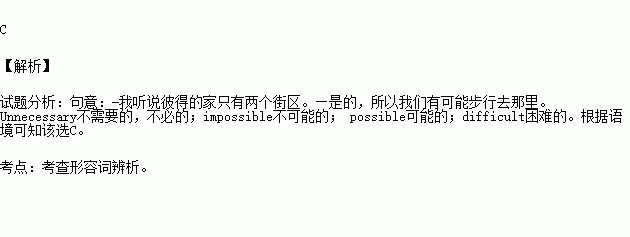
——I hear Peter’s home is only two blocks away.

——Yes, so it’s _________ for us to walk there.

A. unnecessary B. impossible

C. possible D. difficult
练习册系列答案

相关题目

How would we travel without maps? It would be a bit adventurous (冒险的) to set off from Oxford University to go to London Bridge if there wasn't a map of the London Underground at each station. In fact, a lot of the early map-makers were adventurers and explorers, especially in the 15th and 16th centuries.

So what did people do before there were maps? Well, it was quite easy to use natural signs like mountains and rivers if you were travelling on foot or riding a horse. People took small boats down rivers and followed coastlines. And it was much more logical (合理的) to use time, not distance, to measure (计量) journeys: the next village is a three-hour ride, for example.

In fact, in the earliest maps, people didn't draw landmarks. They drew the stars. It was very easy to see the night sky and use it for navigation (航行). The sky was a lot clearer before the light pollution from cities that we have today. When towns and cities were built, people drew road maps which gave correct distances and directions.

The London Underground was opened in 1863 and it also used a road map style. But a man called Henry Beck realized that travelling by train wasn't the same as driving your car across London. Passengers only needed to know which stations to change at. His new design (设计) for the Underground map wasn't very popular with the train companies at first. But the passengers loved it and in 1933, 700,000 copies were printed.

These days, of course, you can ride a bike, drive a car or go through a forest and know where you are exactly, using a GPS. It's really difficult to get lost!

1.What was drawn in the earliest maps?

A. Stars. B. Landmarks.

C. Cities and towns, D. Mountains and rivers.

2.When did road maps come out?

A. Around 15th and 16th centuries.

B. When people began to travel by train.

C. When people began to travel by sea.

D. When cities and towns appeared.

3.Which of the following is true?

A. A GPS helped people to travel long time ago.

B. Ancient people could travel on a horse without maps.

C. The sky was polluted by light before cities were built.

D. Henry Beck's map wasn't popular with the passengers.

4.What is the main idea of the passage?

A. Maps have a long history.

B. We never get lost these days.

C. We can't travel without maps.

D. Henry Beck designed a new map.

A documentary about smog(雾霾) has become well-known across the country with over 100 million views in less than 24 hours. Under the Dome, the documentary by Chai Jing, was shown on video-sharing websites in China on Feb 28. It has pushed the public awareness (意识) about air pollution and people to join in efforts to make a difference.

Showing a number of photos and videos, Chai examines how the pollution problem has become so in the country and told us the project was inspired(启发)by lung(肺) illness of her new-born daughter. “I all the windows. I started every day by checking the pollution index(指数),” Chai said. Millions of other people are also doing the things. While they stop there, Chai goes deeper. “I don’t want to live in this way. I need to find out where the smog comes from and what is going on.”

Over a year, she went to polluted areas to find the cause of smog, visited the US and the UK to learn about their , and interviewed officials, scientists and the general public.

The film has led to national after going popular online. Cheng Chen, a 22-year-old student from Beijing Foreign Studies University, found the documentary “very inspiring”. “I used to think it was not my duty to air pollution–I don’t own a factory or a car,” said Cheng. “But Chai tells me we share the same fate since we breathe the same air and there is a lot I can do.” At the same time, experts remind moved viewers of the film’s limitation. So what do you think of it?

1.A. 103- second B. 103-minute C. 103-hour

2.A. slowly B. rapidly C. quietly

3.A. prevented B. influenced C. encouraged

4.A. serious B. important C. necessary

5.A. opened B. cleaned C. closed

6.A. rubbish B. water C. air

7.A. same B. right C. terrible

8.A. news B. experiences C. hobbies

9.A. agreement B. discussion C. development

10.A. deal with B. find out C. listen to

违法和不良信息举报电话:027-86699610 举报邮箱:58377363@163.com

精英家教网