题目内容
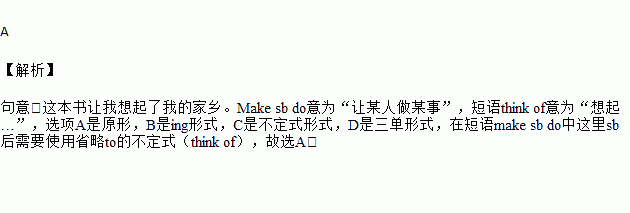
This book makes me _________ my hometown.
A. think of B. thinking of C. to think of D. thinks of
How often do you write emails to your pen pal?
A. Twice a month B. Three years ago C. For two weeks D. In five days
—I think we must obey the traffic rules.
—I ________ you.
A. agree to B. agree with
C. agree on D. agree
书面表达
Write at least 60 words with the topic “A heavy smog day” .(以“大雾霾天”为题,写一篇不少于60个词的短文,标点符号不占格。)
提示:去年12月上旬,杭州笼罩在茫茫的雾霾(was shrouded in heavy smog)中,陷于重度污染(severe pollution)。人们戴口罩(wear masks)出行,雾霾天给人们的健康带来危害,给生活和工作带来不便(inconvenience)。请你就其中某一天,描述你的经历和感受。
Since last December, Hangzhou has been in severe pollution____________________
__________________________________________________________________________________________________________________________________________________________________________________________________________________________________________________________________________________________________________________________________________________________________________________________________________________________________________________________________________________________
根据所给的汉语完成下面的句子,每空一词。
1.这种食品是用什么做的?
What is this kind of food ______________ ____________?
2.钙能使你的骨骼强壮。
Calcium can __________ your bones ____________.
3.你知道如何保持健康吗?
Do you know _____________ ___________ ___________ healthy?
4.我想吃苹果是最好的选择。
I think eating apples is the ____________ ___________.
5.丹尼,你需要多吃蔬菜。
Danny, you ____________ __________ ___________ more vegetables.
根据句意用适当的介词填空。
1.Are you afraid ___________ doctors?
2.Please don’t dress __________ such strange clothes.
3.It’s very kind ___________ you to do so.
4.Who are you smiling _________, Lisa?
5.What kind of music do you like to listen ________?
Empathy(同情心) lets us feel another person’s pain and drives us to help. Do any other animals feel empathy? Scientists recently found that rats(老鼠) do, too.
Most people don’t like rats. In many people’s eyes, rats are only bad. But Jean Decety and his partners at the University of Chicago did an experiment. It showed that rats are kind, warm-hearted animals. They can feel each other’s pain.
Scientists placed pairs of rats in plastic cages(笼子) for two weeks. During this time they got to know each other. Then they put one of the rats from each pair into a small container(容器) in the cages. The small container had a door. It was so designed as to fall to the side when the free rat touched it. Many of the trapped(困住的) rats squeaked(吱吱叫) to show their discomfort. The other rats of the pairs could see their suffering friends clearly.
In most pairs, the free rats would become very worried about their friends. They kept trying to save their friends again and again throughout the month. Scientists put the rats’ favorite chocolate in the cages, but the rats didn’t eat it until they had saved their friends successfully. Scientists also found that female rats seemed to act more empathetic than male rats.
“The results are the first to show that rats take action in response to another’s trouble,” Decety said. “Monkeys and chimpanzees have similar behavior. But unlike those animals, rats can be ready used in laboratory studies. They will help us to learn which parts of the brain lead to empathy and helping behavior and whether empathy is natural.”
1.A person with empathy is often _____.
A. kind-hearted B. clever C. active D. strong
2.What does the underline word mean in Chinese?
A. 休息的 B. 睡着的 C. 死亡的 D. 受苦的
3.Why didn’t the free rats eat the chocolate at first?
A. Because they were full at that time.
B. Because chocolate was not their favorite food.
C. Because they wanted to save the trapped rats first.
D. Because they were afraid that the chocolate was bad.
4.What does the passage mainly tell us?
A. Rats can feel other animals’ pain.
B. Chocolate is rats’ favorite food.
C. Female rats are more empathetic than male rats.
D. Rats are empathetic and can feel each other’s pain.
—Miss Li, must we hand in our homework right now?
—No, you ____.You can hand it in tomorrow.
A. don’t B. mustn’t C. needn’t D. may not
Tu Youyou, an 84yearold female(女性)scientist, became the first Chinese to win a Nobel Prize in science on Oct. 5.Before that, she ever won the 2011 Lasker Award for finding out artemisinin(Qinghaosu), which saved millions of lives.She was grateful(感激的)for the Lasker prize, but said, “It is just a scientist's duty.I will go on fighting for the health of all humans.”
Tu kept her work in the 1960s and 1970s.In that age, Malaria(疟疾)could take away people's health.Scientists all over the world had already tried over 240 000 times but failed.Tu Youyou, a member of the Academy of Traditional Chinese Medicine, Beijing, began to study Chinese herbs.
Before 2011, people didn't know Tu very much.Many friends played jokes with her “the Professor of Three None's” : no degree(学位), no study experience abroad, not a member of any Chinese national colleges.But she is hardworking.She read a lot of traditional Chinese medicine books and did a lot of researches on the disease.
In February, 2012, Tu was named National Outstanding Females(One of the Ten).Tu is now a model of Chinese medical workers.
1.Artemisinin is used to ________.
A. make medicine B. make food
C. get award D. do the experiment
2.In the 1960s and 1970s ________ could find ways to stop the Malaria.
A. scientists in China
B. only Tu Youyou
C. scientists all over the world
D. no scientist
3.Tu Youyou became very famous ________.
A. in the 1960s B. in 1970
C. before 2011 D. after 2012
4.From Tu Youyou's story, we know that she is a ________ woman.
A. friendly B. kind C. clever D. hard-working
5.What can't we learn from the passage?
A. Tu Youyou was the winner of 2011 Lasker Award.
B. Tu Youyou was a professor of much experience abroad.
C. Tu Youyou is the finder of artemisinin.
D. Tu Youyou was one of the ten National Outstanding Females.