题目内容

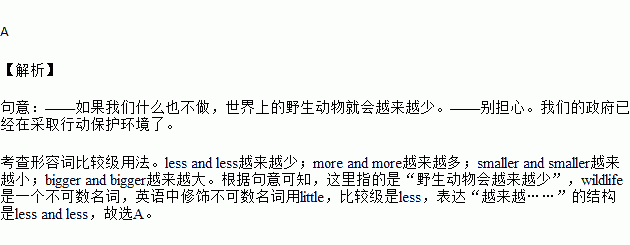
— There will be _________ wildlife in the world if we do nothing.

— Don’t worry. Our government has taken action to protect the environment.

A.less and less B.more and more C.smaller and smaller D.bigger and bigger
练习册系列答案
相关题目

“Never give up!” is my law of life. It has brought me ______. I learned the law from my father's ______ story.

My father was born in a ______ family in Jiangsu, China. When he was a young boy, he went to school in the morning, then he ______ in the field till sunset. He didn't finish his homework ______ midnight. Life was hard for the family because they had no ______ !

At the age of 14, my father heard of the United States of America. ______ was the land of gold, the land where poor people could become rich.

“_______ don't I go to America?” he thought to himself, full of hope.

So my father went to America. “I had thought it was easy to make money in America _______.” he told me. But when I arrived there, I realized it was not true. They did not like to hire(雇佣) me because I spoke ______ English. ______ I worked in a small restaurant, cleaning up tables,_____ the dishes and sweeping the floor. Life was hard in the first few years. I worked from 10 a.m. to 11 p.m. every day. I wanted to go to school to learn English, but it was _______. I couldn't pay for the schooling.

My father ______ working hard, and reached his goal at last.

“Alan,” he often says to me, “If you want something, you have to work for it and never give up. Things do not come ______ in life.” That's what I learned from my father.

1.A.trouble B.illness C.success D.mistakes

2.A.life B.fashion C.danger D.history

3.A.rich B.busy C.quiet D.poor

4.A.taught B.worked C.studied D.slept

5.A.until B.towards C.for D.during

6.A.experience B.energy C.time D.money

7.A.There B.It C.He D.They

8.A.Where B.How C.Why D.When

9.A.at first B.first of all C.secondly D.firstly

10.A.little B.good C.much D.excellent

11.A.So B.And C.But D.Or

12.A.giving B.running C.washing D.receiving

13.A.different B.necessary C.impossible D.wonderful

14.A.kept B.finished C.minded D.stopped

15.A.really B.easily C.quietly D.slowly

Sophie, a 14-year-old British girl, suddenly changed her behavior in class. She lost interest in studies and would sit in the corner with her head mostly down.

Ethan Miller, one of Sophie’s teachers, discovered the reason: she had been bullied(欺凌) online. Sophie was receiving abusive(辱骂) messages on her phone and on Facebook. Miller shared Sophie’s story on the official website of The Children’s Society, a children’s charity in the UK. Sophie was not alone. One in three young people, in 30 countries, said they have experienced online bullying. Twenty percent of those bullied students were not willing to go to school because of it, according to a report in September. The study surveyed more than 170,000 young people aged 13-24 from countries in Europe, Asia, Africa and South America. Seventy-five percent of them said social media, like Facebook and Twitter, are the most common places for online bullying. The growth of social media has left many young people hurt by online bullying, including unfriendly and abusive messages, comments and pictures.

The Internet world makes it easier for people to communicate with each other, but there is more danger for young people as well — and it is surprising that online bullying troubles many young people more than anything else. What’s more, online bullying could lead to serious results for young people. Such bullying makes young people more than twice as likely to hurt themselves or even kill themselves, according to a 2018 study by the university of Oxford, UK. The research also found that young people facing online bullying were not as likely to ask for help as those bullied by traditional ways.

To deal with the problem, UNICEF has called for national helplines to support people who are bullied, along with training for teachers and parents to prevent and deal with online bullying.

Here is some advice to keep yourself safe on the Internet:

1. Make sure that you’re careful and respectful to others, even if you don’t share similar opinions, values or beliefs.

2. If you experience online bullying, the best response to a bully is no response(回应) at all.

3. Keep a record of anything that shows proof(证据) of online bullying, like screenshots. You can use this to report and stop them.

1.What did Sophie do when facing bullying on the Internet?

A.She told her teacher about it. B.She isn’t willing to go to school.

C.She had no interest in studies. D.She would never sit in the corner.

2.The underlined word “discovered” in paragraph 2 most probably means _________.

A.find out B.hide C.protect D.work out

3.What action has UNICEF done to help with online bullying?

A.Respecting all the people around.

B.Improving young people’s studies.

C.Training teachers and parents to prevent bullying.

D.Keeping a record of anything that shows proof of online bullying.

4.How does online bullying trouble young people?

A.Make them willing to go to school. B.Make them unwilling to ask for help.

C.Make it easier for them to communicate. D.Make it impossible for them to hurt themselves.

5.Why does the writer write the report about online bullying?

A.To study the problem of online bullying.

B.To help teachers deal with students’ problems.

C.To tell people what UNICEF has done for children.

D.To help do with online bullying that troubles young people.

违法和不良信息举报电话:027-86699610 举报邮箱:58377363@163.com

精英家教网