题目内容
【题目】阅读下面图文,简要回答所给问题。
Are you happy? Perhaps some of you will say “no”. In fact, being a teenager is hard. You may worry about a lot of things in your life.
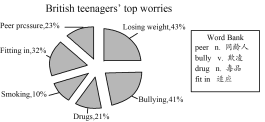
Do you know what British teenagers worry about most? You can find the answer from the chart below. The research was done by the UK's Department of Health among more than 100,000 teenagers. Here are the results.
Many Chinese teenagers share similar worries with the British teenagers. A recent research shows that many Chinese teenagers suffer from social life, study and emotional problems.
To solve the problems, some schools came up with the idea of happiness education. For example, Tsinghua University High School tried to meet students' needs. It built a skating rink and different laboratories to develop their interest.
While schools take action, students themselves can do something, too. The professor Nadia Lovett from Australia believes students' habits, hobbies and attitude toward life all play a role in their happiness.
【1】Which is the biggest worry of British teenagers?
_____________________________________ 。
【2】What percent of British teenagers worry about smoking?
_____________________________________ 。
【3】How did Tsinghua University High School meet students' needs?
_____________________________________ 。
【4】According to Nadia Lovett, what influences students' happiness?
_____________________________________ 。
【5】What do you often worry about in your life?
_____________________________________ 。
【答案】
【1】 Losing weight.
【2】 10%.
【3】 It built a skating rink and different_laboratories to develop their interest./By building a skating rink and different laboratories to develop their interest.
【4】 Students' habits, hobbies and attitude toward life.
【5】 Losing weight.(答案不唯一)
【解析】
你幸福吗?也许有人会回答“不”,的确做一个青少年是不容易的,他们的生活中会有很多的担心。这篇短文介绍了青少年最担心的一些事情,也提到了一些学校对此采取的措施。
【1】短文中有一张图片,介绍的是英国的青少年们最担心的几个问题,其中losing weight减肥占了43%,是占比最大的,故答案为Losing weight。
【2】根据短文中的图片,我们找到smoking这个问题可知,有10%的学生担心吸烟的问题,故答案为10%。
【3】根据短文中Tsinghua University High School tried to meet students' needs. It built a skating rink and different laboratories to develop their interest.可知,清华大学为了满足学生的需求,建造了一个溜冰场和不同的实验室来发展他们的兴趣。由此可知答案。
【4】根据短文最后一句话The professor Nadia Lovett from Australia believes students' habits, hobbies and attitude toward life all play a role in their happiness.可知,Nadia教授认为学生们的习惯、爱好和生活态度都会影响他们的幸福感。由此可知答案为Students’ habits, hobbies and attitude toward life。
【5】这个题目问的是“在你的生活中你经常担心什么?”,这是一道开放性的问题,学生们可以有不同的回答,如短文中图片所示的这些问题,可以从中选择一个回答。
这篇短文介绍的是青少年们日常生活中比较担心的一些事情,分析了影响他们幸福感的原因,也举例说明了一些学校对此采取的措施。文章是说明文,主题明确,层次清楚。题型是任务型阅读,后面的题目都是回答问题,考查我们对文章细节的理解。做题时,应先通读短文,掌握大意;然后根据题目所问定位到原文中,寻找答案。如第1小题和第2小题都是对短文中的图片提问的,答案可以通过观察图表得到。再如第4小题,可以根据题目中的人名Nadia Lovett定位答案在短文的最后一段中。



【题目】Cooking and learning
In this E-book package, we have four e-books.
This fun e-book is filled with exercises --- photo tests, word exams, riddle games coloring pages and exercises on learning more about food. |
Learn more about science and cooking with these food science experiments and instructions for kids. |
To go with the kids cooking lessons e-book, we’ve put our food facts into one e-book. Each part is easy to print off. You can keep it in the kitchen and teach kids facts about the food we eat. The Food Facts E-Book has over 60 pages. | Kids Cooking Lessons E-Book
|


【1】Fun with food will offer ______.
A. photo tests B. science experiments
C. food facts D. cooking instructions
【2】The pages of ______ are easy to print off.
A. Fun with food B. Kids Cooking Lessons E-book
C. Food Facts E-book D. Kids Food Science Experiments
【3】Mrs. Green wanted to learn some cooking together with her two daughters and she choose Kids Cooking Lessons E-book because_______.
A. There is a unit for each age group
B. there are a lot of photo tests in it
C. Kids can learn more about science
D. each part is very easy to print off