题目内容

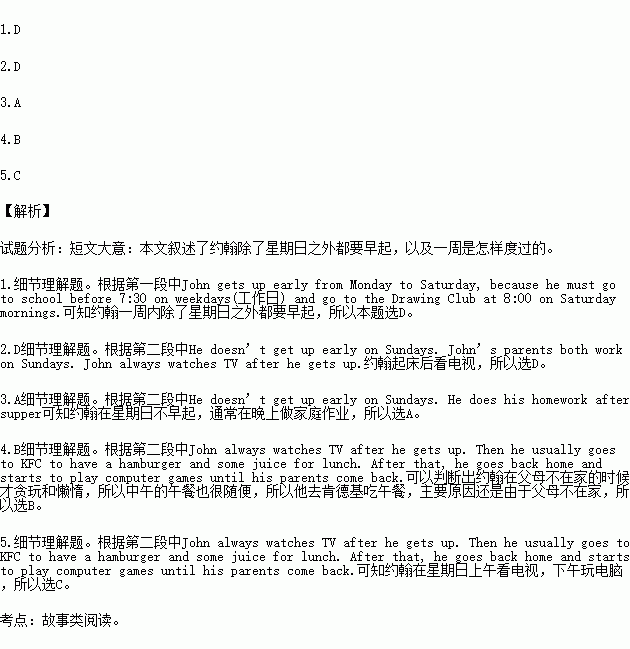
John gets up early from Monday to Saturday, because he must go to school before 7:30 on weekdays(工作日) and go to the Drawing Club at 8:00 on Saturday mornings. He usually goes to the bookshop on Saturday afternoons, and after supper he watches TV until(直到) midnight.

He doesn’t get up early on Sundays. John’s parents both work on Sundays. John always watches TV after he gets up. Then he usually goes to KFC to have a hamburger and some juice for lunch. After that, he goes back home and starts to play computer games until his parents come back. He does his homework after supper. He usually has lots of weekend homework, so he must spend three hours on it. He usually goes to bed at about 11:00 p.m. on Sundays. He often complains(抱怨) he has too much homework to do.

1. How often does John need to get up early?

A. Every day.

B. Five days a week.

C. Only at the weekend.

D. Every day except on Sundays.

2. What does John do on Sunday mornings?

A. He goes to have lessons.

B. He goes to a club.

C. He goes to the bookshop.

D. He watches TV.

3. When does John do his weekend homework?

A. On Sunday evenings. B. On Sunday mornings.

C. On Saturday evenings. D. On Sunday afternoons.

4. Why does John have lunch in KFC on Sundays?

A. Because he’s too busy.

B. Because his parents aren’t at home.

C. Because he gets up too late.

D. Because his parents have lunch in KFC.

5. Which of these is not right?

A. John watches TV after supper on Saturdays.

B. John doesn’t exercise on Sundays.

C. John watches much TV on Sunday afternoons.

D. John goes to bed late on Saturday and Sunday evenings.
练习册系列答案
相关题目

We often praise the world of science.

It explains the world and makes our lives easier with technology. One of the most exciting fields in science is artificial intelligence (人工智能,AI). This is an area where scientists are working on creating machines that think like humans.

However, one of the most famous scientists has a very dark warning for us about this type of technology.

“The development of full artificial intelligence could spell the end of the human race,” said Professor Stephen Hawking to the BBC.

Hawking is a well-known British physicist and author of bestselling science book A Brief History of Time. This warning came after commenting(评论)the technology he uses to speak with. As Hawking has got a serious disease called ALS, he needs an AI computer to communicate. The computer learns how Hawking thinks and suggests the words he may want to use next.

This is a basic type of AI, which is very useful, yet Hawking fears the possibility of creating technology that can match or surpass human intelligence. And it’s easy to imagine how terrible things may be. Many TV shows and films show big, killer machines that are far cleverer than us. “Humans, who are limited(限制) by slow biological evolution (进化), couldn’t compete,” said Hawking.

But not every scientist is pessimistic (悲观的) about AI technology. “I believe we will be in control of the technology for a long time,” said Rollo Carpenter, creator of Cleverbot in the UK, which is a software program that remembers past conversations. “The advantages of it to solve many of the world problems will be realized.” In what direction do you think AI is heading? Should we be hopeful or fearful?

1.Which of the following is TRUE about AI?

A. It makes our lives easier.

B. The technology is not very popular now.

C. Scientists haven’t controlled the technology.

2.The writer took Hawking as an example to ______.

A. explain how AI has helped us

B. show AI has already become part of our life

C. suggest that AI might become dangerous for humans

3.What does the underlined word “surpass” mean in the passage?

A. 象征 B.促进 C. 超越

4.We can know from the last paragraph that _________.

A. Rollo agrees with Hawking

B. Rollo is a British creator

C. Rollo invented Cleverbot in the US

5.Which of the following can be a suitable title for this article?

A. AI: a friend or an enemy

B. The future of human beings

C. The fight between humans and AI

You may know the English letters A, B and C. But do you know there are people called ABC? You may like eating bananas. But do you know there is such a thing a “banana person”? How strange! Are these people from “another earth”? No, they are just Chinese people like you and me.

ABC means American-born Chinese. An ABC is a Chinese, but was born in the United States. Sometimes, people call an ABC a “banana person”. A banana is yellow outside and white inside. So, when a person is a banana, he or she is white inside-thinking like a Westerner and yellow outside-looking like a Chinese.

Do you know why? Usually, ABCs know little about China or the Chinese language. Some of them don’t speak Chinese. Also, they are not interested in Chinese politics.

But if ABCs can not speak Chinese, can we still call them Chinese people? Yes, of course. They are Chinese. They are overseas Chinese (华侨). These people may be citizens (公民) of another country like the US, Canada or Singapore. But they have Chinese blood. Their parents, grandparents or even great-grandparents were from China. They all have black eyes and black hair. But they are not Chinese citizens. They are not people of the People’s Republic of China. For example, we all know the famous scientist, C.N.Yang(杨振宁). He got the Nobel Prize for Physics in 1957. Chinese people love him. But he is an American citizen.

1.What does “ABC” mean in this passage ?

A. three English letters

B. a kind of banana

C. Chinese born in America

D. Americans born in China

2.Why are Chinese in Western countries called “banana persons”?

A. their bodies are white inside but yellow outside

B. they like to eat bananas

C. they were born in China but got to study in America

D. they think like Westerners but look like Chinese

3.What does the underlined word “blood” probably mean?

A. 国籍 B. 血统 C. 爱心 D. 皮肤

4.What does this passage mainly talk about?

A. different kinds of bananas

B. the life story of C.N.Yang

C. the differences between Chinese and foreigners

D. overseas Chinese

违法和不良信息举报电话:027-86699610 举报邮箱:58377363@163.com

精英家教网