题目内容
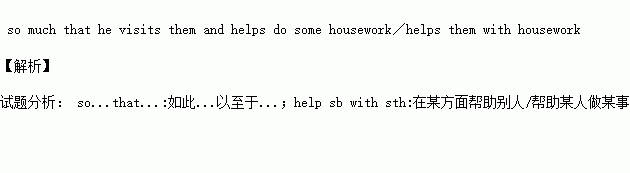
Jim很爱他的爷爷奶奶,他每周末都去看望他们,还帮着做些家务。
Jim loves his grandparents ________ every weekend.
到为春节做准备的时候了。
______________________ the Spring Festival.
你与你的同学相处得好吗?
Do you ________?
请在课前把书准备好。
Please _______________ before class.
我有两个学习英语的方法。一个是大声朗读英语,另一个是坚持收看英语电视节目。
I have two ways of learning English. ________.
昨天晚上,迈克太累了没能画完这幅画。
Mike was _________________ last night.
为了过低碳生活,我将继续骑车上下班。
In order to live a low-carbon life, I will ______ bikes to and from work.
明天是周六,为什么不和我一块参加“地球一小时”活动呢?
It’s Saturday tomorrow. ______ join “Earth Hour” event with me?
完形填空.
For the Japanese, gift-giving is an expression of thanks. It is an important social activity in Japanese life. Here are some customs of 1. gift-giving.
Devalue(贬低) the gift you give. You don't want the receiver to 2. that you are proud. Devalue your gift as much as 3. Praise the gift you 4. It is also important to praise the fine taste of the gift-giver in making that particular choice for you. And don't forget to give a thousand and one thanks. Don't open the gift 5. you aren't asked to do so. And when you do, you must open it carefully. After you see it, you should praise it and say 6. to the sender, and then rewrap the gift as if it was 7. opened. Wrap(包装) all gifts nicely. Wrap any gift with good paper or colorful cloth. Japanese gift-giving is not only a friendly expression but also a(n) 8. You should look out for the colors when you 9. the tapes(丝线). Red and white tapes are especially used for Valentine's Day, 10. red and green are for Christmas. Gold and silver are for weddings(婚礼).
If you keep these points in mind, you'll be sure to make any Japanese happy.
11.A.Japanese B.English C.Chinese D.Russian
12.A.see B.look C.buy D.think
13.A.good B.possible C.necessary D.impossible
14.A.sell B.buy C.receive D.give
15.A.until B.if C.after D.that
16.A.sorry B.thanks C.goodbye D.nothing
17.A.ever B.even C.never D.already
18.A.action B.job C.lesson D.art
19.A.get B.choose C.make D.sell
20.A.when B.after C.before D.while