题目内容

Bill Gates was born on October 28th, 1955. He grew up in Seattle, Washington. Bill Gates was named William Henry after his father and grandfather. He was a very clever boy. His favourite subject at school were science and maths.

When he was 13 years old, Bill started to play with computers. At that time, computers were very large machines. Once he was interested in a very old computer. He and some of his friends spent lots of time doing unusual things with it. In the end, they worked out a software programme with the old machine. Bill sold it for 4, 200 dollars when he was only 17.

In 1973, Bill went to Harvard University. At Harvard, he developed the BASIC language for the first microcomputer (微型计算机). In his third year, he left Harvard to work for a company called Microsoft. Bill began this company in 1975 with his friend Paul Allen. They thought that the computer would be a very important tool in every office and in every home, so they began developing software for personal computers. They improved the software to make it easier for people to use computer.

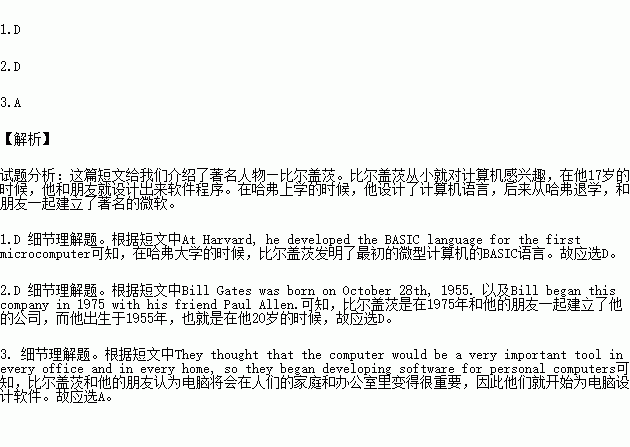
1.He developed the BASIC language for the first microcomputer______.

A. in Seattle B. in Washington

C. in New York D. at Harvard

2.When did he begin Microsoft Company with his friend?______

A. He was 13 years old. B. He was 17 years old.

C. He was 18 years old. D. He was 20 years old.

3.Why did they develop software for personal computer?______

A. They thought the computer would be a very important tool.

B. They wanted to make it easier for people to use computers.

C. They wanted to get much more money.

D. They were interested in it.
练习册系列答案
相关题目

We all know that every class has its own rules, like "No smoking!", "No eating!" and "No sleeping!". Our class used to be noisy, because some students were talking when a student was answering the teacher's questions. So our head teacher made some class rules.

In class, we should observe (遵守) the rules. Now, I list some rules in our class:

1. No talking when Someone is speaking.

2. No sleeping in class.

3. No eating in class.

4. Students can't arrive late for school. Be always on time.

5. No playing in class.

6. No laughing when someone makes a mistake.

7. No smoking or drinking.

8. Students can't dye (染) hair. Boys can't let their hair grow too long.

9. In the schoolyard (校园), students can't ride bikes.

10. Students can't fight with each other.

Maybe some students don't obey some of the rules. They may smoke, fight and dye hair. But most students think the rules are fine and say they will obey the rules. I think because our class has such rules, we will study better and better.

1.Who made the class rules?

A. The monitor B. The students.

C. The head teacher. D. The parents.

2.The students should go to school .

A. at seven o'clock B. by bike

C. very early D. on time

3. mentions (提到) that the students can't smoke or drink.

A. The second rule B. The fourth rule

C. The seventh rule D. The tenth rule

4.In the schoolyard, students .

A. can fight with each other B. can't play games

C. can play cards D. can't ride bikes

5.Which of the following is NOT true?

A. Our class was noisy in the past.

B. There are ten class rules listed.

C. Boys can't dye hair or let their hair grow too long.

D. Only a small number of students will obey the rules.

The brain receives information from the outside world through the sensory (感觉的) system.This information is collected through the eyes,the nose,the ears,the mouth and the surface of the body.It is then kept in the memory.In fact,scientists do not completely understand how the memory works but they are not sure how much information that the human brain can store.Also, it appears that the information is never lost.Very old people often remember things that happened in their childhood which have not come to their minds for sixty to seventy years.If we have kept something in our memory, it is here.But can we get it out again and use it? That is the difficulty.

Some of the information we receive only goes into the Short Term Memory.We only keep this information for a minute or two,then we lose it.This temporary (暂时的) memory is very important in our thinking and understanding.It is used,for example,when you try to remember a name that someone told you a moment ago or a telephone number that you are going to dial (拨).School children in class often seem to use the Short Term Memory if they are not interested in the subject.When school teachers describe this,they say that things go“in one ear and out in the other”.But if a child is interested,he puts the information in his Long Term Memory, and he never loses it.Long Term Memory depends heavily on our understanding of the meaning of the information we receive.

1.Information is collected through the of sight,hearing,smell,taste and touch.

A.sense B.experience

C.practice D.brightness

2.Very old people can remember something happened

A.recently B.about seventy years ago

C.in their thirties D.in their classroom

3.If a school child is not interested in a subject,

A.he forgets what he learns quickly

B.he memorizes what he learns quickly

C.he forgets what he learns slowly

D.he memorizes what he learns slowly

4.The better we understand the meaning of the information,

A.the more information we can put in our Short Term Memory

B.the more information we can put in our Long Term Memory

C.the less information.we can put in our Short Term Memory

D.the less information we can put,in our Long Term Memory

违法和不良信息举报电话:027-86699610 举报邮箱:58377363@163.com

精英家教网