题目内容
Which restaurant would you like ________ to?
[ ]
解析:
|
would like to do sth.喜欢做某事 |

Close contacts between Japan and the rest of the world were created in the twentieth century. In the last forty years, business contacts between Japan and the West have become very important. Many foreign companies now have offices in Japan and Japanese businessmen do business around the world. Differences between Japanese and Western ways of doing business, however, often bewilder foreign businessmen and make doing business in Japan difficult for foreigners.
The American businessman, for example, wants to start talking business immediately. He does not want to wait. The Japanese businessman, on the other hand, likes to arrive at decisions after giving them serious thought. Another thing foreign businessmen have difficulty in understanding is when a Japanese means “Yes” or “No”. This is because of cultural differences between Japanese and Western society(社会), Which make it difficult for a Japanese to say “No” directly.
In the USA, it is easy to say “No” to something one does not want to do. But in Japan, it is very difficult to say “No”. To refuse an invitation or a request(请求) with “No” is felt to be impolite. It is thought to be selfish and unfriendly. So instead of saying “No” directly, the Japanese have developed many ways to avoid(避免) saying “No”. These can help them avoid hurting other people’s feelings. However, this often makes their ways of doing business rather difficult for foreigners to understand and follow.
1.What often makes foreigners feel difficult to do business in Japan?
|
A.Their different ways of doing business. |
|
B.Their different lifestyles. |
|
C.The fact that the Japanese never say “No”. |
|
D.The fact that the Japanese are slow to take action. |
2.Which of the following is the closest in meaning to the underlined expression “bewilder foreign businessmen” in Paragraph One?
|
A.cause foreign businessmen to change their minds. |
|
B.give a feeling of surprise to foreign businessmen. |
|
C.attract foreign businessmen’s attention. |
|
D.make foreign businessmen think wrongly. |
3.What fact does the passage lead you to believe?
|
A.American businessmen do things more slowly than Japanese ones. |
|
B.American businessmen like to say “Yes” and “No”. |
|
C.Americans usually say what they are thinking. |
|
D.Americans do not say what they think or feel clearly. |
4.From the passage we can infer(推断) that __________.
|
A.Japanese businessmen are good at business |
|
B.foreign businessmen should try to know Japanese ways of doing business |
|
C.foreign businessmen must be more polite |
|
D.you must learn from Japanese businessmen if you want to succeed |
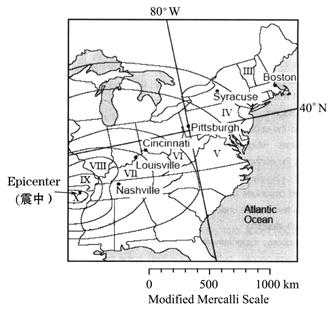
Earthquake Intensity & Observed Effects(强度与现象)
I. Felt by only a few people under very special conditions.
II. Felt by only a few people at rest, especially on the upper floors of buildings.
III. Felt noticeably indoors, especially on upper floors of buildings.
IV. Felt indoors by many people, outdoors by a few; some awaked.
V. Felt by nearly everyone; many awaked; dishes and windows break; plaster (灰泥) cracks (开裂).
VI. Felt by everyone; many frightened and run outdoors; heavy furniture such as tables and shelves moves.
VII. Everyone runs outdoors; small to moderate (中等的) damage(损毁) in usual buildings.
VIII. Considerable (相当大的) damage in usual buildings; monuments(碑) fall.
IX. Considerable damage in all buildings; ground cracks; underground pipes (管道) break.
X. Most buildings damaged; rails bend(弯曲); landslides (山崩) take place; water splashes(溅落) over banks.
XI. Few buildings left standing; bridges damaged; wide cracks in the ground; underground pipes break.
XII. Damage total; waves seen on ground; objects thrown into air.
1.According to the picture, what is the possible position of the earthquake’s epicenter?
A. 36°N, 90°W. B. 36°N, 90°E. C. 90°N, 36°W. D.90°N, 36°E.
2.What is the effects of earthquake intensity IV?
A. Everyone runs outdoors.
B. Only a few people feel it.
C. Many people who stay indoors feel it.
D. Felt by people on the upper floors of buildings.
3.According to the picture, which city would have announced the report: “Nearly everyone felt the earthquake, and many people were awaked. Dishes and windows were broken”?
A. Cincinnati. B. Louisville. C. Pittsburgh. D. Nashville.
4.Which statement best describes the earthquake intensity at Boston?
A. Felt indoors by few people under very special conditions.
B. Few buildings left standing.
C. Felt noticeably indoors, especially on upper floors of buildings.
D. Felt indoors by many people, outdoors by a few, some awaked.
5.For which city was the description of an earthquake “Heavy furniture moved, everyone felt it, and many were frightened and ran outdoors” reported?
A. Nashville. B. Louisville. C. Syracuse. D. Cincinnati.
Mary’s Timetable
|
|
Monday |
Tuesday |
Wednesday |
Thursday |
Friday |
|
8:00~8:45 |
English |
History |
English |
Physics |
Chinese |
|
8:55~9:40 |
Chinese |
Art |
Chinese |
Chinese |
English |
|
9:50~10:35 |
Math. |
English |
History |
Math. |
Music |
|
10:45~1130 |
P.E. |
Geography |
History |
P.E. |
Geography |
|
11:30~1:30 |
Noon break(午休) |
||||
|
1:30~2:15 |
Music |
P. E. |
P.E. |
English |
Self-study |
History (历史) Geography(地理) Physics(物理)
阅读表格,选择正确答案
1.Which lesson does Mary have every day?
A. English B. Chinese C. History D. Math
2. Mary has a rest at noon for_______.
A. 2 hours B. 1 hour C. 1.5 hours D. 2.5 hours
3. How many music lessons does Mary have in a week?.
A. three B. four C. two D. one
4. The third class begins at _____in the morning.
A. 9:35 B. 9:55 C. 9:50 D. 9:40
5.When does Mary have history?
A. Tuesday B. Friday C. Tuesday and Wednesday D. Monday
Mary’s Timetable
|
|
Monday |
Tuesday |
Wednesday |
Thursday |
Friday |
|
8:00~8:45 |
English |
History |
English |
Physics |
Chinese |
|
8:55~9:40 |
Chinese |
Art |
Chinese |
Chinese |
English |
|
9:50~10:35 |
Math. |
English |
History |
Math. |
Music |
|
10:45~1130 |
P.E. |
Geography |
History |
P.E. |
Geography |
|
11:30~1:30 |
Noon break(午休) |
||||
|
1:30~2:15 |
Music |
P. E. |
P.E. |
English |
Self-study |
History (历史) Geography(地理) Physics(物理)
阅读表格,选择正确答案
1.Which lesson does Mary have every day?
A. English B. Chinese C. History D. Math
2. Mary has a rest at noon for_______.
A. 2 hours B. 1 hour C. 1.5 hours D. 2.5 hours
3. How many music lessons does Mary have in a week?.
A. three B. four C. two D. one
4. The third class begins at _____in the morning.
A. 9:35 B. 9:55 C. 9:50 D. 9:40
5.When does Mary have history?
A. Tuesday B. Friday C. Tuesday and Wednesday D. Monday