题目内容

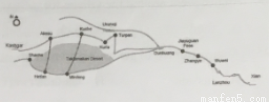
The Silk Road is the name of different roads that connected Europe, Africa and Asia long ago. It was named by F. von Richthofen, who was a famous German geographer. Scientists believe people began to travel the Silk Road about 3,000 years ago. People reached these different places along these roads. By the time the Chinese silk trade became important in the world, the Silk Road covered almost 7,000 kilometers. It went from Rome to China, which is from the West to the Far East.

Businessmen travelled along the Silk Road to carry silk, of course. They also carried and traded other things like spices(香料), cloth, jewels and gold.

Along and around these ancient paths(小路), have come many fascinating and mysterious stories.

It is said that Roman soldiers who lost a war travelled through central Asia. They decided to live somewhere near the ancient Chinese villages. Some of these Romans married local Chinese women and the stories of the blondhaired, blueeyed tribes of China was started.

Some historians believe that the people of Kashmir were taken away from their country Israel. They were prisoners(俘虏) of war almost 2,800 years ago. People say that these people travelled along the Silk Road. They kept their Jewish way of life for a long time.

During its busiest period, the Silk Road allowed people from many different cultures and countries to meet each other and mix. The Silk Road allowed the sharing of valuable things and new ideas. It included people and trading goods from different areas. All these peoples travelled the Silk Road, and they shared goods, stories, languages. and cultures.

In modern times, the old Silk Road routes(路线) are still used, but now they are crossed by trains instead of camels and horses. There is even a Silk Route Museum in Jiuquan in China.  It has over 35,000 objects from all along the Silk Road. In this way, China protects the history of many countries and peoples.

1.Who gave the name "Silk Road" ?

2.How long was the Silk Road?

3.What did people trade along the "Silk Road" in the past?

4.Did people share languages and cultures along the Silk Road?

5.How does China protect the history of Silk Road?

1.F. von Richthofen 2.Almost 7,000 kilometers. 3.Silk, spices, cloth, jewels and gold. 4.Yes, they did. 5.China built a Silk Route Museum in Jiuquan. 【解析】 试题本文介绍了丝绸之路对东西方经济文化交流的影响以及在...
练习册系列答案
相关题目

阅读短文,根据短文内容回答问题。

P. I. C. K. the Right Books for You

The secret to learn how to choose the right book is simple. It’s one word you can depend on when you’re in a library or a bookstore. All you need to remember is “ P. I. C. K. “ P. I. C. K. ” stands for Purpose, Interest,Comprehend, and Know the Words.

P= Purpose. Why are you looking for a book——reading for pleasure or trying to learn something? Reading silently for yourself or reading out loud for someone else? Most often, your purpose for reading can be found with a quick answer.

I = Interest. With the many millions of books on shelves today, there must be something out there for everyone. If you are interested in cars,consider books about history of racing, race car drivers, or car design. Even if you havea short amount of time to choose books, you can determine interest by looking at the front cover, flipping through(快速翻阅)the pages to have a quick look at photos or illustrations, or reading the back cover or the chapter titles.

C = Comprehend. It’s important to choose a book right for your level or ability. How to choose such a book? If you read books at Level A, for example, you’d better not choose a book at Level D. If the book isn’t labeled(贴标签)with a level, you can open the book and choose a page——then you can decide whether the book is at a right level for you by asking yourself:

Did I understand what I just read?

Do I remember what I read?

Was I able to read most of the words?

This brings us to our final letter;

K=Know the Words. Readers should be able to understand most of the words on the page. The key is the ‘‘Five Finger Rule” : Choose a book you would like to read, look at a page in the middle and put one finger down for every word you don’t understand. The “Five Finger Rule” shows a general idea of the relationship between the number of unknown words and the difficulty

level of a book;

0 — 1 unknown word = too easy

2 — 3 unknown words=just right

4~5 unknown words = too difficult

You want to know how to choose books right for you一books that are enjoyable, fun and exciting. P. I. C. K. is all about giving you the tools to be a strong and confident reader.

1.What does “P. I. C. K. ” stand for?

2.According to the passage, what is one possible purpose for reading?

3.What books does the writer advise you to read if you’re interested in cars?

4.What is the fourth paragraph mainly about?

5.If you put three fingers down when you’re reading a page, what’s the

difficulty level of the book?

1.It stands for Purpose,Interest,Comprehend,and Know the Words. 2.For pleasure./Trying to learn something./Reading silently for oneself./ Reading out loud for someone else. 3.Books about history...

请认真阅读下面短文,并根据短文内容回答问题。

Once again, I argued with my son, which I never really wanted to do. When I told my friend about my problems with Paul, he showed me a short article that he had read. It was titled “Disagreeing, with Good Results”.

The article said that understanding another person is never easy, but it is most difficult when we do not agree with the other person. If we want to have good relationships with other people, we must learn to disagree fairly, so that we can solve our problems.

The article went on to say the first rule for a good disagreement is: we must want to solve the problem. Sometimes when people argue, they do not really want to end the disagreement. Therefore, they usually shout at each other, and one person walks away just to end the disagreement. Nothing is changed. The problem is still there.

The second rule is: we should make the problem clear in the simplest way possible. What exactly are we arguing about?

The third rule is: we need to listen actively. In active listening, we listen to understand what the other person says rather than thinking only about what we want to say next. Before we react to the other person’s ideas, we should be sure that we understand them. While we are listening, we should look for similarities in our ideas, not difference. We should look for a way to compromise — to find a solution that both of us can be happy with.

1.What’s the name of the writer’s son?

________________________________________________________________________

2.How can we solve the problems with the other people according to the article?

______________________________________________________________________

3.What will happen if one person walks away to end the disagreement?

______________________________________________________________________

4.Which solution should we find while listening actively?

_______________________________________________________________________

5.How can we get along well with others in your opinion? (请自拟一句话作答)

_____________________________________________________________________

1.His name is Paul./Paul. 2.We must learn to disagree fairly. / By learning to disagree fairly. 3.Nothing is changed./ The problem is still there. 4.The solution that both of us can be happy ...

Four friends were drinking in a village pub(酒吧).Their jackets were hanging on the backs of their chairs. Suddenly one of them, Jack_______that he had lost one hundred pounds. Fred said he was sure_______here had stolen the money. Tom suggested that they should all empty their pockets on the table. But the owner of the pub would not let them do that because all______will look the same. They didn’t know what to do.______, Mike, a traveller, stood up. He said he could help find the money.

“You know how______some animals are,” He said. “I've found out that roosters(公鸡)are good at catching thieves. Let's______the pub owner's rooster.”

Mike took a big black pot(锅)and put it upside down on the table. Then he put the rooster under it. “After I turn off the lights,” he said, “you must come up one by one and touch the______of the pot with your right hand. When the thief does so, the rooster will crow(啼鸣).”

______people did not know whether they should believe him. One by one they went_______the table in the dark, the rooster never made a_______.

“I'm afraid it was a waste of time, “Fred said when the lights were turned back________.

“I'm not sure it was,” Mike said. Then he asked everybody to_______his right hand. He looked at each hand in________, then took Fred's hand and said, “Fred, give the money back to Jack.”

“You must have made a mistake.________, the rooster never crowed! I have nothing to do with the theft,” said Fred.

Mike told Fred to look at all the other hands. “They're all black except yours. Can you______why you didn't dare to touch the pot, Fred?”

1.A. said B. asked C. insisted D. shouted

2.A. somebody B. everybody C. anybody D. nobody

3.A. pockets B. tables C. money D. paper

4.A. Since then B. By then C. Just then D. From then on

5.A. silly B. clever C. beautiful D. curious

6.A. lend B. sell C. borrow D. cook

7.A. bottom B. side C. owner D. top

8.A. Another B. Other C. The others D. The other

9.A. beyond B. past C. across D. onto

10.A. noise B. mistake C. difference D. decision

11.A. off B. up C. down D. on

12.A. show B. touch C. hide D. clean

13.A. order B. time C. turn D. place

14.A. Above all B. In all C. Not at all D. After all

15.A. express B. explain C. describe D. repeat

1.D 2.D 3.C 4.C 5.B 6.C 7.A 8.B 9.B 10.A 11.D 12.A 13.C 14.D 15.B 【解析】这篇短文给我们讲述了一个故事,说的是几个朋友在酒吧喝酒的时候,Jack丢了一百英镑钱。大家都不知道该怎样找出小偷,最后Mike想出了一个聪明的办法。 1.句意:突然...

违法和不良信息举报电话:027-86699610 举报邮箱:58377363@163.com

精英家教网