题目内容

— Have you been wasting time on cartoons again?

— __________. I’ve been working all the time and I need a break.

A. Not really B. No way C. That’s all right D. I couldn’t agree more


A

【解析】

试题分析:句意:你又在卡通上浪费时间了吗?不是真的,我一直在工作,我需要休息。A. Not really不是真的B. No way没门C. That’s all right 没关系D. I couldn’t agree more 我完全同意。根据句意,故选A

考点:考查情景交际


练习册系列答案

相关题目

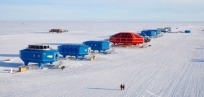
In the most southern part of our planet, there’s a place that’s covered with snow and ice all year round. But it has the clearest and cleanest air. Amazingly, in this place, the sun sometimes hangs even in the midnight sky. This place is Antarctica (南极洲): the coldest, windiest and harshest (恶劣的) place on the Earth.

As the world’s least-known place, Antarctica is of great interest to scientists around the world. In 1983, China joined the Antarctic Treaty (《南极条约》). The treaty made Antarctica a peaceful place for member countries to do scientific research. During 30 years, China has sent many scientists to Antarctica. They mostly look at the resources under the icy land and do research about climate change and marine (海洋的) biology.

Antarctica is a place with fantastic views. However, life there is very hard. Food is one of the biggest problems. Frozen (速冻) food which can be heated easily is people’s daily food. Fresh vegetables are hard to grow in the cold weather. Therefore, scientists often eat dried or canned vegetables.

Sleep is also troublesome. In Antarctica, summer lasts from November to March. During this period, Antarctica points to the sun and receives sunlight 24 hours a day. In order to get some sleep, scientists cover the windows with black plastic cloth to create “night”.

Working in Antarctica is dangerous, especially when meeting gale-force (七级以上的) winds. Sometimes the wind is even stronger than a typhoon. It can easily blow people away. So there are ropes that connect buildings of some research stations. People can hold these ropes to keep their balance in forceful winds.

What’s more, communicating with others is difficult. Without cables and Internet in some research stations, two-way radios are the only tools to communicate. If people want to say hello to friends and relatives, they can use satellite phones.

Although it is challenging to work in Antarctica, scientists’ passion to learn about this mysterious land will never end. It is hopeful that one day they will step every corner of this icy land.

1.From Paragraph 1, we learn that the Antarctica ______.

A. is covered with snow and ice

B. rains heavily from time to time

C. has little wind most of the time

D. has sunshine during every night

2.Scientists from China go to Antarctica to _____.

A. find out ways to control water pollution

B. research climate change and marine biology

C. grow plants and vegetables in special condition

D. stop the hunters from killing the marine biology

3.In order to sleep well in Antarctica, the scientists have to _____.

A. wear more clothes to keep warm

B. cover the windows with black cloth

C. connect research stations with ropes

D. eat more fried and canned vegetables

4.We can replace (替换) the underlined word passion in the last paragraph with .

A. strong love

B. full preparation

C. pleasant introduction

D. amazing imagination

5.The passage is mainly about .

A. view of the Antarctica

B. exploring the Antarctica

C. how to survive in the Antarctica

D. climate changes of the Antarctica


You may have known several kinds of police, traffic police, and street police. But have you ever heard of energy-saving (节能) policemen?

A group of 22 of these new policemen went to work last week in Beijing. They go around the city to see the use of energy in hotels, office buildings, shopping centers and other public places. One of their aims is to make sure that these places have set their air conditioning (空调) no cooler than 26 .

"If everyone sets their air conditioning at 26 , Beijing will save 400 million kilowatt-hours of electricity in one summer. That's one-third of all the usage of the city in the season," said a TV advertisement.

Other Chinese cities, like Wuhan in Hubei Province and Yangzhou in Jiangsu Province, are going to follow Beijing's steps in setting up a similar police team.

From 1986 to 2005, China met 20 warm winters. It means that Chinese cities have to spend billions of yuan solving the environmental problems every year.

To introduce a green life to the public, Beijing also held a show on energy-saving technology and productions last week. It attracted lots of attention.

"We want to tell people that there are certain ways to protect the environment. Each of us can find right ways to do it in our daily lives," said Liu Qianguang, an environmental engineer in Beijing.

1.The job of the energy-saving policemen is ___________.

A. to set the air conditioning cooler

B. to check the use of energy in public places

C. to stop people using air conditioning

D. to make sure that more energy will be produced

2.Beijing will use ___________ million kilowatt-hours electricity in one summer.

A. 1200 B. 800 C. 400D. 133

3.Which of the following years' winters were all warm in China?

A. 1984-1988.B. 1999-2003. C. 2002-2006. D. 2005-2009.

4.According to Liu Qianguang, ___________.

A. there are few ways to protect the environment

B. it's difficult to find good ways to save energy

C. it's easy for one to do something good for the environment

D. it's not easy for one to do something good for the environment


违法和不良信息举报电话:027-86699610 举报邮箱:58377363@163.com

精英家教网