题目内容
Having been translating some of the most valuable ancient Chinese literary works to Spanish(西班牙语) for years, Alicia Relinque has found the key to happiness in her life. When asked by a reporter, “It is the Chinese literature,” said Relinque, a modest and peaceful teacher.
She easily becomes excited when talking about Chinese culture and classic(经典的) literature. Relinque’s translation works include The Peony Pavilion(牡丹亭) by Tang Xianzu in the 16th century --- a romantic play about a love story, and The Orphan of Zhao --- a drama written in the 13th century similar to Hamlet, which are excellent classic works in Chinese culture.
When translating a famous Chinese novel which she liked a lot, she slept only six hours every day in six years because she spent lots of time reading materials about Chinese politics, history and society during that period of time.
After four years’ Chinese study in Peking University, she learnt that the University of Granada would open a department in Asian studies, so she moved to the city in south Spain in 1994 and has stayed there ever since.
She started the Chinese classical literature study in Spain, and therefore made the University of Granada a major place of sinology(汉学) in the country.
Given her excellent work in translating Chinese classic literature, Relinque was granted(授予) a special prize by the Chinese government in 2017.
“Spain should pay more attention to China, and on the other hand, I ask my students to study Chinese history because the country’s today and future lie in history,” said Relinque.
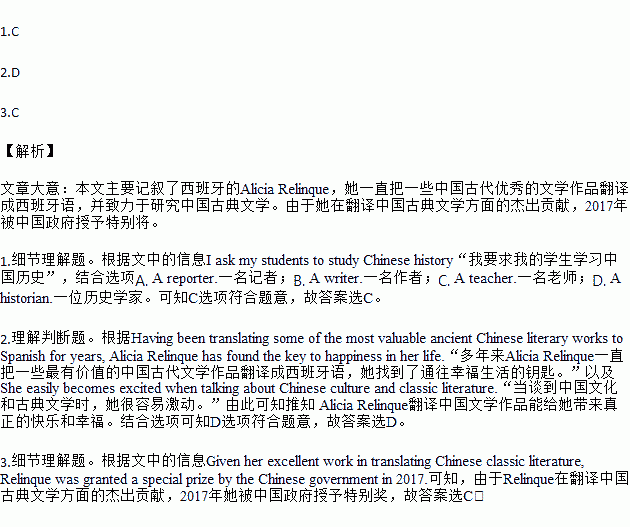
1.Who is Relinque?
A. A reporter. B. A writer.
C. A teacher. D. A historian.
2.Which of the following is true according to the passage?
A. To know China, Relinque learned Chinese history first.
B. Relinque has translated Hamlet into Spanish and Chinese.
C. Relinque spent 6 hours translating literature work every day.
D. Translating Chinese literary works brings Relinque happiness.
3.Relinque was granted by the Chinese government because of _____________.
A. Her experiences in Peking University.
B. Her words of supporting Chinese culture.
C. Her translation of Chinese classic literature.
D. Her teaching achievement of sinology in Spain.