题目内容
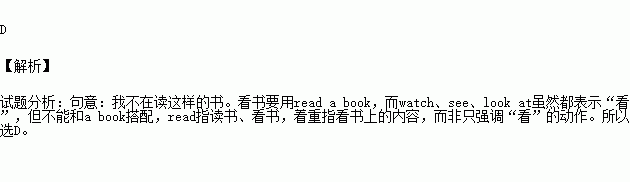
I'm not ______ a book like this.
A. watching B. looking at C. seeing D. reading
---- Don’t talk in class, please. -----Sorry, I__________.
A. do B. don’t C. will D. won’t
It’s never pleasant to stand in a crowded subway train. To make it worse, there’s often someone next to you eating loudly.
Eating and drinking is not rare(罕见的) among Chinese passengers. They may do this to save time, but the smell and noise annoys(打扰) others.
To change this, the Beijing municipal government is thinking about banning people from eating and drinking on the subway. Those who break the rule could face a fine(罚款) of up to 500 yuan.
Many people support the rule because they care for public manners in the city. Besides, eating and drinking on the subway is not healthy for both the eaters and the people around.
But others say that sometimes eating and drinking should be OK..
“If a little child is eating on the subway, how can you fine him 500 yuan?” said Jin Bo, a news commentator.
But he suggests that people start to pay attention to the issue(问题).
“Eating [in public] is not only about ourselves. It annoys others. We should keep this in mind from a young age.”
Beijing is not the first city in China to fine eaters on the subways. People who eat on the subway in Hong Kong face fines of up to 2,000 Hong Kong dollars(1,625 yuan).
1.Why are some people used to eating and drinking in a subway train?
A. To make the food smell better
B. To save time
C. They have nowhere to eat
D. They are too hungry.
2.The article tells us about what problem on the subway?
A. People sometimes have to stand for a long time.
B. It’s too crowded to move on the subway.
C. Many people often talk on the phone.
D. Some people are eating and drinking on the subway.
3.What does the underlined word “banning” in Paragraph 3 mean?
A. 禁止 B. 支持 C. 同意 D. 默认
4.What do many people think of the rule?
A. It has nothing to do with them.
B. It’s good for public manners.
C. They are worried about being fined.
D. It won’t last for long.
5.From the article, we learn that .
A. children can still eat or drink on the subway.
B. Beijing is planning to ban food and drink on the subway.
C. Beijing is the second city in China to fine eaters on the subway.
D. people in Hong Kong are not happy with the rule.
— 1ate for school again,Tim!
一Sorry,I promise that I .
A.Don’t;won’t B.Don’t;will
C.Don’t be;don’t D.Don’t be;won’t
There are different kinds of presents in the gift shop. I can’t decide _______.
A. to buy what B. to buy which
C. what to buy D. which to buy
完形填空。
通读下面的短文, 掌握其大意, 然后从各题所给的A、B、C三个选项中选出一个最佳答案。
A businessman sent his son to learn the secret of happiness from the wisest man. The boy walked through the desert for forty days he reached a beautiful castle at the top of a mountain where the Sage (圣人) lived.
When he a room, he saw lots of strange views: businessmen coming and going, a small music group sweet music, and all kinds of delicious dishes on a large table.
The Sage everyone. The young man had to wait for two hours until it was his .
______ enough patience, the Sage listened to the boy, but he was too ___ to explain to him the secret of happiness. While he suggested that the boy walk ___ his palace and come back in two hours.
“However,” he added, handing the boy a teaspoon with two drops of oil in it, “while you walk, _______ this spoon and don’t let the oil spill.”
The boy began to walk around the palace, keeping his eyes fixed on the spoon. At last he returned to the Sage.
“So,” asked the Sage, “did you notice anything amazing in my palace?” Embarrassed(尴尬的), the boy said that he had seen . He was only concentrating on the .
“OK. Now go back and see the wonders of my world,” said the Sage. Now more , the boy took the spoon and walked again through the palace. Returning to the Sage, he exactly reported ___ he had seen.
“But where is the oil?” asked the Sage. Looking down at the spoon, the boy realized that he had spilled it all.
“Well, the secret of happiness lies in looking at all the wonders of the world and never ____ the two drops of oil in the spoon,” the Sage said with a smile. They were both important. Then the boy realized what happiness was.
1.A. until B. when C. after D. since
2.A. saw B. left C. entered D. lived
3.A. hearing B. writing C. enjoying D. playing
4.A. looked for B. talked with C. heard from D. knew about
5.A. time B. way C. turn D. duty
6.A. To B. For C. In D. With
7.A. busy B. angry C. happy D. funny
8.A. into B. around C. across D. out of
9.A. catch B. bring C. get D. take
10.A. never B. nearly C. always D. sometimes
11.A. something B. anything C. nothing D. everything
12.A. spoon B. man C. castle D. palace
13.A. carefully B. freely C. luckily D. difficultly
14.A. that B. which C. who D. what
15.A. forgetting B. minding C. realizing D. considering
You can take_______ of the two toy cars and leave the other for your brother.
A. both B. none
C. either D. neither
---I hear Miss Wang will go boating with us this Sunday.
--- We will have a good time.
A.Good news! B.Thanks a lot.
C.What a pity! D.Don’t mention it.
He is ________to reach the apple on the tree.
A. enough tall B. tall enough C. thin enough