题目内容


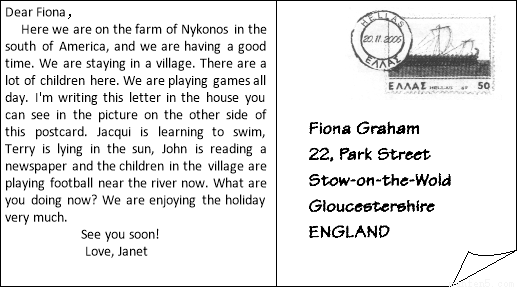
1.Who is writing the postcard?

A.Fiona. B.Janet. C.Terry. D.Jacqui.

2.Where are they staying now?

A.North of the Great Wall.

B.In the south of England.

C.In a big city.

D.In a village.

3.Which one is NOT right?

A.John is reading a newspaper.

B.The children are swimming in the river.

C.Terry is lying in the sun.

D.Janet is in the house.

4.How do they like the holiday?

A.enjoyable B.terrible C.boring D.bad


1.B

2.D

3.B

4.A

【解析】

试题分析:这篇文章主要讲了我们去乡村去玩,我们玩的很高兴。

1. 细节题。根据信件的落款名Love, Janet可知这封信是Janet所写。故B正确。

2.细节题。根据信的第一句Here we are on the farm of Nykonos in the south of America. We are staying in a village.故D正确。

3. 细节题。在文章中提及了ACD3项,但是B项中的swimming in the river没有提及in the river,故B项符合要求。

4.推理题。根据文章最后一句话We are enjoying the holiday very much可知他们玩得非常开心。故A正确。

考点:故事类阅读。

练习册系列答案
相关题目

完形填空(共15小题,每题1分,满分15分)

阅读下面短文,从短文后各题所给的四个选项中,选出可以填入空白处的最佳选项。

After the earthquake hit northeast Japan on March 11, 2011, many moving stories that I saw with my own eyes happened around me.

I had to walk home since all the had stopped after the quake. On my way home I an old Japanese lady at the bakery shop who was giving out free bread, which made my heart . A middle-aged Japanese man was holding a sign that said, “Please use our .” He was opening his house for people to go to the restroom.

My friend wanted to help others. He stood in the cold with a sign “If you are okay with a motorcycle, I will you to your house.” And then I saw him take one gentleman home, all the way to faraway place!

Then the next day I drove to my car with gas. There is a lack(缺乏)gas (汽油)now and many gasoline stations were either closed or had very lines. I got worried, since I was behind 15 cars. Finally, when it was my , the man smiled and said, “ this situation, we are only giving $ 30 worth gas per person. Is that alright?” “Of course, I’m just glad that we are all able to ,” I said. His smile gave me so much comfort.

I saw a man at the evacuation(疏散) center when people brought food to him, It was the first time in three days that food has been brought to their center. However, after he wiped the tears, his next surprised me. “I am very that we are provided with food. But people in the city next to us haven’t any food at all. Please go to that centre as well.” And when hearing that, I realized there is a bright future on the other side of this .

1.A. work B. life C. traffic D. business

2.A. missed B. caught C. noticed D. heard

3.A. kind B. soft C. broken D. warm

4.A. toilet B. hotel C. hospital D. house

5.A. drive B. follow C. lead D. send

6.A. start B. fill C. check D. wash

7.A. direct B. fine C. long D. thin

8.A. time B. turn C. duty D. decision

9.A. Except for B. Together with C. Because of D. Instead of

10.A. share B. offer C. learn D. choose

11.A. singing B. eating C. smiling D. crying

12.A. words B. roles C. ways D. promises

13.A. sure B. grateful C. surprised D. proud

14.A.bought B. wasted C. prepared D. received

15.A. disaster(灾难)B. chance C. center D. city


A baby giraffe is born 10 feet high and usually lands on its back. Bringing a giraffe into the world is a tall order. In his book, A View from the Zoo, Gary Richmond describes how a new-born giraffe learns its first lesson.

The mother giraffe lowers her head long enough to take a quick look. Then she puts herself directly over her child. She waits for about a minute, and then she does the most unreasonable thing. She throws her long leg and kicks her baby, so that it’s sent sprawling (四脚朝天).

When it doesn’t get up, what the mother has done is repeated again and again. The struggle (挣扎) to rise is important. As the baby giraffe grows tired, the mother kicks it again. Finally, it stands for the first time. Then the mother giraffe kicks it off again. Why? She wants it to remember how it can get up. In the wild, a baby giraffe must be able to get up as quickly as possible to stay with its group, where there’s safety.

Another writer named Irving Stone understood this. He spent a lifetime studying great people, writing stories about such men as Michelangelo, Vincent van Gogh, Sigmund Freud, and Charles Darwin.

Stone was once asked if he had found something unusual about these great people. He said, “I write about people who sometime in their life have a dream of something. They’re beaten over the head, knocked down and for years they get nowhere. But every time they stand up again. And at the end of their lives they’ve realized some small parts of what they set out (着手) to do.”

1.The expression “a tall order” in Paragraph 1 most probably means ______.

A. a happy thing B. a difficult task

C. a big dream D. a beautiful place

2.A View from the Zoo is a book written by .

A. Gary Richmond B. Charles Darwin

C. Irving Stone D. Vincent van Gogh

3.The mother giraffe puts herself over her child and throws her long leg and kicks her baby because she .

A. is an unkind mother

B. likes watching her bay sprawling

C. doesn’t want her baby to live with her

D. wants to train her baby to get up in this way

4.The writer mainly wants to tell the readers that .

A. the giraffe is an unusual animal

B. we should learn to be a careful writer

C. learning to get up leads to success

D. A View from the Zoo is a good book to read


违法和不良信息举报电话:027-86699610 举报邮箱:58377363@163.com

精英家教网