题目内容
—What’s your _______, Dave?
—I want to be a musician one day.
A. job B. habit
C. dream D. question
C 【解析】句意:——Dave,你的梦想是什么?——我想有一天成为一名音乐家。job工作;habit习惯;dream梦想;question问题。根据I want to be a musician one day.可知此处表示梦想,故选C。—Bill, do you get home by bike _______ by bus?
—By bus.
A. and B. but
C. or D. so
查看答案Mrs. Green is so nice. She’s like a mother _______ us.
A. with B. to
C. about D. of
查看答案书面表达(15分)
上周六你们班同学在老师的带领下参观了博物馆。请根据下列提示写一篇短文介绍活动的过程以及你的感受。要求:短文必须包括所有提示点,不少于60词。
提示:①出发时间(8∶30am) ②交通方式(bus) ③路上所用时间(about twenty minutes) ④活动内容(see old things, listen to the guide, watch videos) ⑤返程时间及感受(5∶00pm, tired, happy and excited)
查看答案
根据句意,用括号中所给词的适当形式填空。
1.Jane got up late.__ (luck),she didn't miss the early bus.
2.Mary likes drawing very much.Her __ (paint) are very beautiful.
3.I __ (hear) from my friend yesterday.
4.Miss Lin is __ (worry) about her son.
5.He __ (feed) the little rabbit much milk yesterday.
查看答案单词填空。用括号中所给词的适当形式填空,使语篇意思完整,必要时请用否定形式。
There was a boy and his family was very rich(富裕的).One day his father 1. (take) him on a trip.He wanted2. (show) his son how poor(贫穷的) people were there.They spent seven 3.(day) on the farm.There4. (be) many poor families living on the farm.
On5. (they)way home, the father asked the son, “How was the trip?”
“It was great, Dad,” the son answered.
“Did you see how poor people were there?” asked his father.
“Oh, yes,” said the son.
“So, tell me,” said his father.
The son said, “Well, we have one dog and they have four.We have a pool in our garden(花园), but they have a river.We have expensive lanterns(吊灯), but they have free 6. (star) at night.We have only a small house 7. (live) in, but they have a big farm.We buy our food, but they 8.(grow) theirs.”
Hearing this, the father didn't say9. (something).
Then the boy said, “Thank you for 10. (let) me see how poor we are.”
查看答案 试题属性- 题型:单选题
- 难度:中等
 Copyright @ 2008-2013 满分5 学习网 ManFen5.COM. All Rights Reserved.答案无忧

I think important for us to help people learn more about protecting animals.
A. that B. that's C. its D. it
D 【解析】句意:我认为对我们来说重要的是帮助人们更多地了解保护动物。根据句型think it+形容词for sb to do sth“认为对于某人来说做某事是……”此处作为形式宾语,故用代词it。故选D。The worker asked the _______ not _______ down their names in this form.
A. writer; to write B. writers; writing C. writers; to write D. writer; write
查看答案The woman keeps _______ the house because she wants to keep it _______.
A. cleaning; clean B. to clean; clean
C. clean; cleaning D. cleaning; cleaning
查看答案-What do sparrows look like? - _______.
A. They are really cute animals B. They like eating insects
C. They are fine D. They are small
查看答案-Why are you so excited? -Peter invited me _______ on a trip to Yunnan.
A. to go B. go C. going D. went
查看答案-What's that bird called in English? -Which one? There are two. Do you mean the one with _______ neck?
A. long B. longer C. a longer D. a longest
查看答案 试题属性- 题型:单选题
- 难度:中等
Copyright @ 2008-2013 满分5 学习网 ManFen5.COM. All Rights Reserved.答案无忧
How Different Will Things Be 20 Years From Now? We asked readers to write to tell us about their predictions for life in the future.Here are a few of their responses.
I don’t think life will change a lot over the next 20 years.I think more people will be living in
even bigger cities than today.Fewer people will be living in the countryside.Pollution will be the most serious global problems.
-----Li Ling, Beijing We’ll be doing all our shopping online.I think shops are going to disappear and they will be
replaced(代替) by online shopping malls.The process(过程)has already started with some city supermarkets taking online orders. We’ll be able to buy anything,even buildings.
----Sharon, Sydney
I’m sure we won’t be driving cars or personal planes.I think it’s more likely that we’ll be
walking and riding bikes more.Oil (石油)is going to run ou(t
用尽) and cars are going to become
too expensive to use.Also,air pollution will be the biggest problem in cities so we’ll have to find other clean ways of transport.The railways will develop and there will be a lot more very fast trains.
1.As Li Ling, will be the most serious problem.
A. People B. Air pollution C. Pollution D. Oil
2.According to the passage, what’s the meaning of the underline word disappear?
A. 消失 B. 出现 C. 提高 D. 流行的
3.What will happen if there is no oil?
A. We will have to find other clean ways of transport.
B. There won’t be more fast trains
C. We will drive personal planes
D. Cars are going to become cheap to use
4.According to the four students, which is ture?
A. Rose thinks shops are going to disappear.
B. We will walk and ride bikes less
C. Students will spend less time online at home.
D. We will be able to buy anything on line at home
5.Which is the best title for the article?
A. The most serious problems in the future
B. Air pollution will be a major problem in cities
C. How different will things be in 20 years?
D. On-line shops will be more popular.
1.C 2.A 3.A 4.D 5.C 【解析】本文是几位读者认为20年后的生活和现在的不同。 1.C 细节理解题。根据Pollution will be the most serious global problems.-----Li Ling, Beijing 可知李玲认为污染将是最严重的问题,故选C。 2.A 词义猜测题。根据they w...It was a Monday morning. As the teacher walked into the classroom, he heard a low voice (低声), "Here's the teacher. I'm sure this boring fellow (家伙) is going to talk about how to use commas (逗号)." It was a boy's voice and the teacher knew who he was.
However, the teacher didn't get angry. He said nothing about it, but really began to talk about how to use commas And then he wrote the following sentence on the blackboard, "Nick says the teacher is a boring fellow."
The class laughed and Nick's face turned red. "Now," said the teacher, "I'll tell you the importance of commas." He put two commas in the sentence and then read, "Nick, says the teacher, is a boring fellow."
The whole class laughed again. Nick felt very surprised first, then his face much redder.
Finally he couldn't help (情不自禁) laughing with the other students, too.
1.What subject did the teacher teach the students?
A. math B. English C. music D. history
2.What kind of boy was Nick like?
A. naughty B. healthy C. tall D. good
3.I think Nick liked to have lessons.
A. boring B. singing C. no D. interesting
4."Nick says the teacher is a boring fellow." is "Nick says the teacher, is a boring fellow."
A. the same as B. as similar as C. quite different from D. the similar to
5.What do you think of the teacher? He is very .
A. boring B. serious C. bad D. funny
查看答案Cathy is 1.53 meters tall, but she is 160 pounds (磅). So she decides to lose weight from now on. She makes
a plan for losing weight and puts it on the wall.
Exercise
1.Run for 30 minutes every morning.
2.Swim in the club twice a week.
3.Go to work on foot instead of by bus every day.
4.Take a walk after supper every day.
Food
1.Have only a glass of milk and an egg for breakfast every morning.
2.Just have fruit for supper three times a week.
3.Eat more vegetables and less meat for dinner.
4.Never eat junk food.
5.Drink at least eight cups of water every day.
1.Cathy plans to run for every day.
A. twenty minutes B. thirty minutes C. an hour D. forty minutes
2.Cathy plans to go swimming
A. every month B. once a week C. every day D. twice a week
3.We can infer that Cathy probably goes to work before she goes to the doctor.
A. on foot B. by bike C. by bus D. by car
4.Cathy wants to have for dinner.
A. some rice and milk
B. more vegetables and less meat
C. fruit, vegetables and meat
D. a glass of milk and an egg
5.According to the passage, which is NOT true?
A. Cathy eats junk food three times a week.
B. Take a walk after dinner every day.
C. She has fruit for dinner three times a week.
D. Drink at least eight cups of water every day.
查看答案What is your favorite color? Do you like yellow, orange, or red? If you do, you must be an active person who enjoys life.Do you like blue? Then you are probably quiet, shy, and would rather follow than lead.
Colors do influence our moods. A yellow room makes most people feel more cheerful and more relaxed than a dark green one; and a red dress brings warmth and cheer to the saddest winter day. On the other hand, black is depressing. There was a black bridge over the Thames River, near London. The number of people who killed themselves on that bridge used to be larger than on any other bridge in the area until it was repainted green.
Light and bright colors make people not only happier but also more active.In the factory,
the workers will work better, harder, and have fewer accidents when their machines are painted orange rather than black.
1.An active person may like .
A. yellow, orange or red B. yellow, black or red
C. orange, blue or black D. orange, blue or white
2.Most people feel more in the yellow room than in the dark green one.
A. Tired B. Bored C. Cheerful and relaxed D. Nervous
3.Why did more people probably kill themselves on the black bridge than on any other bridge?
A. Because the bridge is too crowded.
B. Because people didn’t like the bridge.
C. Because the color of the bridge was depressing.
D. Because the color of the bridge was black.
4.In the factory, when the machines are painted orange, the workers will work .
A. worse B. better and harder C. more slowly D. better
5.Which could be the best title for the passage?
A. Your Favorite Color B. The Secret of Color
C. The Color of a Bridge D. Different Kinds of Colors
查看答案When we go to the top of the mountains. We were very tired, we felt happy.
A. Although; but B. Although; / C. / ; though D. Thought; /
查看答案cheese do we need?
A. How many B. How long C. How often D. How much
查看答案 试题属性- 题型:阅读单选
- 难度:困难
Copyright @ 2008-2013 满分5 学习网 ManFen5.COM. All Rights Reserved.答案无忧
根据汉语意思完成英语句子,每空一词。
1.你认为这个体育节目怎么样?
What do you _________ _________ this sports show?
2.她经常在晚上六点到七点之间来我家。
She often comes to my home _________ six _________ seven o’clock in the evening.
3.吉尔每天要花费两个小时做家庭作业吗?
_________ _________ _________ Jill two hours _________ _________ _________ homework every day?
4.他当医生的梦想能实现吗?
Can his dream to be a doctor _________ _________?
5.你妈妈是骑自行车还是步行去上班呢?
Does your mother ride a bike _________ _________ to work?
1.thinkof 2.betweenand 3.Does it taketo do her 4.come true 5.or walk 【解析】 1.根据What do you think of sth?“你认为某物怎么样?”故此处为(1). think (2). of。 2.表示“在……和……之间”,故此处为(1). between (2). and ...The Lambert family lives near (在……附近) a big river. They are a family of four. Mr. Lambert is a teacher. He teaches English in a middle school. He can also speak French and Spanish. His school is across (在……对面) the river, so he goes to work by boat every day. Mrs. Lambert has a small bookshop. The books there are all interesting. Mrs. Lambert is very nice, so people like reading (阅读) and shopping in her bookshop. Elena is Mr. and Mrs. Lambert’s daughter. She is only 5 years old. She likes riding her bike near their house. Sometimes she goes swimming in the river. She is a very good swimmer. Philip, the son of the family, doesn’t like swimming, but he likes the river. He likes fishing (钓鱼). His favorite thing after school is going fishing with his dad in a boat. He is only 12 years old, but he is really good at it.
根据材料内容选择最佳答案。
1.Mr. Lambert CANNOT speak ______.
A. English B. French C. Spanish D. Chinese
2.What can we know about Mrs. Lambert?
A. She reads a lot.
B. She sells books.
C. She is very interesting.
D. She goes to work by boat.
3.Elena is Philip’s ______.
A. teacher B. classmate C. sister D. cousin
4.Why does Philip like the river?
A. Because his father works on the river.
B. Because the river is very beautiful.
C. Because he likes swimming.
D. Because he likes fishing.
5.What’s the best title (标题) of the passage?
A. A great shop
B. A good swimmer
C. The Lambert family
D. The Lambert family’s habit
查看答案Tom lives in the UK. His friend Jack is in Dubai. He will go to see his friend. First he needs to go to London to take the plane.
On Friday morning, Tom takes a bus to the train station. It takes Tom about 30 minutes to get there. Tom gets on the train at about 10 o’clock. The train leaves at 10:15. The train trip to London takes three hours. At lunchtime Tom gets to London. Tom eats a hamburger for lunch. Then he goes to the airport (机场) by subway. After about one hour, Tom gets to the airport. Tom gets on the plane at 8 o’clock in the evening. The trip takes a long time. Tom is tired (疲倦的) after a busy day. So he goes to sleep (睡觉). On Saturday morning, Tom gets to Dubai. He is very happy, because he will have a great time with his friend.
根据材料内容选择最佳答案。
1.Where is Jack?
A. In London. B. In Dubai. C. In New York. D. In Beijing.
2.How does Tom go to the train station?
A. By car. B. By bus. C. By bike. D. By subway.
3.What does Tom eat for lunch?
A. Some salad. B. Some bread. C. An apple. D. A hamburger.
4.When does Tom get on the plane?
A. At 8:00 a.m. B. At 10:00 a.m. C. At 1:00 p.m. D. At 8:00 p.m.
5.What can we know from the passage?
A. Tom takes a train to London.
B. Tom goes to the airport by bus.
C. Tom is very happy on the plane.
D. Tom gets to Dubai in the evening.
查看答案根据对话内容,从方框中选择恰当的选项补全对话,其中有两项多余。
A: Excuse me. Do you know the way to the People’s Hospital?
B: Let me see. 1.
A: Really? 2.
B: It’s about ten kilometers.
A: 3.
B: Yes, you can take the No. 208 bus.
A: 4.
B: It takes about half an hour.
A: OK. 5.
B: You are welcome.
A. How long does it take to get there?
B. Can I ride my bike there?
C. How far is it?
D. Can I take a bus to get there?
E. I’m not sure.
F. Oh, it’s far from here.
G. Thanks for your help.
查看答案An officer (军官) is at a bus stop. He wants to take a ______ to see his girlfriend. He wants to tell her the ______ of his bus’s arrival (到达), so she can meet ______ at the stop on time. He wants to ______ her on a pay phone, ______ he doesn’t have a coin (硬币) for the phone. He wants someone to ______ him.
A soldier (士兵) is near the stop. The officer ______ over to the soldier and asks, “Do you have any coins ______ the phone?”
“Let me have a look,” says the soldier. “I’ll see if (是否) I can help you.”
“Don’t you know ______ to speak to an officer?” says the officer. “Now let’s start again. Do you have any coins ...?”
“No, sir,” says the soldier ______.
1.A. bus B. train C. bike D. subway
2.A. name B. station C. color D. time
3.A. me B. you C. him D. her
4.A. call B. e-mail C. meet D. leave
5.A. and B. but C. after D. because
6.A. find B. ask C. help D. thank
7.A. speaks B. talks C. rides D. walks
8.A. for B. on C. under D. in
9.A. what B. how C. when D. where
10.A. early B. really C. quickly D. happily
查看答案—Is Lisa’s book sale on December 12th?
—_______. Let’s ask her.
A. Yes, it is B. You’re right
C. Have a good day D. I’m not sure
查看答案 试题属性- 题型:完成句子
- 难度:中等
Copyright @ 2008-2013 满分5 学习网 ManFen5.COM. All Rights Reserved.答案无忧
—_______ is it from your home to school?
—About two kilometers.
A. How far B. How long
C. How much D. How old
A 【解析】句意:——从你家到学校有多远?——大约两千米。how far多远,对距离提问;how long多长时间,对时间提问;how much多少钱,对价格提问;how old多大,对年龄提问。根据About two kilometers可知此处对距离提问,故用how far。故选A。Mr. Miller has a _______ daughter.
A. five year’s old B. five-year-old
C. five years old D. five-years-old
查看答案Don’t let that dog come here. I am _______ of it.
A. free B. funny
C. afraid D. happy
查看答案It’s very easy for him _______ a car.
A. drive B. drives
C. driving D. to drive
查看答案These young men eat _______ hamburgers and _______ bread every day.
A. many; much B. many; many
C. much; many D. much; much
查看答案—What’s your _______, Dave?
—I want to be a musician one day.
A. job B. habit
C. dream D. question
查看答案 试题属性- 题型:单选题
- 难度:中等
Copyright @ 2008-2013 满分5 学习网 ManFen5.COM. All Rights Reserved.答案无忧
单词填空。用括号中所给词的适当形式填空,使语篇意思完整,必要时请用否定形式。
There was a boy and his family was very rich(富裕的).One day his father 1. (take) him on a trip.He wanted2. (show) his son how poor(贫穷的) people were there.They spent seven 3.(day) on the farm.There4. (be) many poor families living on the farm.
On5. (they)way home, the father asked the son, “How was the trip?”
“It was great, Dad,” the son answered.
“Did you see how poor people were there?” asked his father.
“Oh, yes,” said the son.
“So, tell me,” said his father.
The son said, “Well, we have one dog and they have four.We have a pool in our garden(花园), but they have a river.We have expensive lanterns(吊灯), but they have free 6. (star) at night.We have only a small house 7. (live) in, but they have a big farm.We buy our food, but they 8.(grow) theirs.”
Hearing this, the father didn't say9. (something).
Then the boy said, “Thank you for 10. (let) me see how poor we are.”
1.took 2.to show 3.days 4.were 5.their 6.stars 7.to live 8.grow 9.anying 10.letting 【解析】文章介绍了一个富有的爸爸带儿子去农村,让儿子感受农民的生活的故事。 1.句意:一天,父亲带儿子去旅行。根据was 可知是过去时态;故填took 2.句意...根据短文内容,从短文后的选项中,选出能填入空白处的最佳选项。选项中有两项为多余选项。
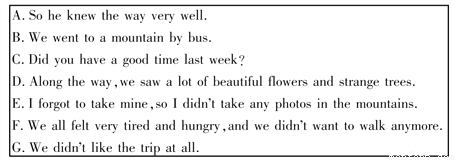
We had a school trip yesterday.1.The bus was slow but very comfortable.When we arrived at the bottom(底部) of the mountain,it was 9 o'clock.We began to climb the mountain.2.Some students took their cameras(照相机) with them.3.
The guide was our English teacher—Mr.Wang.His parents lived in the mountains.4.After we climbed to the middle of the mountain,it was about 11 o'clock.5.But Mr.Wang told us it was not far from his parents' house,so we walked on.In the end we had delicious food in Mr.Wang's parents' house.The trip was tiring,but we felt very happy!
根据短文内容,从题中所给的A、B、C、D四个选项中选出最佳选项
Hello,I am Gina.I went to California for a weekend with my father.We stayed in the mountains for 36 hours.We went climbing and walking.The weather wasn't very nice,but the mountains were beautiful.In the evening we learnt how to make knots(绳结).We also learnt about first aid(急救).
Hi,my name is Jim.Last Sunday,we visited uncle Sam's farm.We saw hundreds of cows on the farm.Uncle Sam was very friendly to us.He taught us how to feed cows and how to milk them.This is Uncle Sam's farm.We also rode horses on the farm.The horses ran quite fast.It was exciting.
1.Where did Gina go last weekend?
A. California. B. First Aid Center. C. A farm. D. A beach.
2.How long did Gina and her father stay in the mountains?
A. Two days. B. Thirty?six hours. C. Thirty days. D. We don't know.
3.What did Gina do in the evening in the mountains?
A. She learnt to plant. B. She learnt to make knots.
C. She learnt about first aid. D. Both B and C.
4.Uncle Sam was ________ Jim.
A. worried about B. friendly to C. angry with D. strict with
5.What did Jim think of riding horses on the farm?
A. Boring. B. Scary. C. Dangerous. D. Exciting.
查看答案Last Sunday we had a great trip.My father, my mother and I ______ to summer camp.We went to the mountains.First we ______ to the foot of the mountain ______ bus.In the middle of the mountain there was a river.The water was clean and clear.I washed my face ______ the water.It was warm.There ______ some fish in the river.In the mountain there were flowers.They were ______.At noon, many people got together, and they were very ______.We made our meal in the mountain.The food was very ______,and we liked it very much.After meal, we went on our trip.We felt ______,but it was really ______.
1.A. go B. goes C. went D. to go
2.A. get B. got C. got on D. arrived
3.A. by B. on C. in D. took
4.A. on B. with C. in D. into
5.A. is B. was C. were D. are
6.A. ugly B. beautiful C. awful D. delicious
7.A. friendly B. friends C. busy D. tired
8.A. nice B. terrible C. bad D. great
9.A. happy B. tired C. friendly D. interesting
10.A. cold B. hot C. fun D. easy
查看答案—Do you want to milk a cow with me?
—Sorry,I don't.I'm not ________ in doing it.
A. happy B. different C. interested D. popular
查看答案—Don't ________,Jill!We can help you with the problem.
—Thanks.
A. talk B. relax C. fight D. worry
查看答案 试题属性- 题型:补全短文7选5
- 难度:简单
Copyright @ 2008-2013 满分5 学习网 ManFen5.COM. All Rights Reserved.答案无忧
Don't__have__a__cow!I'll pay for the broken book.
A. Don't buy a cow! B. Don't milk the cow.
C. Don't get a surprize(吃惊). D. Don't keep a cow.
C 【解析】句意:不要惊讶,我会为这本破书付钱的。A. Don't buy a cow! 不要买一个牛; B. Don't milk the cow.不要挤牛奶;C. Don't get a surprize(吃惊). 不要吃惊; D. Don't keep a cow.不要养牛;根据句意故选CLet's climb the tree to ________ the apples.
A. sell B. pick C. wash D. grow
查看答案Nowadays,more and more people have taken an interest________watching Running Man________Friday evening.
A. in;in B. at;on C. in;on D. for;in
查看答案—I found a job at the radio station.It's very interesting.
—________.
A. You're welcome B. No problem C. Lucky you D. You're right
查看答案Lucy and Lily ________ the museum and ________ a lot of gifts yesterday.
A. visit;bought B. visited;bought C. visited;buy D. visit;buy
查看答案–Why don’t you buy the sweater?
--It’s too ____, and I don’t have enough money to buy it.
A. nice B. expensive C. popular D. cheap
查看答案 试题属性- 题型:单选题
- 难度:简单
Copyright @ 2008-2013 满分5 学习网 ManFen5.COM. All Rights Reserved.答案无忧
I have a good friend in my class. His name is Jim. He is from England. He is in China with his parents. He likes China. He likes Chinese food very much. He has breakfast at home. He eats an egg. bread and milk for breakfast. He doesn’t like fish. He has lunch at home. The lunch in his school is delicious. He can have different kinds of food for lunch. He eats rice, meat and vegetables. Sometimes he has noodles and dumplings. He has supper at home with his friends. Sometimes he goes out to eat with his friends. He has meat , vegetables and fruit for dinner .
1.Where is Jim from?
A. America B. England C. China D. Japan
2.What does Jim like about China?
A. Chinese food B. Japanese food C. American food D. fish
3.Where does Jim have lunch?
A. At home. B. At school. C. At hospital. D. We don’t know.
4.How is the lunch in Jim’s school?
A. Terrible. B. Delicious. C. Spicy. D. Sweet.
5.What does Jim have for dinner?
A. bread and milk B. vegetables, meat and fruit C. rice, meat and vegetables D. fish
1.B 2.A 3.A 4.B 5.B 【解析】文章介绍了作者的好朋友吉姆的情况。 1.根据His name is Jim. He is from England故选B 2.根据He likes Chinese food very much故选A 3.根据He has lunch at home.故选A 4.根据The lunch in his...I am in a new school this year. I have a new _____ . His _____ is Li Ning. He is my new classmate______ .He is _____ . He is tall and has_____ short hair. He _____ football and he is very good at it. He often plays football with _____ after school. We both like dancing. We hope to be good dancers when we grow up(长大).On Sunday, we often _____ in the park .______ are always happy together. We are good classmates ______ friends.
1.A. brother B. sister C. aunt D. friend
2.A. name B. school C. class D. hand
3.A. also B. two C. to D. too
4.A. 13 B. 13 years C. 13 old D. 13-year-old
5.A. a B. an C. / D. the
6.A. like B. likes C. is D. are
7.A. I B. my C. me D. she
8.A. see B. look C. listen D. meet
9.A. We B. You C. They D. I
10.A. but B. or C. so D. and
查看答案Look! The women over there are ____ mothers.
A. Jenny and Lucy B. Jenny’s and Lucy’s C. Jenny and Lucy’s D. Jenny’s and Lucy
查看答案Tom and I ____ good friends. He____ twelve.
A. am; is B. is; is C. are; is D. are; are
查看答案—This blue notebook is Lucy's.________ this yellow notebook?
—It's Li Cheng's.
A. What's B. What about
C. How's D. Who's
查看答案November comes after____.
A. September B. July C. October D. December
查看答案 试题属性- 题型:阅读单选
- 难度:简单
Copyright @ 2008-2013 满分5 学习网 ManFen5.COM. All Rights Reserved.答案无忧
—Can you write stories or tell stories? —______.
A. Yes,I can write stories B. No,I can't tell stories
C. I can write stories D. I can't write stories
C 【解析】试题分析:句意:——你会写故事还是讲故事?——我会写故事。本题问句是选择疑问句,选择疑问句不能用Yes或No作答,它的回答是在选择项中取一种或多种回答。故选C。Ted can play the guitar,and he can ______ play the piano.
A. or B. and C. too D. also
查看答案Monica is an active(活跃的) girl.She's good at ______ stories.
A. saying B. speaking C. telling D. talking
查看答案I can sing.And I want to join ______.
A. the music club B. the art club
C. the English club D. the chess club
查看答案—______? —They can teach music.
A. What do they do B. Why can they teach music
C. Where do they teach music D. What can they do
查看答案—Can you play ping-pong?
—______.I often play it in our school sports club.
A. Yes,I do B. Yes,I can C. No,I don't D. No,I can't
查看答案 试题属性- 题型:单选题
- 难度:困难
Copyright @ 2008-2013 满分5 学习网 ManFen5.COM. All Rights Reserved.答案无忧