题目内容
--- When you ____the street, you must look carefully.
A. past B. across C. pass D. cross
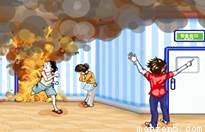
Fire accidents often happen in our daily life. So, as middle school students, it is very important for us to learn what to do when a fire breaks out. Here are some tips, and please keep in mind.
Put a smoke alarm in the house. Smoke from a fire causes the alarm to go off. The alarm makes a loud sound. The sound tells us to leave the house at once.
Make escape plans. We should know all the ways out of the house. If there is a fire, everyone follows the plan to get out. Part of the plan is to check all the windows to make sure they can be opened easily.
Prepare fire extinguishers (灭火器) in the house. Everyone in the family should know how to use them. Practice for a fire. We should do fire practice because they teach us about fire safety. Everyone should know the following fire rules:
Don't open a hot door! The fire can grow more quickly if you open the door.
Stay close to the floor! Smoke can be more dangerous than fire.
The best air is near the floor because smoke rises.
What will you do if your hair or clothes start to burn? First, stop! Don't run! The fire burns faster because of more air. Drop! Fall to the floor. Then roll! Turning over and over will make the fire go out. Put a blanket around you to keep air away from the fire that may still be on you.
There are many possible causes for fires. A wise family is ready all the time. If there is a fire, don't forget to call 119 for help.
1.When a smoke alarm rings at a house, it means that __________________
A. you have to get up
B. water is running to the floor
C. something is burning
D. someone breaks your window
2.We should do the following to prepare for a fire EXCEPT that ______________.
A. we practise for a fire
B. we make escape plans
C. we have fire extinguishers
D. we use electrical cookers
3.What does the underlined word "escape" in the 3rd paragraph mean?
A. 逃离.
B. 跳楼.
C. 安全.
D. 灭火.
4.When your hair or clothes catch fire, the right steps are _________________.
A. stop, run, roll
B. stop, drop, roll
C. run, drop, roll
D. roll, drop, stop
I have kept this letter from my class teacher _________I graduated 10 years ago.
A. since B. until C. after D. when
Hello! I’m Alex. I often get up at 6:30 am. Half an hour later(之后), I have my breakfast. At 7:30 am, I take a bus to school. We have Math, Chinese and English classes from 8:00 am to 11: 30 am. I have lunch and talk with my classmates at school. We have three classes from 1:40 to 4:10 in the afternoon. After school, I often play with my classmates. We often play soccer, tennis and ping-pong. I go home at about 5:00 pm. I usually have dinner at 6:00 pm. Then I do my homework and watch TV. At about 10:30 pm, I go to bed.
1.---When does Alex go to school in the morning?
--- At______.
A. half past six B. seven C. six thirty D. seven thirty
2.---What time does Alex eat breakfast?
--- At ______.
A. six B. seven C. seven thirty D. eight
3.How long does it take Alex to have breakfast?
A. Thirty minutes B. An hour C. Ten minutes D. Seven hours
4.Alex usually ______before he goes to bed.
A. plays computer games B. takes a shower
C. play soccer D. watch TV
My sisters don’t like tigers. I don’t like tigers, ______.
A. also B. two C. either D. too
-Miss Read is good ____ music.
-And she can be good _____ children in the music club.
A. at; at B. with; with C. at; with D. with; at
It is necessary to relax ourselves after the exam. There are some kinds of1.(activity) for us to take part in. First of all, we can go for a w2. along the bank of the river. We can also go to the movies or listen to music. What’s more, joining in a sports club is a good 3.(choose), which can keep us healthy. For example, p4. football in the afternoon may relax ourselves. Above all, we should arrange(管理) our time 5.(proper) and live a regular(规律的) life. I hope all of us can have a wonderful time.
Li Ming goes to school ________ his father’s car every day.
A. by B. in C. on D. for
Go downstairs, __________stand in line on the playground as soon as possible.
A. and B. but C. so D. or