题目内容

My First Marathon(马拉松)

A month before my first marathon, one of my ankles(脚踝)was hurt and this meant not running for two weeks, leaving me only two weeks to train. Yet, I decided to go ahead.

I remember back to my 7th year in school. In my first P.E. class, the teacher required us to run laps and then hit a softball. I didn’t do either well. He later told me that I was “not good it sports”.

The idea that I was “not good at sports” stuck with me for years. When I started running in my 30s, I realized running was a battle(斗争)against myself, not about competition or whether or not I was good at sports. It was all about the battle against my own body and mind. A test of wills!

The night before my marathon, I dreamt that I couldn’t even find the finish line. I woke up sweating(出汗)and nervous, but ready to prove something to myself.

Shortly after crossing the start line, my shoe laces(鞋带)became untied. So I stopped to he them. Not the start I wanted!

At mile 3, I passed a sign: “GO FOR IT, RUNNERE!”

By mile 17, I became out of breath and the ankle hurt badly. But I stayed the course walking a bit and then running again.

As I came near mile 23, I could see my wife waving a sign. She is my biggest fan. She ever minded the clock sounding at 4 a.m. or questioned how much I spent on running.

I was one of the final runners to finish. But I finished! And I got a medal. In fact, I got be same medal as the one that the guy who came in first place had. Now I can call myself a marathon winner”.

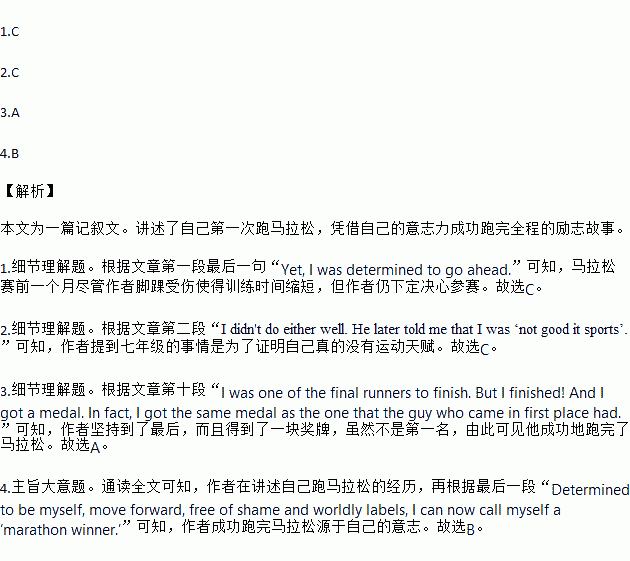
1.A month before the marathon, the author .

A.was well trained B.felt afraid to train

C.made up his mind to run D.lost hope of recovery

2.Why did the author mention the P.E. class in his 7th year?

A.To admit the support of his teacher. B.To make the readers laugh.

C.To show he wasn’t talented in sports. D.To share a wonderful memory.

3.How was the author’s first marathon?

A.He made it. B.He stopped running halfway.

C.He got the first prize. D.He walked to the end.

4.What does the story mainly tell us?

A.Success depends on family support. B.A winner is one with a strong will.

C.Failure is the mother of success. D.One is never too old to learn.
练习册系列答案
相关题目

In 2017, when the high speed train. Furing, left Beijing for shanghai at a speed of 350 km/h, it amazed the world. It is China's newest high-speed train and also the fastest train in the world.

Therewere2, 959 high-speed trains running across China by 2016. They make up60 percent of

the worlds total high- speed trains. Chinese companies have also built more than 10 high-speed

railways in Europe, Southeast Asia and South America. And the high speed trains has become anew name card for China.

Besides the high-speed trains, many other innovations(创新)have also changed people's lives in China.

For example, though bike sharing is not new itself China has made it much more convenient.

And popular. When the Chinese bike sharing companies reached Singapore and Britain months ago, users there excited and couldn’t wait to post photos of themselves riding the bikes on social media(媒体).

Cashless payment has become a lifestyle choice in China it is common that people in China go shopping with no cash(现金)in pockets. Many people just pay with their bile phones by scanning a quick respond code(QR, 二维码)from the seller. Even a person selling vegetables has a QR code.

Many foreigners have experienced lives without carrying any cash in China. They say they can't do it when they are back home in Europe.

China is now in a great time. It has made great achievements in innovation They are true pictures of national strength. It seems that China is really leading in some ways. And Chinese people have every reason to believe in an even brighter future.

1.How many examples are mentioned to show China’s achievement in innovation according to the passage?

A. One B. Two C. Three D. Four

2.The underlined word “it” means ____.

A. living in China B. buying things without carrying any cash

C. having QR codes D. making enough money by working hard

3.The best title for the passage might be _____.

A. China leads in innovation B. Science develops very quickly

C. China faces many chances D. Science catches the world’s attention

I'd just got in a taxi at the railway station when suddenly I found one of my bags missing. Just then, I saw a young man about 30 feet away with it, opening it and drawing out the valuables. "Stop thief! Stop thief!" I shouted and opened the car door and rushed out to him, followed by the driver and half a dozen passengers. Very soon they caught the thief by the neck and put his hand into his trouser pocket, drawing out money, credit card, telephone book and so on and put them back into my bag,

Half an hour later, the car was running at full speed on the highway. I sat back and breathed a long sigh of relief(松口气). But as I pulled out those stolen things from the bag and started to check them, I became completely surprised. Before my eyes were 200 yuan instead of 100 yuan. And a medical test report of a 58-year-old woman appeared. I suddenly realized that the taxi driver must have mistaken the thief's things for mine and put his into my bag. My heart began to sink.

Two years has passed since then. But this event keeps coming back to me. Was the young man a habitual robber(惯偷) or a dutiful(有责任感的) son who had been driven to desperation(铤而走险) to find money to save his mother' s life? My heart hurts for him. How I wish I had gone back that summer afternoon to return the 200 yuan and say sorry to him! For the first time in my life, I realized that hate and love are very close.

判断正误,正确的写A,错误的写B。

1.The writer took a taxi to the railway station when finding his bag missing,

2.The driver with several other people helped the writer catch the thief.

3.The writer was completely surprised when he was searching a different bag in the car on the highway.

4.The writer was sure that the young man stole things to enjoy himself.

5.The writer realized hate is close to love.

违法和不良信息举报电话:027-86699610 举报邮箱:58377363@163.com

精英家教网