题目内容
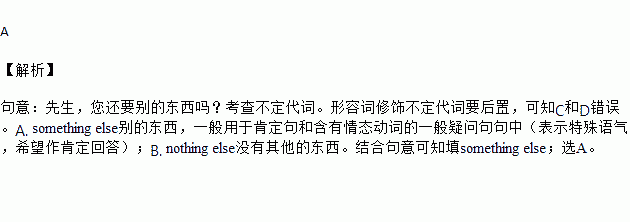
Would you like ________, sir?
A. something else B. nothing else
C. else something D. else anything
Mr. Smith is from New York. He comes to China in 2008. He teaches us English. His English classes are very interesting. We all like his classes very much.
Mr. Smith has two children — Scott and Catherine. Scott is 16 and his sister is 12. They are in China, too. And they can do a lot of things. For Scott, he likes music, especially (尤其) hip-hop (说唱音乐). He is at the music club in his school. He is also at Chinese kung fu club, because he likes China and Chinese kung fu very much. For Catherine, she is a quiet (内向) girl. She likes music too, but her favorite music is pop music. And she is good at writing. She wants to be a writer, so Mr. Smith teaches her to write. She learns a lot from Mr. Smith. Mr. Smith says he is very happy to have these two children. He is proud of them.
1.Mr. Smith is________.
A. a Chinese teacher
B. a musician
C. a sports player
D. an English teacher
2.Mr. Smith is in China for about ___________ years.
A. six B. eight C. five D. nine
3.What is Catherine good at?
A. Hip-hop. B. Popular music.
C. Chinese kung fu. D. Writing.
4.The underlined word “proud” means “_______” in Chinese.
A. 失望的 B. 沮丧的
C. 骄傲的 D. 开心的
5.What is the second paragraph mainly about?
A. What Mr. Smith can do.
B. When the Smiths come to China.
C. What Scott and Catherine can do.
D. Scott’s and Catherine’s favorite games.
Mum, can I turn ______ the radio? I want to listen to the talk show.
A. on B. off C. up
根据括号内的要求完成下列各题,每空一词(含缩略形式)。
1.I have the flu.(改为一般疑问句)
________ ________ ________ the flu?
2.He should see the dentist first.(改为一般疑问句)
________ he ________ the dentist first?
3.—Does Lily’s brother have a toothache? (作肯定回答)
—________, ________ ________.
4.—Should I take this kind of medicine? (作否定回答)
5.My father should exercise more. (对划线部分提问)
________ ________ your father ________?
6.Jenny can’t move her neck. (对划线部分提问)
________ ________ ________ ________ Jenny?
补全对话,方框中有两个多余选项
A: Good morning! 1.
B: Oh, I want to buy a jacket for my father.
A: Look! There are many kinds of jackets for men. They are all on sale.
B: 2.
A: They are 269 yuan each.
B: 3. Can I take one with a lower(更低的) price?
A: No, but there are some cheaper ones over there.
B: How much is the blue one?
A: 4.
B: But I only have 160 yuan.5.
A: Well, you can.
A.They are too expensive!
B.Can I take it?
C.What can I do for you?
D.How many jackets are there?
E.How much are they?
F.It is 175 yuan.
G.What size would you like?
阅读短文,回答问题。
Do you live in a city? Do you know how cities began? Long long ago, there were only a few thousand people in the world. These people moved from one place to another. They moved over the land, hunting animals for food.
No one knows how or when these people learned about growing food. But when they did, their lives changed. They did not have to move any more.
They could stay in one place and grow food there. People began to live near each other, so the first villages appeared. Many people came to work in the villages, and these villages became larger and larger.
Later people had machines. Life in the villages changed again. People built factories. More and more people lived near the factories, so the villages grew into cities. Some of them grew very big.
Today, it's strange that some people are moving back to small villages. Can you tell me why?
1.How many people were there in the world long long ago?
__________________________________________________________________________
2.What did the villages grow into after people built factories?
___________________________________________________________________________
3.Why did people move from place to place long long ago?
_________________________________________________________________________
4.Who knows when people learned about growing food?
5.Why are some people moving back to small villages?
There are tourists visiting the island during the May Day holiday every year.
A. two thousand of B. two thousands C. thousands of D. thousand of
The sick man_______to hospital by the policeman an hour ago.
A. is taken B. was taken C. takes D. took
— Who ________ to our class tomorrow morning?— Mrs. Brown.
A. come B. comes C. will come D. came