题目内容
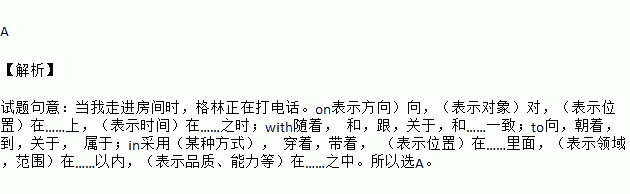
When I got into the room, Green was talking _________ the phone.
A. on B. with C. to D. in
The air _______ fresh after the rain. And the sky is blue.
A. feels B. tastes C. smells D. sounds
---The light in the professor’s lab was still on at 11:00 o’clock. Do you know ?
---maybe at midnight again.
A. how long has he worked B. why does he stay up so late
C. if he is busy studying D. when he stopped working
China’s national anthem, March of the Volunteers, is a song that we learn at the beginning of primary school and sing at every flag-raising ceremony. And now, there’s even a law to protect it.
Last September, the government passed the National Anthem Law, which became effective(生效)
from Oct.1, 2017. It states how we should sing or play the song, requiring all of us to behave towards it politely.
Primary and middle schools must teach the anthem to their students and make them understand the song’s spirit and history. Moreover, the law requires us to be serious when we are singing the song. We can’t joke about it or change the song’s words or music. If someone breaks the law, he or she can be detained for up to 15 days, or face further punishment in more serious situations. The national anthem is different from other songs – it is the symbol of our country.
Many foreign countries also have laws for their national anthems. For example, American school children should put their right hand over their heart while singing their country’s anthem at school. In Russia, the national anthem must be played on television and radio before the start and end of broadcasting. And in the Philippines, people are required to sing the national anthem with feelings when it’s played in public.
1.How long has the National Anthem Law become effective till now?
A. For more than one year. B. For just half a year.
C. For less than 9 months. D. For about 10 months.
2.Why must we be serious when singing the song?
A. Because the school asks us to. B. Because it has a long history.
C. Because we are good students. D. Because it’s our country’s symbol.
3.What does the underlined word “detained” mean?
A. Kept in a police station. B. Forced to work.
C. Prevented from eating. D. Kept singing the song.
4.Students are required to put their right hand over their heart in .
A. China B. America C. Philippine D. Russia
(题文)We stopped _________, but there was not any sound.
A. to listen B. listens C. listen D. listening
阅读短文,并按要求完成66—70题。
Salt is very important to us. We eat salt every day. Without salt,we don't think the food is tasty. Without enough salt,we will get ill. Animals need salt,too. They need salt to grow strong.
Most of salt comes from the sea. People dig very big pools and let sea water in. When the sun dries up the water,people can get salt from the ground.
There are a lot of salt wells(井)in our country. People bring the well water up to the ground and then dry it up in big jars over fire. In this way,we can get salt.
We can also get salt from salt mines(矿).The salt mines are under the ground. A few years ago,people found a big salt mine in China.
In the northwest of China,there are a great number of salt lakes. Some of them are very big. The salt in these lakes will be enough for all the people in our country for hundreds of years.
66题完成句子;67题简略回答问题;68题找出并写下意思相同或相近的句子;69题找出并写下第一段的主题句;70题将文中划线句子译成汉语。
1.We can get salt from the sea,salt wells,sat mines and _____________.
2.Where are a great number of salt lakes?__________________________.
3.If we have not enough salt,we will get ill._______________________.
4._________________________________________________________.
5._________________________________________________________.
—Do you have any plans for this winter holiday?
—I'm not sure. I __________ take a trip to Hainan.
A. must B. need C. may D. should
There is no ______ that the technology is changing the way we work.
A. way B. doubt C. chance D. possibility
__________the old man isn't rich himself,he gives most of his money to the poor children.
A. When B. Though C. If D. Because