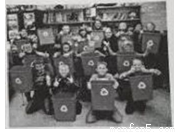
The Recycling Center

Students at an elementary school in Chicago studied ecology (生态学).They learned that there was so much rubbish that it was a world-wide problem. They asked their teacher if thce could do something to help solve the problem. “ It is a very big problem.” the teacher said, “but if every community helps,that would really make a difference."

The students decided to set up a program called Saturday Recycling Center. They would collect rubbish and then get it to a place. The students used the Internet to find out more about recycling in Chicago. They found that there are 15 “drop off" places, where people can bring rubbish to get it recycled

The students had to work out how to get the rubbish

to the place. They went to talk with the leader of the church( 教堂) near their school.

They knew that he drove a van. They asked him to help with their plan.

The churchman agreed to help. He said he would pick up the rubbish on the first Saturday of each month. So everything was organized. All the students needed was rubbish to recycle.

The students made posters to put in stores in the neighborhood. The churchman advertised die new recycling program at the church service. The community center put a note about the recycling center in their monthly newsletter. The students went into the other classrooms at their school and asked children to tell their families about the Saturday recycling.

The first Saturday was beyond their expectations.In fact ,they got so many rubbish that the churchman had to make two trips to take it all to the “drop off”place.Now most people in the community know the first Saturday is the time to recycle.

1.The students set up the program to_________ .

A. help the community

B. collect rubbish for recycling

C. find "drop off" places

D. teach children to solve problems

2.Who helped to pick up the rubbish?

A. A student. B. A teacher.

C. A parent. D. A churchman

3.The community center helped with the program by___________ •

A advertising it at the church service

B. asking children to tell their families about it

C. putting o note about it in the monthly newsletter

D. putting posters about it in stores in the neighborhood

4..What does the last paragraph mainly tell us?

A. Recycling is very hard.

B. The program needs more help.

C. The program is successful.

D. People only recycle on Saturday.

No one knows when the first house was built and who the first one to build the house was. But the houses are changing all the time.

1. What will the house of the future look like? Could it have gardens on its walls, or a pool with fish for diner? Architects(建筑学家) believe that they may come true one day. The only thing

for sure is that the houses will be as green as possible in the future.

2. Many architects in the world would like to build a house like a leaf—the surface of the house collects sunlight during the day. The energy can be used to heat water, produce electricity, and even make fresh air for the room. The “roof” (根) of the house is deep under the ground. It uses the soil to control the room’s temperature.

3. Like a lizard(蜥蜴), changing color with the weather is the most important design of a lizard house. When it’s in the bright sun, the cover of the house will return white to protect it from strong heat. During dark days, it turns dark and takes in as much light and heat as possible to produce energy.

4. This design is perhaps for the future of food. It has a garden on the outside wall of the house. People can plant tomatoes, carrots and green tea on them. So every morning, you just need to walk outside and collect your meals.

5. Looking to the future isn’t the only way to be green. Sometimes, the old ways of building houses can also help cut down energy use. For example, a chimney(烟囱) can be a useful air conditioner because it is easier for hot air to run out of the chimney.

A Learning from the past

B Meals at home

C The lizard house

D Houses in the future

E The tree house

F The history of the houses

违法和不良信息举报电话:027-86699610 举报邮箱:58377363@163.com

精英家教网