“Am I my brother’s keeper?” The question comes from the Bible(圣经). In the Bible, Cain kills his brother Abel. When God asks Cain where Abel is, he replies, “I don’t know. Am I my brother’s keeper?” by which he means, “Am I responsible (有责任心的) for my brother—his safety and health?” The answer, of course, is “Yes, you are.”

This sense of responsibility for others is basic to all good societies. And also it is basic to what we call “civil(文明的) society”. China is now working on building a civil society and the high schools in Shanghai want students to take part in that through volunteering. They are supposed to do sixty class hours of volunteer work before graduation. This is something new in China, but it is not new in other countries.

In the Canadian province of Ontario, high school students are required to do forty hours of volunteering. In some American states, the volunteering requirement is one hundred hours. These students spend about an hour a week during the school year and summer vacations, helping the poor, the sick and the old. They also teach young children to read and help to clean up the environment. And studies have shown that this volunteering experience influences students a lot after graduation.

Some of you may be thinking, “Gee, sixty class hours is a lot. How can I find the time?” In fact, if you finish it in three years, you only need to do the work about three class hours a month. And the time is well spent if it helps you realize that “being your brother’s keeper” makes you a better person and makes society a better place for everyone.

1. A Shanghai high school student should finish class hours of volunteer work before graduation.

A. thirty B. forty C. sixty D. one hundred

2.The underlined word “that” in Paragraph 2 refers to “ ”.

A. building a civil society B. reading the Bible

C. doing the volunteer work D. playing more sports

3.According to the writer, “being your brother’s keeper” means “ ”.

A. being a good school student

B. being responsible for others

C. taking good care of your brother

D. doing volunteer work with your brother

4.The main purpose of the writing is to .

A. tell students where to do volunteer work

B. give advice on how to be a good volunteer

C. encourage students to do more volunteer work

D. introduce volunteer work in different countries

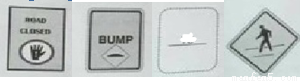
Sometimes, the choices you have made prove to be wrong. Don’t worry – it’s not the end of the world! In traffic, what you do in this situation is just turn around and find a way. That’s exactly what you should also do in real life. In your life you will find many dead ends but you will always find your way out of them.

Life is not always a walk in the park. There will be uphill as well as downhill, bumps(凸块) and smooth rides. If you are not careful, a bump can make you . However, riding your life along just straight roads with no bumps can become . So, a bump can be a nice experience as well.

Right or left? In your life there will be times when you have to make a . You may want to focus on your studies, so you choose to stop a hobby that you’ve had for years. ! Before putting away the guitar or stopping your dance lessons, you should think how you could divide your time between studying and hobbies. Basically, it’s just a question of how to manage your time.

Whatever you do in life, remember to take it easy. You don’t have to run everywhere. Sometimes running make life less enjoyable. It’s often better to think before taking action. So, think first and then act! There’s really no rush! You don’t have to experience everything before you’re 20!

1. A.better B.shorter C.faster D. wider

2. A. grow B.cry C.change D.fall

3. A. helpful B.boring C. lucky D. dangerous

4.

5. A.living B.decision C. mistake D.wish

6. A.Drive careful B. Act immediately C.Think again D. Speak aloud

A little stream (小溪) ran down from a high mountain through many villages and forests. Then it reached a desert,“I went through so many difficulties. I should have no problem crossing the desert,”she thought. As she started, she found herself slowly disappearing into the sand. After many tries, she still failed.

At this time, a deep voice said,“if a breeze (微风) can cross the desert, so can a river.”It was the voice of the desert. But the little stream answered,“that’s because a breeze can fly, but I can’t.”

“That’s because you can’t give up what you are. Let yourself evaporate (蒸发) into the breeze, and it can take you across,”said the desert.

“Give up what I am now? No! No!”The little stream could not accept this idea.

“The breeze can carry the vapor (蒸汽) across the desert and let it leave as rain. The rain will form a river again,”said the desert.“And whether you’re a river or vapor, your nature (本性) never changes.”

Hearing this, the little stream went into the open arms of the breeze. It carried her to the next stage (阶段) of her life.

1.What did the stream think when she reached a desert?

A. She thought she couldn’t cross the desert.

B. She believed she could cross the desert.

C. She thought she knew well about the desert.

D. She started to worry about herself.

2.What does the underlined word“it”refer to (指的是)?

A. The desert. B. The nature.

C. The breeze. D. The stream.

3.What did the stream do in the end?

A. Crossed the desert. B. Stopped trying.

C. Failed to get to the ocean. D. Died.

4.What is the main idea of the story?

A. The road to success is not always easy.

B. We should do the right thing whatever others say.

C. Our lives can be as difficult as the little stream’s.

D. To succeed, we should change the way we used to be.

违法和不良信息举报电话:027-86699610 举报邮箱:58377363@163.com

精英家教网