题目内容
“_________ we watch TV?”“_________, let's finish our homework first.”
- A.Shall, Yes
- B.Do, No
- C.Shall, OK
- D.Shall, No


The London Olympic Games are coming soon. This summer, Chinese sports fans will be able to watch the exciting games in 3-D on CCTV.
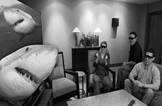
When you watch 3-D movies or TV, you have to wear a special pair of glasses. The 3-D glasses make the people and the things on the screen look like they are in the room with you.
3-D, means having three *dimensions: *width, height and *depth. 3-D technology is based on the way the human brain and eye work. Because the *pupils of a person’s eyes are about 6.5cm apart, when we look at something, each eye sees it from different *angle. Our eyes send the two pictures to our brain, and the brain puts them together. The small difference between the picture from the right eye and the picture from the left eye make us see depth.
While watching 2-D films, we don’t have to wear the special glasses. We see the pictures in two dimensions, each eye get the same information. This is because there is only one way of watching it.
So the aim of 3-D technology is to get a different picture into each eye of the person. It uses two film *projectors. One *projects a left eye picture and the other projects a right eye picture. When we are in the cinema, we can see different pictures in each eye at the same time with the help of the 3-D glasses.
While watching 3-D films, we feel that we are actually in the same environment as the things we are watching. However, some people are against watching 3-D films. One of the reasons is the 3-D glasses makes the screen of the film or TV look darker. It is bad for eyes. What’s more, people with eye problems may get headaches if they spend too much time watching 3-D movies, because their brains need to work harder to “read” the pictures.
【小题1】Paragraph 3 mainly tells us __________.
| A.how we see things in 3-D | B.how we watch the Olympic Games |
| C.how 3-D films are made | D.where we watch 3-D films or TV |
| A.no | B.different | C.dark | D.the same |
| A.We don’t have to wear 3-D glasses if we watch games in 3-D on TV. |
| B.The 3-D technology is based on the way the human ear and eye work. |
| C.All the people can have fun watching 3-D movies or TV for a long time. |
| D.3-D glasses make us see different pictures in each eye at the same time. |
| A.they make them more excited or sadder |
| B.3-D glasses make the screen look darker |
| C.3-D films make all people get headaches |
| D.they dislike watching the Olympic Games |
Television has a huge influence on our lives. It is one of the most important ways of getting information. People spend part of their spare time watching television, and much of what they learn comes from it.
What we see on TV—movies, news shows, sports shows, advertisements and so on have increased our knowledge and have changed the way we learn about the world today. However, not everything on TV is true.
Most of the viewers are children. Television sometimes is like a baby-sitter. It spends more time with children than parents do. But it keeps them in the living room away from healthy outdoor activities. They spend less time playing soccer or walking in the park or playing games in the yard.
Of course, there are some programs on TV that are good for children. But there are also some shows which are bad. Children should not watch unhealthy shows. Maybe we can’t change what is on TV, but we can choose what we watch. Do you agree?
【小题1】Why is television sometimes like a baby-sitter?
| A.Because television can take care of children. |
| B.Because children spend more time watching TV than staying with their parents. |
| C.Because television spends time looking after children. |
| D.Because television keeps children from going out. |
| A.It stops children from attending healthy outdoor activities. |
| B.It provides a lot of information. |
| C.It changes people’s way of learning. |
| D.It increases people’s knowledge. |
| A.parents shouldn’t let children watch TV |
| B.We should believe everything on TV. |
| C.we can choose TV programmes |
| D.parents shouldn’t watch TV |
| A.消极的 | B.积极的 | C.中立的 | D.愤怒的 |
| A.children spend too much time watching TV |
| B.people spend their time on TV for information |
| C.TV programmes attract children |
| D.the great influence TV has on our lives |
完成表格 阅读下面的短文,根据内容,完成表格中所缺的信息。(共5小题,每小题1分,计5分)
George Stephenson was born in 1781 in a poor family. He had to start work when he was only eight. When George was fourteen, he became his father’s helper. He spent a lot of time learning about engines. On holidays, he often took engines into pieces and studied each piece carefully. Soon he became a very good worker though he could not read or write.
He began to learn the English letters when he was seventeen years old. Every day after he did twelve hours of hard work, he walked a long way to have lessons from a young teacher.
On his eighteenth birthday, he wrote his own name for the first time in his life. George invented many things in his life. The train was the greatest one among them. Today when we watch or take trains from one place to another, we will think of this great man—George Stephenson.
|
Great Inventor: 1 |
|
|
In 2 |
He started work. |
|
In 1795 |
He spent much time 3 . |
|
In 1798 |
He began to learn the English letters. |
|
In 1799 |
He could 4 for the first time. |
|
In his life |
He invented many things, including 5 . |