题目内容

完形填空,先通读下面的短文,掌握其大意,然后在每小题所给的四个选项中,选出可以填入空白处的最佳选项。

The situation seemed hopeless.

From the first day he entered my junior-high classroom, Willard P. Franklin lived in his own ________ , shutting out his classmates and me, his teacher. I tried to build a ________ relationship with him but he showed no interest. Even a “Good Morning Willar” received only a grunt(咕哝) that couldn’t be ________ . Willard was a loner(孤独的人) who seemed to have no hope or need to break silence.

Shortly after the Thanksgiving holiday, we received the news of the annual(每年的) Christmas collection of money for the less ________ people in our school district.“Christmas is a season of giving ,” I told my students. “There are a few students in the school who might not have a happy holiday season. ________ donating our Christmas collection, you will help buy food, clothing and toys for these needy people. We start the collection tomorrow.”

When I called for the donations the next day, I discovered that ________ everyone had forgotten, except Willard P. Franklin. The boy dug deep into his pants pockets ________ he walked up to my desk. Carefully, he ________ two coins into the small box.

“I don’t need milk for lunch,” he said quietly . For a moment, just a moment, he smiled . Then he turned and walked back to his desk.

That night, after school, I took our donations to the school principal. I couldn’t ________ sharing the incident(事件) that had taken place.

“I may be wrong, but I believe Willard might be getting ready to become a part of the world around him,” I told the principal.

“Yes, I believe it is hopeful for him to get out of his own world,” he nodded. “And I think we can do something to have him ________ a bit of his world with us. I just received a list of the poor families in our school who most need help through the Christmas collection. Here, take a look at it.”

As I read, I discovered Willard P. Franklin and his family were the top names on the list.

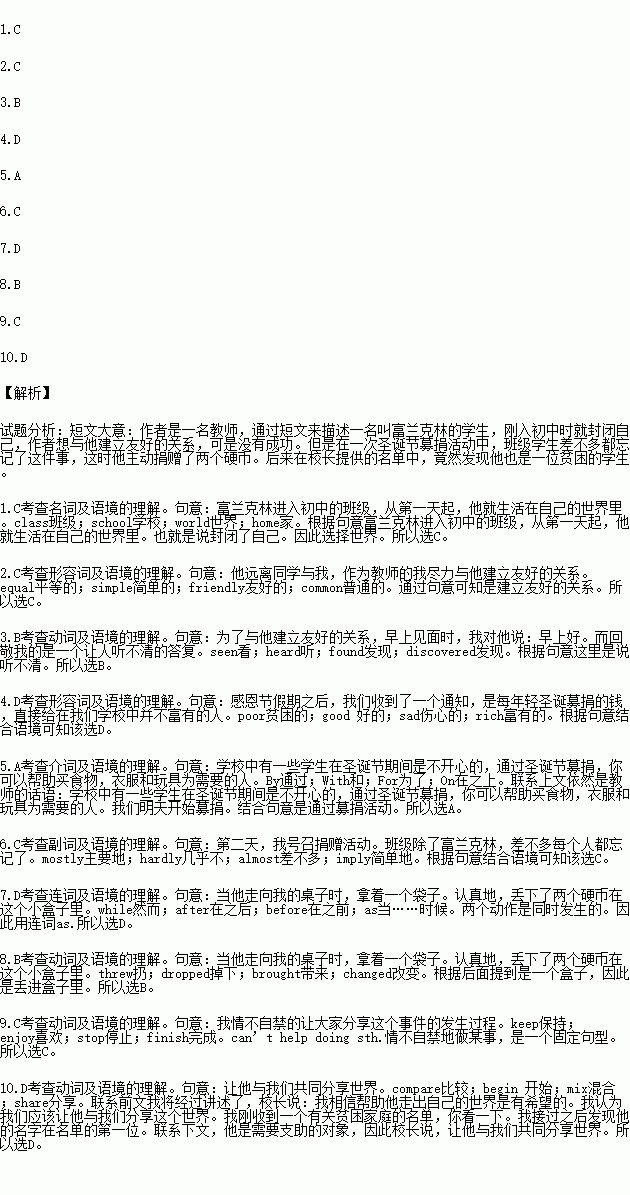
1.A. class B. school C. world D.home

2.A. equal B. simple C. friendly D. common

3.A. seen B. heard C. found D. discovered

4.A. poor B. good C. sad D. rich

5.A. By B. With C. For D. On

6.A. mostly B. hardly C. almost D. simply

7.A. while B. after C. before D.as

8.A. threw B. dropped C. brought D. changed

9.A. keep B. enjoy C. stop D. finish

10.A. compare B. begin C. mix D. share
练习册系列答案
相关题目

A secret to win

Once a 10-year-old boy decided to learn judo (柔道) though he had lost his left arm in a car accident.

The boy began lessons with an old Japanese sensei, a judo teacher. Three months later, he was still practising with the same move. So he asked, “Sensei, shouldn’t I be learning more moves?”

“This is the only move you know, but this is the only move you’ll ever need to know,” the sensei replied.

The boy kept training. Months later, the sensei took him to his first match.

Surprisingly, the boy easily won his first two matches. The third match was more difficult, but after some time, his opponent (对手) became impatient. The boy used his one move to win the match and now was in the final.

This time, his opponent was bigger, stronger, and more experienced. For a while, the boy seemed to lose the game. Being worried that the boy might get hurt, the referee (裁判) called a break. Just before the referee wanted to end the match, the sensei came to him.

“No,” the sensei said, “let him go on.” Soon after the match began, his opponent made a big mistake: he dropped his guard (防守). Suddenly, the boy won the match.

On the way home, the boy and the sensei talked about every move in each match. Then the boy gathered the courage to ask, “Sensei, how did I win the match with only one move?”

“You won for two reasons,” the sensei answered. “First, you’ve learned one of the most difficult throws in all of judo. Second, the only known guard for that move is for your opponent to catch your left arm.”

1.How many opponents did the boy face in the story?

A. Two. B. Three. C. Four. D. Five.

2.Why did the boy’s last opponent lose the game?

A. Because he failed to protect himself in time.

B. Because he was not strong and experienced enough.

C. Because the referee ended the match.

D. Because he was afraid to hurt the boy.

3.The boy could win all the matches mainly because ______.

A. his opponents made more mistakes than he did

B. his opponents were more impatient than he was

C. the boy was better at guard than his opponents were

D. the boy’s biggest weakness became his biggest strength

4.From the passage we can infer that ______.

A. disabled people are the best ones in learning judo

B. one can win achievements by keeping practising

C. it is important to find a good referee to win a match

D. it is useless to learn too much knowledge and skills

违法和不良信息举报电话:027-86699610 举报邮箱:58377363@163.com

精英家教网