Have you ever had the strange feeling that you were being watched You turn around and ,sure enough, someone was looking right at you!

Parapsychologists(心灵学家) say that humans have a natural ability to sense when someone is looking at them. To research whether such a “ six sense” really exists, Robert Baker, a psychologist(心理学家) at the University of Kentucky, did two experiments.

In the first one, Baker sat behind unknowing people in public places and stared at the backs of their heads for 5 to 15 minutes. The subjects (受试者) were eating, drinking, reading, studying, watching TV, or working at a computer. Baker made sure that the people could not tell that he was sitting behind them during those periods. Later when he questioned the subjects, almost all of them said they had no sense that someone was staring at them.

For the second experiment, Baker told the subjects that they would be stared at from time to time from behind in a laboratory setting. The people had to write down when they felt they being stared at and when they weren’t. Baker found the subjects were no better at telling when they were stared at and when they weren’t.

Baker concludes that people do not have the ability to sense when they are being stared at. If people doubt the outcome of his two experiments, said Baker, “I suggest they repeat the experiments and see for themselves.”

1.what’s the aim of the two experiments ?

A. To study whether humans can sense when they are stared at.

B. To explain when people can have a sixth sense

C. To show how people act while being watched in the lab.

D. To Prove why humans have a sixth sense.

2.what sense does parapsychologists say that humans have to

A. A looking feeling B. A natural staring ability

C. A strange thinking D. A natural ability

3.The underlined word” outcome” in the last paragraph most probably means

A. value B. performance

C. result D. connection

4. What can we learn from the passage

A. People are born with a sixth sense.

B. The experiments support parapsychologists’ idea.

C. The subjects do not have a sixth sense in the experiments.

D. People have a sixth sense in all places.

阅读与表达(问答式)

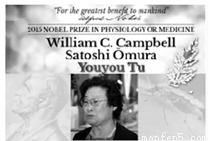
China has its first Nobel Prize in Science. And the winner, 84-year-old Chinese scientist Tu Youyou, also became the first Chinese woman to win the Nobel Prize. She won the 2015 Nobel Prize in Physiology or Medicine with William C. Campbell, an Irish-born researcher, and Satoshi Omura of Japan. The three winners will share the prize of 8 million Swedish crowns ($920,000).

Half of the Prize was given to William C. Campbell and Satoshi Omura for their new treatment against illness caused by roundworm parasites (寄生虫). Tu Youyou won the other half of the Prize for developing a medicine, Artemisinin(青蒿素), which can help people fight malaria(疟疾). More than 240 million people in Africa have benefited from the treatment, according to the WHO (World Health Organization), and more than 1.5 million lives have been saved since 2000, thanks to the medicine.

Tu Youyou started her research in 1969 when she was chosen as the director of a government project to find anti-malaria medicines. She and her workmates studied ancient Chinese medicine books and many different traditional treatments. They did nearly 200 experiments before they finally succeeded in getting the material Qinghaosu, later known as Artemisinin, in the 1970s. This medicine became the standard treatment for malaria in the WHO's list of important medicines.

Premier Li Keqiang congratulated Tu for winning the Prize. He said, "Tu's winning the prize shows China's progress in scientific and technological field, and marks a great contribution of Traditional Chinese Medicine (TCM) to human health."

Although it's a late honor for Tu and the world's recognition of Traditional Chinese Medicine, Tu's winning the first Nobel Prize in Physiology or Medicine makes Chinese scientists encouraged and confident to achieve more success in the future.

根据短文内容,完成下列小题。

1.Is Tu Youyou the first Chinese woman to win the Nobel Prize?

2.How many scientists won the 2015 Noble Prize in Physiology or Medicine?

3.Why did Tu Youyou win the Nobel Prize?

4.How did Tu Youyou and her workmates do the research?

5.What do you think of Tu youyou and her achievement?

违法和不良信息举报电话:027-86699610 举报邮箱:58377363@163.com

精英家教网