题目内容

完形填空,通读下面短文,掌握其大意,然后在各题所给的四个选项中选出一个最佳答案。

Growing up is not always easy. When facing difficulties, courage and a spirit of independence (独立)can be more useful than crying for help. That’s what’s the story I’ve heard recently tells me .

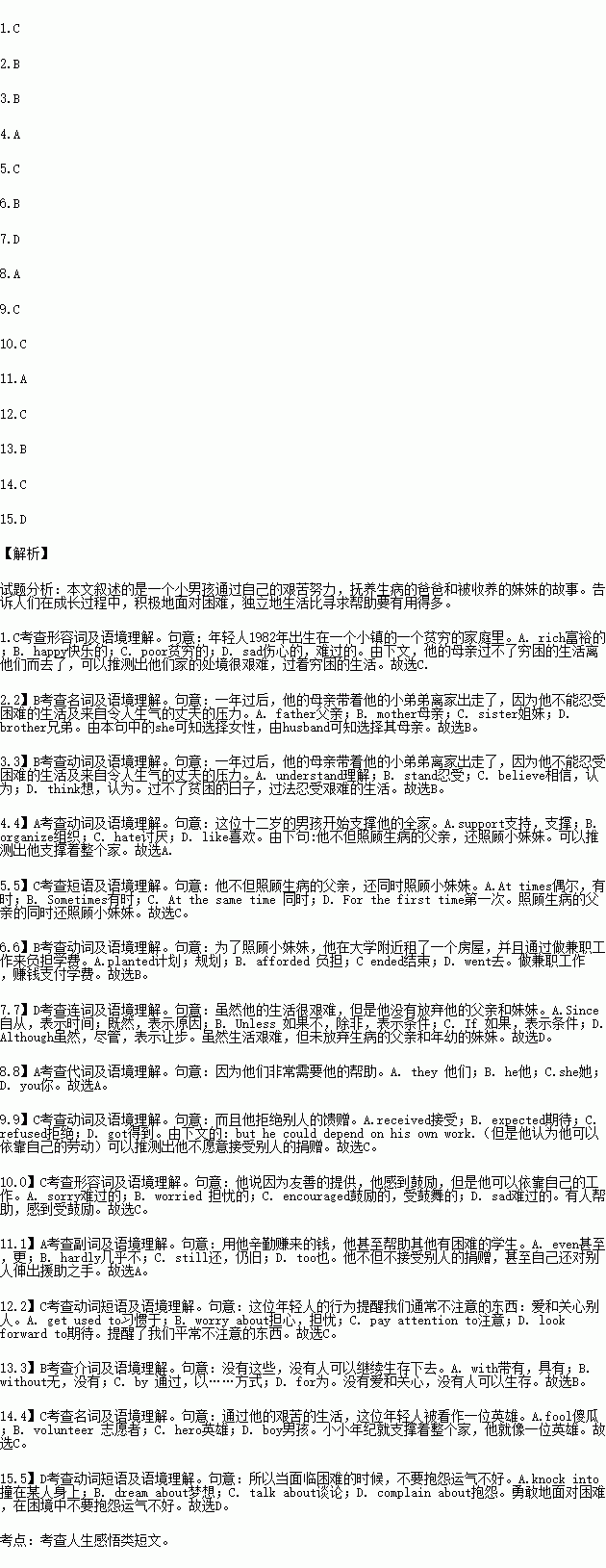
The young man was born in 1982 in a _________ family in a small town .When he was only 11, his father became mentally ill and one day came back with an abandoned baby (弃儿) girl .A year later, his_________ left home with his younger brother because she couldn’t _________ hard life and pressure from her mad husband. The 12-year-old boy began to_________ his whole family: he took care of not only his sick father, but also the little girl. _________ ,he didn’t give up studying. Later he went to college. To care for the little girl, he rented a room near his college and _________ her education by doing part-time jobs.

After the young man’s story went public, people were deeply impressed by his behavior.

_________ his life was hard, he didn’t abandon his father and his sister because_________ needed his help very much. And he _________ donations from others. He said he felt _________ because of kind offers, but he could depend on his own work. With his hard –won money, he _________ helped other students in trouble .

Today when many young people worry more about their own happiness, this young man’s behavior reminds us of what we don’t usually _________ : love and care for others. Nobody could continue to live _________ these .

Through his hard life, the young man is regarded as a _________ . So when facing difficulties, don’t _________ bad luck. Consider what more you could do for your family and society, and you’ll find the world smiling back .

1.A. rich B. happy C. poor D. sad

2.A. father B. mother C. sister D. brother

3.A. understand B. stand C. believe D. think

4.A.support B. organize C. hate D. like

5.A.At times B. Sometimes C. At the same time D. For the first time

6.A.planted B. afforded C. ended D. went

7.A.Since B. Unless C. If D. Although

8.A. they B. he C. she D. you

9.A.received B. expected C. refused D. got

10.A. sorry B. worried C. encouraged D. sad

11.A. even B. hardly C. still D. too

12.A. get used to B. worry about C. pay attention to D. look forward to

13.A. with B. without C. by D. for

14.A.fool B. volunteer C. hero D. boy

15.A.knock into B. dream about C. talk about D. complain about
练习册系列答案
相关题目

There’s always something deep in our soul that never dies. I moved to the small, busy town of Edison in New Jersey six years ago. It was during the second term of my fifth grade. My parents got new jobs and higher income, so they decided it was time to move from Woodbridge to a better, more educational town.

In the US, it is unnecessary to take a test to get into a “good” middle or high school. You just attend the school close to where you live. So, many parents will think about the quality (质量,品质) of the local school when they decide to buy a new house. My parents did the same. We finally chose Edison mainly because of the high quality of its school.

In New Jersey, an area with a good school usually means a concentration of Asian people. There are about 300 students in our school. 55% are Asians and just under half of that are Chinese. There are so many Chinese people nearby that we even have our own Chinese school.

Edison is an old town, just like thousands of others in the United States. However, I have treated it as my hometown. That’s where I spend much of my youth, and the memories there can’t be moved at all.

1.Why did the writer’s parents move to Edison?

A. Because they were born there.

B. Because it was a better educational town.

C. Because the writer began his fifth grade.

D. Because the writer didn’t need to take a test.

2. How many students are from Asia in the writer’s school?

A. About 80. B. About 160.

C. About 220. D. About 300.

3. What does the underlined expression “a concentration of” mean in Paragraph 3?

A. None of B. The whole of

C. A large number of D. A small number of

4.Why can’t the writer forget Edison?

A. Because he regards it as his hometown.

B. Because his parents got new jobs there.

C. Because there are many Asians there.

D. Because it is in the state of New Jersey.

"If you want to see a thing well, reach out and touch it!"

That may seem a strange thing to say. But touching things can help you to see them better.

Your eyes can tell you that a glass ball is round. But by holding it in your hands, you can feel how smooth and cool the ball is. You can feel how heavy the glass is. When you feel all these about the ball, you really see it. With your skin, you can feel better. For example, your fingers can tell the difference between two coins in your pocket. You can feel a little drop of water on the back of your hand, too. You can even feel sounds against your skin. Have you ever wanted to know why some people like very loud music? They must like to feel the sounds of music.

All children soon learn what "Don't touch!" means. They hear it often. Yet most of us keep on touching things as we grow up. In shops, we touch things we might buy: food, clothes. To see something well, we have to touch it. The bottoms of our feet can feel things, too. You know this when you walk on warm sand, cool grass or a hard floor. All feel different under your feet.

There are ways of learning to see well by feeling. One way is to close your eyes and try to feel everything that is touching your skin. Feel the shoes on your feet, the clothes on your body, the air on your skin. At first, it is not easy to feel these things. You are too used to them!

Most museums are just for looking. But today some museums have some things to touch. Their signs say, "Do touch!" There you can feel everything on show.

If you want to see better, reach out and touch. Then you will really see!

1.By touching things ______.

A. you will have a strange feeling

B. you will learn how to reach out your hand

C. you can learn more about them

D. you can tell what colors they really are

2.Which of the following can be the best title of the story?

A. Touching by Feeling B. To See or to Feel

C. To See Better ---- Feel D. Ways of Feeling

3.Which of the following parts can tell you the difference between two coins in your pocket?

A. Your fingers B. Your eyes

C. Your foot D. Your back.

4.What can't your skin feel?

A. sounds B. darkness C. water D. coins

5.Which of the following is NOT true?

A. Touching is helping us to see better.

B. Our skins may help us enjoy music.

C. Feeling is a good way to learn.

D. Visitors can't feel the things on show in any museums.

完形填空,阅读下面的短文,根据短文内容从各题所给的A、B、C、D四个选项中,选出一个可以填入空白处的最佳选项,使短文完整、通顺,并在答题卡上将该标号涂黑。

There are many ways to help improve your memory, so you shouldn’t feel ___________ in study.

My first ___________ is that if you want to remember something well, you have to go over it regularly(有规律地). You might go over the material two days after you learn it, then a week later, then two weeks later, and then a month later. After a month you will ___________ that you can easily remember the material.

My second advice is to use a red pen to _____________ lines under the important sentences in your book. This will help you in two ways. First, it will help you concentrate(集中) on the most important parts when you learn the __________. It is always easier to remember only the important sentences. Second, this will make reviewing easier. When you open your book, the underlined parts will _________ you the most important things immediately. In this way, you don’t have to go over all the materials again.

Another piece of advice is to review all the information in your ___________ just before you go to sleep. Your brain is working ____________ you are sleeping. If you think about the information before you go to sleep, you might be able to remember it better. Another good __________ for memorizing information is in the morning because you have just rested and your brain is fresh and clear. So you might also ___________ memorize the important information in the morning.

1.A. easy B. upset C. excited D. useful

2.A. choice B. answer C. advice D. action

3.A. forget B. mention C. imagine D. find

4.A. draw B. write C. think D. make

5.A. word B. knowledge C. advice D. number

6.A. show B. lead C. take D. decide

7.A. book B. idea C. dream D. mind

8.A. before B. while C. after D. until

9.A. result B. way C. time D. idea

10.A. lead to B. send to C. come to D. try to

违法和不良信息举报电话:027-86699610 举报邮箱:58377363@163.com

精英家教网
