题目内容
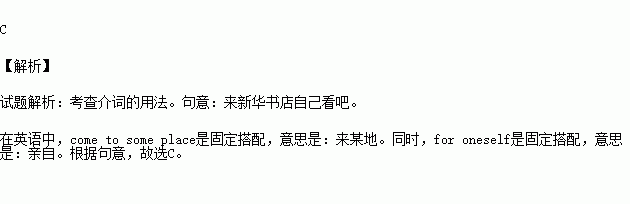
Come ________ Xin Hua book store and see ________ yourself.
A.to, toB.for, for
C.to, forD.for, to
—We really shouldn’t use plastic bags any more when shopping.
—_____ It’s important to protect our environment.
A. So do I.
B. With pleasure.
C. That’s OK.
D. So it is.
It is true that people with better education are usually able to get better paying jobs. In other words, they have more chances to choose a good job while people with little or no education don’t. It seems that the purpose of education is to make people get jobs. But this isn’t accepted by all people.
Some people may think that a person should spend the best years of his life to get education only for a way of living. This was probably one of the earliest reasons of education. In fact, if education is just a way of making a living, people don’t need to spend so much time in school. People can get education for a living in a short time. Subjects like history and geography need not be taught to everyone. Even language and mathematics need not be taught in detail(详细地), either. Here it is clear that education is much more than teaching a man to get a way of living.
Education is well-rounded. It is not only to teach him to speak, read and write, but also to develop his creative thinking and other abilities. And it is mainly for improving a man, it is to make him a wise man and thankfully enjoy the achievements of human. Education is to make a man lead a better life. Educated people are expected to be able to listen to good music, read good books, watch plays and take an interest in the world.
I would agree that making a good living is an important reason for education, but certainly not the most important or the main reason.
1.People with little education usually .
A. spend a long time in school
B. have a good chance to get a job
C. spend the best years to choose jobs
D. have fewer chances to get a good job
2.The earliest education was probably to .
A. make people take an interest in the world
B. teach a man to watch plays
C. make people get a way of living
D. teach people to read good books
3.The underlined word “well-rounded” in the passage means “ “in Chinese.
A. 圆满的 B. 崭新的
C.公平的 D. 全面的
4.The passage tells us that .
A. education is mainly to make a man improve
B. people can get education in a short time
C. making a good living is the only reason for education
D. all subjects are so important for a way of living
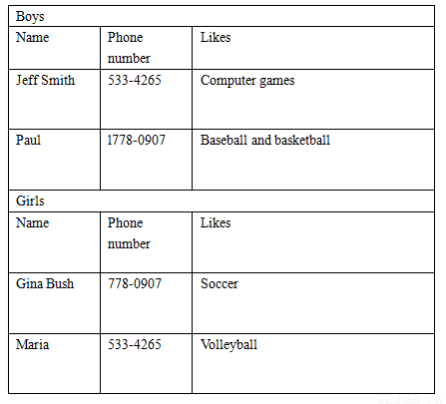
阅读下面表格,从每题所给的四个选项(A、B、C和D)中,选出最佳选项。
1.Maria is Jeff’s sister, so what’s Maria’s family name?
A.Bush.
B.Jeff.
C.Smith.
D.Gina.
2.Gina has a brother. Who is her brother according to(根据)the telephone number?
A.Jeff.
B.Smith.
C.Paul.
D.Bush.
3.What does Paul like?
A.Soccer.
B.Baseball.
C.Computer games.
D.Volleyball.
4.Who likes volleyball?
B.Gina.
D.Maria.
5.Who likes playing computer games?
B.Gina
完形填空
My uncle works in a shop. It’s near an English ________ . Every day the students come to _______ things. In the morning,my uncle gets up ________ six o’clock and after breakfast he________ his bike to the shop. He________ there at about ten to seven. The shop ________ at seven o’clock. The shop sells(卖) things ________ food and drink. It has school things, too. So there ________a lot of people in the shop ________ morning to evening. My uncle is very busy. He is friendly(友好的) to the students and the students like ________ very much.
1.A. farm B. factory C. school D. shop
2.A. buy B. sell C. take D. borrow
3.A. on B. in C. from D. at
4.A. on B. by C. rides D. riding
5.A. goes B. gets C. stays D. returns
6.A. opens B. open C. is opening D. is open
7.A. with B. like C. for D. about
8.A. are B. come C. have D. see
9.A. in B. at C. on D. from
10.A. his B. he C. him D. it
Linda ______coffee or tea, but she likes orange juice.
A.likeB.don't like
C.doesn't likeD.not like
翻译
1.丹尼尔穿着蓝色牛仔看上去很酷。
___________________________________________________________
2.这双黑色靴子和我的红色连衣裙很配。
3.孩子们在儿童节玩得很开心。
4.Simon想买一些和Sandy不同的书。
5.电影院是个和朋友见面、玩乐的好地方。
—What do you think of these two rabbits?
—_____ of them are cute. I’ll take them.
A.AllB.EachC.EveryD.Both
—Do you enjoy _____ in this city? —Yes, I do.
A. to live B. living
C. lived D. to living

 after breakfast he________ his bike to the shop. He________ there at about ten to seven. The shop ________ at seven o’clock. The shop sell