题目内容
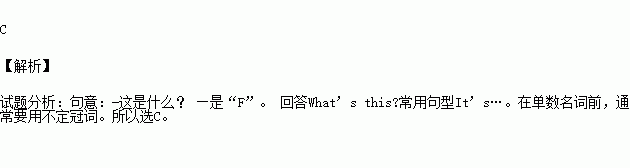
— What’s this?
— .
A. This is “M”. B. I’m “c”.
C. It’s “F” . D. It’s orange.
Tony isn’t going to the cinema with us because he the film twice.
A. sees B. is seeing C. will see D. has seen
The moon light is coming in ________the window and the room seems(似乎)quite beautifu1.
A.across B.over C.from D.through
根据汉语意思,完成英语句子
1.你的夹克衫什么颜色?_______ _______ is ______ _______?
2.橘子是橙色的。______ _______ is _________.
3.那用英语怎么说? _______ that ______ ________?
4.你姓什么? 布莱克。
----What ______ your_________ name? ----Black.
5.你的电话号码是什么?我的电话号码是4778596。
--- What is your __________ ___________? —It’s 4778596.
6.我是布鲁斯,见到你真高兴。
______ Bluce, Nice ______ meet you.
7.我的身份证号是420620198610083452.
My _________ __________ number is 420620198610083452.
8.你好吗? 我很好,谢谢。
______ ______ you ?I’m _____,_______.
9.3+9=?
What’s _____ and _____?
10.这是我祖父母. _____ are _____ _______.
---Can you spell his name?
---___________.
A. Yes, his name is Jim. C. J-I-M, jim.
B. No, I’m not. D. Yes, T-O-M. Tom.
____________ those your _____________?
A. Are, apple B. Is, apple
C. Is, apples D. Are apples
请按顺序默写26个英文字母(大小写)并在元音字母下划横线(按格式书写)
—It’s time _____ lunch.
—OK. Let’s _____.
A. for; go B. for; going C. to; going
完形填空
Many students often complain about the school. They might feel they have work to do sometimes, or think the rules are too strict. We must learn these “problems” into “challenges”. is an important part of our development. As young adults, is our duty(职责) to try our best to deal with each challenge in our education the help of our teacher.
By comparing yourself to other people, you your problems are not so terrible. Think about Stephen Hawking, for example, a very clever scientist regards his many physical (身体上的)problems as unimportant. He can’t walk or even speak he has become very famous and successful. We are probably quite healthy and smart. not worry about our problems. Let’s face the challenges .
1.A. too much B. much tooC. too many D. many too
2.A. how change B. how to change C. what change D. what to change
3.A. Education B. KnowledgeC. Thought D. Feeling
4.A. it B. this C. that D. one
5.A. in B. with C. under D. on
6.A. find B. found C. will find D. finds
7.A. who B. that C. which D. whose
8.A. and B. or C. but D. so
9.A. Let’s B. Let me C. We D. everyone
10.A. yet B. already C. instead ofD. Instead

 春雨教育同步作文系列答案春雨教育同步作文系列答案