题目内容
话题 | 叶公好龙 | 文体 | 记叙文 | 词数 | 181 | 限时 | 10分 | 正确率 | % |
Lord Ye's Love of Dragons (叶公好龙) Long ago,there was a person. People c 1 him Lord Ye (叶公) . It was said that Lord Ye liked dragons very much. E 2 in his room was about dragons. The walls of his house had dragon p 3 . The doors and windows were carved (雕刻) with them.
“I love dragons best ,” Lord Ye always said to o 4 people.
When the real dragon in heaven (天堂) heard this,he f 5 very happy.
“Lord Ye loves dragons so much. I should v 6 him and thank him”’ said the real dragon. So he f 7 to Lord Ye's house. He put his head into Lord Ye's window and shou-ted ,“Lord Ye,are you in?”
You might think Lord Ye was very h 8 to see a real dragon. But,in fact,when he saw the real dragon,he was very frightened and ran a 9 as fast as he could.
From then on,people knew that Lord Ye o 10 loved pictures of dragons,but not real dragons.
根据短文内容及首字母提示,补全短文。请将答案填在下面相应的横线上:
1. 2. 3. 4. 5.
6. 7. 8. 9. 10.
答案 1. called 2. Everything 3. pictures
4. other 5. felt 6. visit 7. flew 8. happy
9. away 10. only
[解析]本文是中国的古代故事,讲述了叶公好龙的 趣事。
1. 本句的含义为:人们把他叫做叶公,call sb. sth.表 示“把某人叫做……”的含义,又因是过去式故填 called。
2. 本句的含义为:在他的房间一切都是有关龙的东 西,故填 Everything。
3. 本句的含义为:房屋墙上也有龙的图片,故本句空 格处填pictures。
4. 本句的含义为:叶公总是对别人说,他最喜欢龙, 故本句空格处填other。
5. 本句的含义为:当真的龙听到这样的话时,感到非 常开心,故填过去式felt。
6. 本句的含义为:叶公非常喜欢龙,“我”应该去看望 他,并且谢谢他,should后跟动词原形,故填visit。
7. 本句的含义为:他飞到叶公的家,故本句空格处填 飞的过去式flew。
8. 本句的含义为:你或许认为叶公看到真龙非常开 心,故填happy。
9. 本句的含义为:当叶公看到真龙时,害怕的跑掉了,run away 表7K“跑掉”,故填 away。
10. 本句的含义为:叶公只喜欢龙的图片,而非真龙, 故本句空格处填only。

 时刻准备着暑假作业原子能出版社系列答案
 暑假衔接教材期末暑假预习武汉出版社系列答案
 假期作业暑假成长乐园新疆青少年出版社系列答案
话题 | 笔友 | 又体 | 说明文 | 词数 | 152 | 限时 | 分 | 正确率 | % |
My pen friend is a kind and friendly girl. She is in England. Her 1 is Connie. I meet Connie 2 the Internet,and we are both twelve years 3 First,I 4 a letter to her and introduce (介绍) my hobbies,my school and my daily life. A few days later,I get Connie's 5 . She 6 me a lot about herself. I learn that she loves languages,sports and films. She likes China and Chinese food very much. She tells me something about England,too. Connie is good at English,French (法语) and Spanish (西班牙 语) ,so I ask her to 7 me a little. Connie wants to learn some 8 ,but it's very difficult for her.
From Connie,I know 9 about the world outside. I would like to go to England to 10 Connie some day.
() 1. A. hobby B. name C. age D. job ?
() 2. A. on B. for C. at D. in
() 3. A. young B. big C. small D. old
() 4. A. read B. sing C. write D. draw
() 5. A. book B. letter C. call D. photo
() 6. A. asks B. says C. talks D. tells
() 7. A. teach B. help C. give D. answer
() 8. A. English B. French C. Chinese D. Spanish
() 9. A. many B. much C. few D. little
() 10. A. call B. write C. visit D. help
话题 | 交流方式 | 文体 | 说明文 | 词数 | 137 | 限时 | 8分 | 正确率 | % |
Some things can carry messages,for example,a sign at the bus stop helps you to know which bus to take. Signs on the door tell you where to go in or out. Have you ever noticed that there are a lot of signs around you and that you receive messages from them all the time?
(1) People can communicate in many other ways. An artist can use his drawing to tell about beautiful mountains,about the blue sea and many other things. Books are written to tell you about all the wonderful things in the world and also about people and their ideas.
Books? magazines,TVs? radios and films all help us to communicate with others. They all help us to know what is going on in the world and what other people are thinking about.
1题为判断正(T) 误(F) ;2题为补全句子;3题为简略回答问题;4题为翻译句子;5题为对画 线部分提问。1. Signs on the door tell you where to go in.()
2. can help us to communicate with others.
3. What can help you if you want to know which bus to take?
4. 请将文中画线句子(1) 翻译成汉语。
5. They all help us to know what is going on in the world and what other people are thinking about.
话题 | 地图 | 文体 | 说明文1词数 | 190 限时 | 分正确率 | % |
Look at the map of my neighbourhood. The bank is next to my house. The school is next to the bank. There are a lot of teachers and they help me learn about many subjects. (l) They are very friendly to me. If I want to read books or surf the Internet (网上冲浪) ,I can go to the library. It5s on No. 3Street.
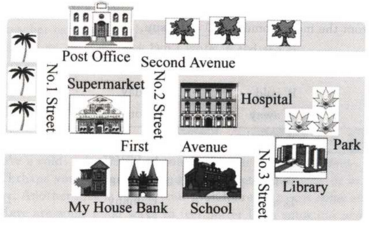
When I get sick (生病) ,the doctors (医生) can give me a hand. Where is the hospital (医院) ?
Can you find it? It's on No. 2Street.
(2) There is also a big supermarket in my neighbourhood. I can buy a lot of things from there. It's across from the bank and my house. But the post office is far from my home. If I want to post a letter,I have to go along First Avenue and turn left at the turning. Go along No. 1Street and turn right again,and the post office is on my left.
It's a good place to have fun. Welcome to my neighbourhood.
1题为判断正(T) 误(F) ;2题为补全句子;3题为简略回答问题;4题为翻译句子;5题为句型 转换。1. There is a park next to the house.()
2. The is next to the school.
3. How do you get to the post office from the house?
4.请将文中画线句子(1) 翻译成汉语。
5. 请将文中画线句子(2) 变为特殊疑问句。
话题 | 穷人的梦 | 文体 | 记叙文 | 词数 | 238 | 限时 | 10分 | 正确率 | % |
Each morning a rich man found a poor man sitting on a park bench (凳) . The poor man al- ways 1 there,looking at the big 2 in which the rich man lived. One day the rich man got out of his car and said to the poor man, “Excuse me,but I just want to know 3 you sit here and look at my hotel 4 . said the poor man, 4,I am a failure. I have no mon ey,no family,no home. I sleep on this bench,and every night I dream that one day I'll sleep in that hotel. ”
The rich man said ,“Tonight your dream will 5 . I will pay for the 6 room in that hotel for you 7 a whole month. ”
A few days later,the rich man 8 the poor man's room to ask him if he was enjoying 9 . To his 10 ,he found that the man had moved out of the hotel,back to his 11 .
When the rich man asked why,the poor man said ,“You see,12 Im down here sleeping on my bench,I dream I'm up there,in that big hotel. It's a 13 dream. But when I was 14 there,I dreamed I was back to this cold bench. It was a terrible dream,and I 15 get any sleep at all. ”
() 1. A. sat B. stood C. slept D. jumped
() 2. A. car B. room C. hotel D. house
() 3. A. when B. how C. what D. why
() 4. A. yesterday morning B. every morning
C. last night D. every night
() 5. A. come back B. come out C. come over D. come true
() 6. A. good B. well C. better D. best
() 7. A. for B. to C. with D. in
() 8. A. went passed B. broke into
C. went past D. ran through
() 9. A. it B. itself C. him D. himself
() 10. A. joke B. happiness C. sadness D. surprise
() 11. A. house B. corner C. bench D. work
() 12. A. if B. when C. after D. as soon as
() 13. A. sad B. wonderful C. quick D. slow
() 14. A. out B. even C. up D. down
() 15. A. would B. wouldn’t C. could D. couldn’t
话题 | 生活介绍 | 文体 | 说明文 | 词数 | 120 | 限时 | 分 | 正确率 | % |
computer,Sunday,but,movies,don't There are seven days in a week. They are 1 ,Monday,Tuesday,Wednesday,Thurs day,Friday and Saturday. Students go to school from Monday to Friday. They have many les-sons,2 they can play after school. At the weekends,they 3 go to school. They are at home. They do their homework,help with housework,read books and watch TV. Some boys like to play 4 games. But they can't play too much. It's bad for their eyes. They have nice food and drinks. Sometimes they go out. They go shopping with their parents,watch 5,and play ball games like football,basketball,volleyball,rhey like their weekends.
从方框中选出合适的单词,补全短文。请将答案填在下面相应的横线上:1. 2. 3. 4. 5.